

If the British filmmaker Terence Davies had been more into the Manchester post-punk scene rather than Doris Day and The King Singers, then there’s a chance he might have made something akin to Carol Morley’s captivating, ripped-from-the-heart memory piece, 7 Miles Out. This new fiction feature from the reliably leftfield writer/director offers a tragicomic bildungsroman detailing life below the poverty line in late Seventies Stockport, where the sum of £1.50 for pop concert tickets is an unfathomable fortune that’s entirely inaccessible to even the most resourceful teenager.
The film is based on Morley’s own 2015 memoir of the same name, with the title denoting the distance between Stockport and Manchester which, to those with no possibility of upward mobility, would be considered the equivalent to going end-to-end on the Trans Siberian Railway. They are also words spoken by the father (a brief, cooly charismatic turn by Aidan Gillen) to the bouncy and inquisitive Ann Westbourne (Amelie Hughes) prior to his sudden decision to up sticks and abandon the family, leaving his once-upbeat brood in a state of confusion and even deeper penury.
Get more Little White Lies
Ann’s mother Bryn (Gemma Whelan) suffers from chronic heartbreak and falls to pieces, taking many years of sleeping in doss houses and gleaning pleasures from making bonfires of the trinkets of her old life to get back on the straight and narrow. Meanwhile, her siblings manage to break out of Stockport at the soonest opportunity and follow professional and domestic dreams, tacitly severing ties with the grim old country.
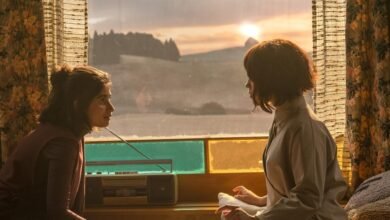
The majority of the film follows Ann as she louchely hopscotches through life, brushing off bullies, forging meaningful friendships, eye-rolling at flashers and processing the latent trauma of her family disintegration. She is later played by Lucy Halliday as an older teen and we observe her trying to counterpunch against the sexual, social and economic inequalities that serve to pin her down to her sorry lot.
The one release in life – the great leveller – is music, particularly the depressive electronic dronecore of on-the-up local lads, Joy Division. Morley laces the soundtrack with evocative tracks by the likes of The Fall, Durutti Column, The Raincoats and Magazine, not only giving a sense of alternative art as a mode of escape and salvation, but signalling the winds of potentially positive change and, for Ann, offering a viable route into the future. Indeed, the film offers a fictionalised, unsentimental retelling of the Morley’s own experiences fronting a feminist post-punk trio.
The narrative arc is episodic in nature, and this allows Morley to create a satisfying and constant tension between moments of levity and anguish. In one scene we witness this in full circle, with Ann coming home and having a rollercoaster conversation with her mother which begins as a snarky chat, quickly escalates into a bout of accusatory screaming and then ends with sorrow and acceptance. There’s a sense that the cast are all in total sync with Morely’s vision – by the story’s end we see that this highly combustible mode of communication is the thing that prevents Ann from breaking out of her rut.
In 7 Miles Out, the lives of all the characters are in a constant state of flux, and the film mirrors these interior worlds by combining a colourful patchwork of episodes, anecdotes and primal memories rather than just training its focus on a single event. (Sidenote: this is all represented and elevated by the sparse but careful period production design). There’s a section where Ann and her two besties are hatching schemes to sneak into a Joy Division concert, and while it makes for a fun little escapade, Morley is wise to not make it the load-bearing narrative beam for the entire film. She instead fully commits to the idea that things don’t happen to us in a vacuum, and that people are the product of a wide variety of influences, from family members, friends, acquaintances, enemies and even ghosts.