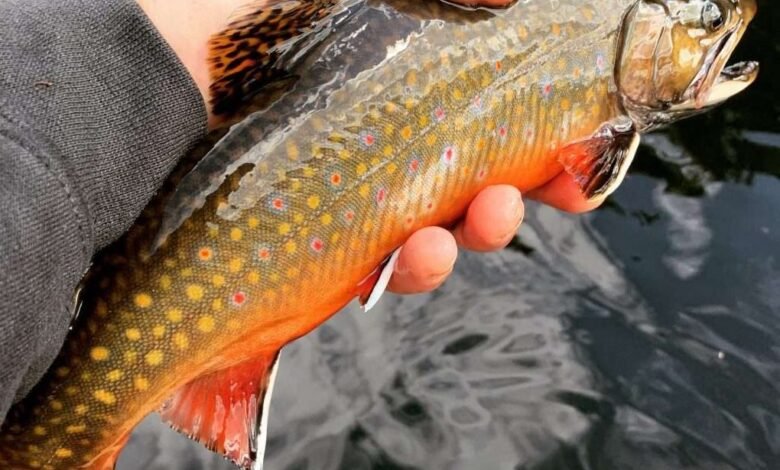
 The brook trout is New York’s state fish and an iconic symbol of the Adirondacks, but about 90% of brook trout pond habitat has been lost due to poor management.
Now, for the first time in 46 years, New York State has a new plan that identifies the current risks for lacustrine (lake and pond living) brook trout and it hopes will guide the State’s management actions at Adirondack brook trout ponds for the next 15 years.
“Other than Maine, New York’s Adirondack Park is the only other location in the lower 48 states that supports a significant number of ponded brook trout fisheries, which shape the region’s ecological legacy and future,” New York State Department of Environmental Conservation (DEC) Commissioner Amanda Lefton said in making the announcement of the new Adirondack Brook Trout Pond Management Plan.
In the United States, pond dwelling populations of brook trout are extremely rare outside of Maine and New York. Brook trout ponds are an important component of the natural heritage of the Adirondacks, providing a unique angling opportunity in an often-secluded location.
The new plan describes a brook trout pond as “a ponded water whose habitat and water quality can support the survival and growth of naturally reproduced or stocked brook trout (Salvelinus fontinalis).”
Devastating Habitat Losses
Once ubiquitous on our northern landscape, up to 90% of brook trout pond habitat has been lost due to anthropogenic (human) factors, including poor silvicultural (forestry, wildlife management) practices, acid-precipitation (acid rain), and incompatible and detrimental fish species introductions.
Ponded brook trout populations are now known to exist in 411 publicly accessible ponds in the Adirondack Park. Ponded brook trout populations are also found on private land in the Park.
There are relatively recent records of brook trout over 16 inches in length from about 34% of these 411 ponds. About 14% of public brook trout ponds are identified as self-sustaining populations.
Unfortunately, many once Self-Sustaining ponds have been and continue to be lost due to the introduction of detrimental and incompatible species some irretrievably.
In some cases, however, brook trout ponds can be reclaimed by applying a piscicide and subsequently restocking brook trout. A total of 234 reclamations have been performed since 1950 as part of the ongoing program for brook trout restoration in New York.
After a reclamation, ponds generally remain as viable brook trout ponds for 30 years or more, and without reclamation only a fraction of the current brook trout ponds would exist.
According to DEC, Reclamation remains the only effective tool for the restoration of brook trout populations in ponds that have been invaded by non-native or incompatible and detrimental fish species.
The New Plan
The original plan for managing pond-dwelling brook trout was created in 1979. Fisheries managers, the public, and sporting and conservation organizations had a hand in creating the latest plan. According to DEC, its expected benefits include:
 “Protection of existing and establishment of new self-sustaining brook trout populations;
Safeguarded hatchery brook trout production for fishing and restoration purposes;
Maintenance and expansion of heritage broodstock waters;
Consistent and standardized data collection and management, and development of a decision support tool for management actions;
Creation of a citizen science brook trout pond angler partnership program and deployment of a citizen science survey to provide information on angler use, catch, and harvest;
Uniform fishing regulations;
Improved management of “put, grow, and take” recreational fishing;
Increased awareness about the value of ponded brook trout populations and human and ecological threats to the security of those populations;
Actions to reduce the spread of incompatible and detrimental fish, including baitfish; and
Consideration of climate change in management actions.”
Expanding heritage broodstock waters involves identifying, protecting, and managing lakes and ponds with self-sustaining, genetically pure native brook trout by controlling non-native species, implementing strict fishing regulations (no live bait, catch limits), boat inspections and/or barrier dams.
 A final copy of the plan and more information about Adirondack brook trout pond management can be found on the DEC website.
Earlier this year, DEC announced a $100 million investment from the Clean Water, Clean Air and Green Jobs Environmental Bond Act and other capital funds for State hatchery improvements, including enhancements at the Adirondack Fish Hatchery that will help construct a new brook trout broodstock building.
DEC also held the “Trek for Trout” citizen science initiative aimed at collecting information from anglers about their fishing trip.
DEC and partner organizations Trout Unlimited, NY Backcountry Hunters and Anglers, Trout Power, Native Fish Coalition, Paul Smith’s College, and State University of New York College of Environmental Science and Forestry posted signs at 148 Adirondack brook trout ponds.
In addition to a pond-specific QR code, signs posted by the volunteers for use by anglers include important messaging about the prohibition of baitfish use in brook trout ponds.
You can also watch the video, Trek for Trout on DEC’s YouTube page.
Read more about New York fisheries.
Photos: A brook trout and Horn Lake strain brookie (middle), provided by DEC; Benjamin Ferguson, a brook trout angler from Lowville, Lewis County, with his State Record 22-inch, six-pound three-ounce brook trout caught in the St. Regis Canoe Area in July, 2025.
Source link