 Fascism is not the easiest thing to identify and analyze; nor, once in power, is it easy to destroy. It is important for our future and that of the world that as many of us as possible understand the causes and practices of fascism, in order to combat it.
Points to stress are: (1) Fascism is more apt to come to power at a time of economic crisis; (2) fascism inevitably leads to war; (3) it can come to any country; (4) we can best combat it by making our democracy work.
“Fascism” is a word that’s been used a great deal these last few years. We come across it in our newspapers, we hear it in our newsreels, it comes up in our bull sessions. We’ve heard about the cruelties of fascism, its terror, its conquest of country after country.
Some of the things that have been done to people by fascists seem too horrible to believe, especially to Americans who believe in “live and let live.” Hardboiled American correspondents, formerly skeptical, now believe because they have seen.
We Americans have been fighting fascists for more than three years. When Cecil Brown, one of the leading war correspondents, came back from the battle fronts, he went on a trip that took him into big cities and small towns all over America.
He talked and listened to all kinds of people. He found that most Americans are vague about just what fascism really means. He found few Americans who were confident they would recognize a fascist if they saw one.
And are we in uniform any more certain what fascism is — where it came from — what made it strong? Do we know how fascism leads men to do the things done to people at Maidanek [a detention center turned extermination camp]? Do we know how it leads them to attack helpless nations? Are Maidaneks and war inevitable results of fascism?
Do all fascists speak only German, Italian or Japanese — or do some of them speak our language? Will military victory in this War automatically kill fascism? Or could fascism rise in the United States after it’s been crushed abroad? What can we do to prevent it?
Perhaps we ought to get to know the answers. If we don’t understand fascism and recognize fascism when we see it, it might crop up again — under another label — and cause another war.
Fascism is a way to run a country—it’s the way Italy was run, and the way Germany and Japan are run. Fascism is the precise opposite of democracy. The people run democratic governments, but fascist governments run the people.
Fascism is government by the few and for the few. The objective is seizure and control of the economic, political, social, and cultural life of the state.
Why? The democratic way of life interferes with their methods and desires for: (1) conducting business; (2) living with their fellow-men; (3) having the final say in matters concerning others, as well as themselves.
The basic principles of democracy stand in the way of their desires; hence — democracy must go! Anyone who is not a member of their inner gang has to do what he’s told.
They permit no civil liberties, no equality before the law. They make their own rules and change them when they choose. If you don’t like it, it’s “T.S.” [tough shit].
They maintain themselves in power by use of force combined with propaganda based on primitive ideas of “blood” and “race,” by skillful manipulation of fear and hate, and by false promise of security. The propaganda glorifies war and insists it is smart and “realistic” to be pitiless and violent.
How It Starts
Fascism came to power in Germany, Italy, and Japan at a time of social and economic unrest. A small group of men, supported in secret by powerful financial and military interests, convinced enough insecure people that fascism would give them the things they wanted.
They did so partly by clever propaganda and deception. They promised the people that fascism would bring them great power and prosperity. The details differed from country to country but the general pattern was the same.
The Japanese spoke of a “greater Asia co-prosperity sphere.” Mussolini mouthed humanitarian ideals and promised a re-born Roman empire.
Hitler and his associates adopted the name of National Socialist German Workers’ Party (Nazi) and announced objectives that attracted many German people.
The official title of the Nazi party was deliberately worded for its propaganda value, appealing to “nationalists,” “socialists,” “workers,” and all others who might be favorably influenced by these labels.
At the very time that the fascists proclaimed that their party was the party of the “average citizen,” they were in the pay of certain big industrialists and financiers who wanted to run the people with an iron hand.
The fascists promised everything to everyone: They would make the poor rich and the rich richer. To the farmers, the fascists promised land through elimination of large estates. To the workers they promised elimination of unemployment — jobs for all at high wages. To the small business men they promised more customers and profits through the elimination of large business enterprises.
To big business men and the industrialists they secretly promised greater security and profits through the elimination of small business competitors and trade unions and the crushing of socialists and communists. To the whole nation they promised glory and wealth by conquest. They asserted it was their right, as a “superior people,” to rule the world.
As soon as these methods had won them enough of a following to form their Storm Troops, the fascists began using force to stifle and wipe out any opposition. Those who saw through the false front of fascism and opposed them were beaten, tortured, and killed.
The fascists knew that all believers in democracy were their enemies. They knew that the fundamental principle of democracy — faith in the common sense of the common people — was the direct opposite of the fascist principle of rule by the elite few. So they fought democracy in all its phases.
How It Works
It was easy enough for the fascists to promise all things to all people before they were in power. Once they were actually in power, they could not, of course, keep their contradictory promises. They had intended in advance to break some, and they did break those they had made to the middle classes, the workers, and the farmers.
As soon as the fascists were in control of the government, the torturings and the killings were no longer the unlawful acts of a political party and its hoodlum gangs. They became official government policy.
Among the first victims of this official policy were those farmers, workers, and small business men who had believed the promises that had been made to them and who complained that they had been “sucked in.”
Some simply vanished. Often they came home to their families by return mail in little jars of ashes.
The concentration camps and graves filled with the opponents of fascism. Out went equality before the law, free elections and free political parties, independent trade unions and independent schools, freedom of speech and freedom of the press, and, in time, freedom of religion.
Pastor Niemoeller was thrown into a concentration camp in Germany; Cardinal Innitzer was “stoned,” and Catholic priests were imprisoned. Jews were murdered in cold blood and synagogues destroyed. Christian ministers were ousted from Japan.
The fascists “solved” unemployment by converting their nations into giant war machines. The unemployed were either conscripted into the army or organized in labor battalions and put to work in war plants.
Deprived of their unions, the working people could be driven to work longer and harder for less and less money, so that those who subsidized and ran fascism could grow richer.
By wiping out all internal competition — especially the small and medium sized business firms — profits were increased still higher for the handful on top. In some cases, the fascists then gobbled control of the top corporations.
The living standards of the masses of the people declined, of course. As they earned less and less, they were able to buy less and less of the goods they produced.
Every last detail of life was regulated, with the death penalty often imposed for slight violations. One unhappy victim complained: “Fascism is a regime under which everything not prohibited is compulsory.”
Once the fascists were in control of the government, not even the gang on top was safe from its own members. There would be more loot and power per fascist leader if some fascist leaders were eliminated.
Some of the party “big-shots” and some of those who had helped them take over were therefore “purged.” Many would-be partners in the dictatorship, including some industrialists, wound up in jail, in exile, or dead.
Can It Happen Here?
Some Americans would give an emphatic “No” to the question “Can fascism come to America after it has been defeated abroad?”
They would say that Americans are too smart, that they are sold on the democratic way of life, that they wouldn’t permit any group to put fascism over in America.
Fascism, some might say, is something peculiar that you find only among people who like swastikas, who like to listen to speeches from balconies in Rome, or who like to think that their emperor is god.
Their reaction might be that it is something “foreign” that Americans would recognize in a minute, like the goose-step. They might feel that we’d laugh it out of existence in a hurry.
In a good many European nations, the people felt the same way some of us do: that fascism was foreign to them and could never become a power in their land.
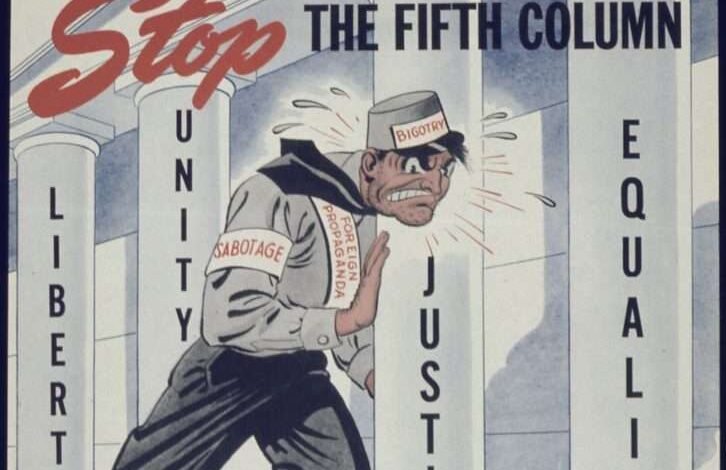
They found, however, that fascist-minded people within their borders, especially with aid from the outside, could seize power. The Germans, of course, made efficient use of fascist-minded traitors whom we have come to know generally as “the fifth column.”
In France, which was considered a leading democracy of Europe, the betrayal was spearheaded by a powerful clique of native “100 percent French” fascists.
Norway had its Quisling who was as “pure-blooded” a Norwegian as Laval was a “pure-blooded” Frenchman. The Netherlands’ Musserts were “100 percent Dutch,” Belgium’s Degrelles “100 percent Belgian,” and Britain’s Mosleys “100 percent British.”
The United States also has its native fascists who say that they are “100 percent American.” There were native fascists in the Philippines, in Thailand (Siam), in China, in Burma, in many other countries — all waiting to become the willing puppets of the Axis.
Not one of these fascists is a “foreigner” who had to be imported from Germany, or Japan, or Italy.
Most of the people in America like to be good neighbors. But, at various times and places in our history, we have had sorry instances of mob sadism, lynchings, vigilantism, terror, and suppression of civil liberties.
We have had our hooded gangs, Black Legions, Silver Shirts, and racial and religious bigots. All of them, in the name of Americanism, have used undemocratic methods and doctrines which experience has shown can be properly identified as “fascist.”
Can we afford to brush them off as mere crackpots? We once laughed Hitler off as a harmless little clown with a funny mustache.
Whenever free governments anywhere fail to solve their basic economic and social problems, there is always the danger that a native brand of fascism will arise to exploit the situation and the people.
Can We Spot It?
An American fascist seeking power would not proclaim that he is a fascist. Fascism always camouflages its plans and purposes. Hitler made demagogic appeals to all groups and swore: “Neither I nor anybody in the National Socialist Party advocates proceeding by anything but Constitutional methods.”
Any fascist attempt to gain power in America would not use the exact Hitler pattern. It would work under the guise of “super-patriotism” and “super-Americanism.”
Fascist leaders are neither stupid nor naive. They know that they must hand out a line that “sells.” Huey Long is said to have remarked that if fascism came to America, it would be on a program of “Americanism.”
Fascists in America may differ slightly from fascists in other countries, but there are a number of attitudes and practices that they have in common. Following are three. Every person who has one of them is not necessarily a fascist. But he is in a mental state that lends itself to the acceptance of fascist aims.
1. Pitting of religious, racial, and economic groups against one another in order to break down national unity is a device of the divide and conquer” technique used by Hitler to gain power in Germany and in other countries.
With slight variations, to suit local conditions, fascists everywhere have used this Hitler method. In many countries, anti-Semitism (hatred of Jews) is a dominant device of fascism.
In the United States, native fascists have often been anti-Catholic, anti-Jew, anti-Negro, anti-Labor, anti-foreign-born. In South America, the native fascists use the same scapegoats except that they substitute anti-Protestantism for anti-Catholicism.
Interwoven with the “master race” theory of fascism is a well-planned “hate campaign” against minority races, religions, and other groups. To suit their particular needs and aims, fascists will use any one or a combination of such groups as a convenient scapegoat.
2. Fascism cannot tolerate such religious and ethical concepts as the “brotherhood of man.” Fascists deny the need for international cooperation. These ideas contradict the fascist theory of the “master race.”
The brotherhood of man implies that all people — regardless of color, race, creed, or nationality —have rights. International cooperation, as expressed in the Dumbarton Oaks proposals [which led to the founding of the United Nations], runs counter to the fascist program of war and world domination.
In place of international cooperation, the fascists seek to substitute a perverted sort of ultra-nationalism which tells their people that they are the only people in the world who count. With this goes hatred and suspicion toward the people of all other nations.
Right now our native fascists are spreading anti-British, anti-Soviet, anti-French, and anti-United Nations propaganda. They know that allied unity now foretells the certain defeat of fascism abroad. They know that post-war allied unity means world peace and security. They realize that fascism cannot thrive or grow under these conditions.
3. It is accurate to call a member of a communist party a “communist.” For short, he is often called a “Red.” Indiscriminate pinning of the label “Red” on people and proposals which one opposes is a common political device. It is a favorite trick of native as well as foreign fascists.
Many fascists make the spurious claim that the world has but two choices — either fascism or communism, and they label as “communist” everyone who refuses to support them. By attacking our free enterprise, capitalist democracy and by denying the effectiveness of our way of life they hope to trap many people.
Hitler insisted that only fascism could save Europe and the world from the “communist menace.” There were many people inside and outside Germany and Italy who welcomed and supported Hitler and Mussolini because they believed fascism was the only safeguard against communism.
The “Red bogey” was a convincing enough argument to help Hitler take and maintain power. The Rome-Berlin-Tokyo Axis, whose aggressions plunged the world into global war, was called the “Anti-Comintern Axis.” It was proclaimed by Hitler, Mussolini, and Hirohito as a “bulwark against communism.”
Learning to identify native fascists and to detect their techniques is not easy. They plan it that way.
But it is vitally important to learn to spot them, even though they adopt names and slogans with popular appeal, drape themselves with the American flag, and attempt to carry out their program in the name of the democracy they are trying to destroy.
How To Stop It
The only way to prevent fascism from getting a hold in America is by making our democracy work and by actively cooperating to preserve world peace security.
Lots of things can happen inside of people when they are unemployed or hungry. They become frightened, angry, desperate, confused. Many, in their misery, seek to find somebody to blame.
They look for a scapegoat as a way out. Fascism is always ready to provide one. In its bid for power, it is ready to drive wedges that will disunite the people and weaken the nation.
It supplies the scapegoat — Catholics, Jews, Negroes, labor unions, big business — any group upon which the insecure and unemployed can be brought to pin the blame for their misfortune.
We all know that many serious problems will face us when the War is over. If there is a period of economic stress it will create tensions among our people, including us as returning veterans.
The resentment may be directed against minorities — especially if undemocratic organizations with power and money can direct our emotions and thinking along these lines.
The fascist doctrine of hate fulfills a triple mission. By creating disunity — it weakens democracy. By getting men to hate rather than to think — it prevents men from seeking the real cause and a democratic solution to the problem.
By fake promises of jobs and security, fascism then tries to lure men to its program as the way out of insecurity. Only by democratically solving the economic problems of our day can there be any certainty that fascism won’t happen here. That is our job as citizens.
Citizenship in a democracy is more than a ballot dropped in a box on Election Day. It’s a 365-days-a-year job requiring the active participation and best judgment of every citizen in the affairs of his community, his nation, and his country’s relations with the world.
Fascism thrives on indifference and ignorance. It makes headway when people are apathetic or cynical about their government — when they think of it as something far removed from them and beyond their personal concern.
The erection of a traffic light on your block is important to your safety and the safety of your children. The erection of a world organization to safeguard peace and world security is just as important to our personal security. Both must be the concern of every citizen.
Freedom, like peace and security, cannot be maintained in isolation. It involves being alert and on guard against the infringement not only of our own freedom but the freedom of every American.
If we permit discrimination, prejudice, or hate to rob anyone of his democratic rights, our own freedom and all democracy is threatened.
What is true of America is true of the world. The germ of fascism cannot be quarantined in a Munich Brown House [NAZI Headquarters] or a balcony in Rome. If we want to make certain that fascism does not come to America, we must make certain that it does not thrive anywhere in the world.
This essay was first published by the U.S. Army in 1945 as an “Army Talk” orientation lecture given to soldiers during World War Two. Only a couple minor paragraphs not at all relevant to modern readers have been left out for brevity. You can find the entire text here.
New York Almanack is reporting on the Trump regime’s impacts in New York State, but we can’t do it without your help. Please support this work.
Illustrations, from above: A World War Two poster denouncing fifth columnists, 1941 (National Archives)
Source link