 In April 1775, when news of the Battle of Lexington and Concord reached New York, Nicholas Fish, born in Newtown, Long Island, was a 17-year old law student at King’s College (now Columbia University).
Together with his close friend, Alexander Hamilton, and other law colleagues who were members of the Sons of Liberty, Fish without hesitation joined a volunteer militia called the “Corsicans” – later named the “Hearts of Oak.”
The Hearts of Oak carried out one of the early actions of the war in August 1775 when they seized 21 royal cannons from New York’s Battery under fire from the British warship HMS Asia.
In January 1776, Fish chose to break with his loyalist family and tragically never saw his mother again – she died in 1778 – and saw his father only once before the latter’s death in 1779 left Nicholas orphaned and homeless at age 21. Appointed a brigade major for General John Morin Scott in August 1776, he would constantly be engaged in combat for the next seven years.
Nicholas Fish fought in the Battle of Long Island, the Battle of Harlem Heights, the Battle of White Plains, the relief of the Siege of Fort Stanwix, both Battles of Saratoga, the Sullivan – Clinton Expedition, the Battle of Monmouth, and finally the Battle of Yorktown.
He spent the cold winter of 1777-78 at Valley Forge where he earned the praise of Baron von Steuben. He served as Acting Deputy Adjutant General at West Point in 1780, at the time of Benedict Arnold’s treachery, and he testified in support of his friend Richard Varick at the latter’s court-martial for possible involvement with Arnold’s plot.
 At Yorktown, he fought bravely side by side with Alexander Hamilton and the Marquis de Lafayette, conquering the crucial Redoubt Number 10, and returned there with Lafayette in 1824; Fish and Lafayette stayed lifelong friends.
Trusted by General Washington, who chose him to help select the first recipients of the Badge of Military Merit (later known as the Purple Heart), Fish spent the last year of the American Revolution in Newburgh on Washington’s staff.
He was promoted to lieutenant-colonel and was with Washington in the city of New York on Evacuation Day, November 25, 1783, when the British left New York forever.
At Fraunces Tavern on December 4, he bid farewell to Washington. He was an original member of the Society of the Cincinnati, formed at General von Steuben’s headquarters at Mt. Gulian in Beacon, NY, and served in various officer categories for the New York chapter.
 After the American Revolution, Nicholas Fish struggled with finding a path to the future; he rejected the thought of continuing with his long-delayed legal career and continued to serve in the military.
He was responsible for raising the New York segment of the First American Regiment, the first peacetime troops authorized by Congress in 1784 under the Articles of Confederation.
In 1786, Fish was named adjutant-general for the militia of the state of New York, and lived and worked in New York City, also engaging in property investment and trading. He had the honor of planning – and participated in – the New York ceremonies surrounding Washington’s inauguration as president in 1789.
In 1791, Washington appointed him Supervisor of Revenue for New York. A Federalist, Fish ran unsuccessfully for Congress and lieutenant governor, but was elected a New York City alderman in 1806. During the War of 1812, he was one of the Commissioners charged with the defense of New York Harbor. Fort Fish in Central Park, now leveled, was named for him.
Fish was deeply involved in New York City affairs, serving on the board of Columbia University and the Vestry of St. Mark’s Church in the Bowery, and was very active with the New York chapter of the Society of the Cincinnati.
Fish was a member of the Manumission Society that worked to end slavery in New York after the American Revolution. His own Fish family owned no slaves, but his mother’s family, the Sacketts, and his wife’s family, the Stuyvesants, were enslavers. After his marriage, his household held one enslaved woman in the 1810 census; she was freed by 1820.
In 1795, he served as Alexander Hamilton’s second in a duel with Commodore James Nicholson that never actually took place, thanks to the diplomacy of Fish and Nicholson’s second. Tragically, in 1804, Fish was one of the executors of Alexander Hamilton’s will when the latter was killed in a duel with Aaron Burr.
 In 1803, Nicholas Fish married Elizabeth Stuyvesant, a great-granddaughter of Peter Stuyvesant, and they had five children: three girls and two boys. His son Hamilton Fish (1808-1893), named for Alexander Hamilton, went on to serve as Congressman, Secretary of State, and Governor of New York, among other achievements.
A total of four generations of Hamilton Fish have served in Congress, an unprecedented achievement. Nicholas Fish’s great-grandson, Hamilton Fish III, was the co-founder, with his wife Alice, of the Alice Curtis Desmond and Hamilton Fish Library in Garrison, New York. Hamilton Fish IV and Hamilton Fish V have served as presidents of the Library’s Board of Trustees.
Exhibition Opens May 1st
On the 250th anniversary of the American Revolution, the Desmond-Fish Public Library in Garrison, New York presents an exhibition depicting that conflict as seen through the eyes of the young Major Nicholas Fish.
The exhibit will open with a reception on Friday, May 1, at 5:30 pm and be on display through June 15. Displayed on panels and including portraits and artifacts, the exhibit will be available for viewing during regular Library hours.
The exhibit is made possible by a generous grant from the Revolutionary Putnam County 250 Fund, with additional support from M&T Bank, the William G. Pomeroy Foundation, Daughters of the US Army (DUSA), and the Trustees of the Desmond-Fish Public Library. The Putnam History Museum is a valuable partner in the preparation of the exhibition.
The exhibit is in honor of Nicholas Stuyvesant Fish (September 30, 1958 – January 2, 2020), who was the inspiration for the project. Nick was a politician, lawyer, and lover of history who served as a Commissioner of Portland, Oregon from 2008 to 2020.
The Desmond-Fish Public Library is located at 472 NY Route 403, in Garrison, NY.
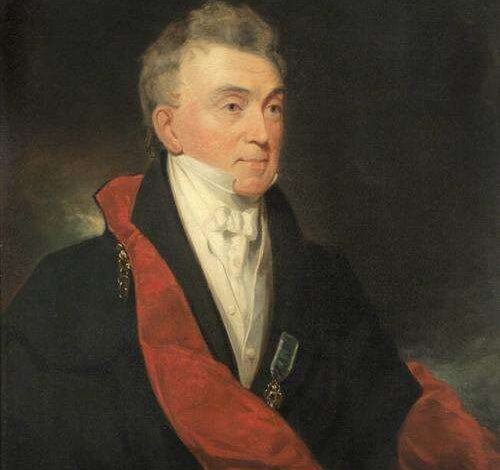
Illustrations, from above: Nicholas Fish (1758–1833) Nicholas Fish painted by Henry Inman in 1824, in the collection of the Metropolitan Museum of Art; Trumbull’s Surrender of Cornwallis, following the siege of Yorktown with Fish standing furthest to the right in the front; Nicholas Fish painted by Henry Inman in 1824, in the collection of the Metropolitan Museum of Art; Nicholas Fish etching by H.B. Hall and Sons, undated; and a portrait of Hamilton Fish as Governor by
Source link