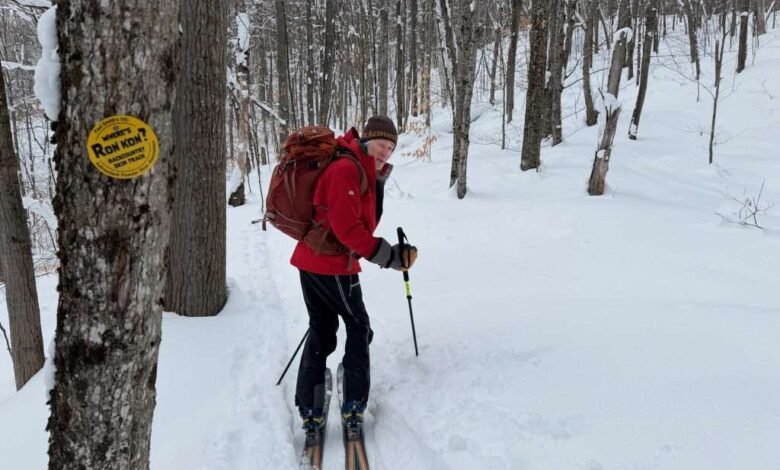
 What a winter it’s been for skiing in the Adirondack woods. With all this snow, it seems as though you can earn your turns just about anywhere. I took advantage of the conditions recently to check out the Jenkins Mountain Open Woods Ski Zone at the Paul Smith’s Visitor Interpretive Center on land owned by Paul Smith’s College.
A few years ago, I had visited the area in autumn, before snowfall, and found that the ski trails blended so well with the surrounding forest that they were difficult to discern. That’s all well and good, but how do they ski?
My guide for the day was none other than Ron Konowitz, the creator of this unique resource for backcountry skiers. Since my car was in the shop, he picked me up in Saranac Lake and we drove together to the VIC.
From the VIC headquarters, we skied a few miles on a wide, groomed trail en route to a frozen beaver pond at the base of the ski zone.
On the way we ran into two Nordic skiers: Jack Burke, a retired vice president of Paul Smith’s College, and Randy Young, who once managed the cross-country trails on Dewey Mountain outside Saranac Lake. Jack is the father of Tim Burke, who competed in the biathlon in four Olympics.
Eventually, the wide trail headed uphill and morphed into an ungrooomed hiking trail that leads to the summit of Jenkins Mountain. We followed the hiking trail (marked with blue disks) a short distance and then turned right to cross the beaver pond. Ron remarked that when the pond hasn’t yet frozen, it’s probably too early in the season to ski his trails.
 The crossing begins at a kiosk with information about the Jenkins Mountain Open Woods Ski Zone. In less than a minute we reached the other side of the pond and stopped to affix our climbing skins to the bottoms of our skis. The skins would would enable to us to shuffle uphill on our skis.
While we attached the skins, two backcountry snowboarders came blasting downhill through deep powder. Their happy faces assured us that the conditions were good.
The ski zone has three intersecting descent trails and one climbing trail, all marked with disks asking “Where’s Ron Kon?” As a longtime backcountry skier, Ron usually is somewhere in the woods on winter days, though he often is loath to tell you where.
It’s worth noting that Ron takes down the disks and the signs at the end of the ski season, leaving the woods looking natural and “untrammeled by man,” as the federal Wilderness Act says.
As we climbed the skin track, marked by yellow disks, Ron discussed the work he did to create the trails and the ongoing work to maintain them. In winter, he visits the area every few weeks to check conditions and remove blowdown.
In creating the three ski trails, totaling 1.5 miles, Ron cut only four trees with a diameter greater than 3 inches at breast height. All four were hazard trees that had partially fallen over the trails. Nearly all of the other trees cut were less than two inches in diameter — saplings that might not have grown to maturity anyway. Until a 2021 court decision, the state didn’t even bother to count trees this small when evaluating the impact of building trails in the Forest Preserve.
“If a tree didn’t have to go, we left it,” Ron said. Indeed, some trees still stand within the trail corridors. “We’re not disturbing the canopy at all,” he added.
 Ron created the ski zone in part to show that backcountry skiing has little impact on the natural environment. Ski trails are used only part of the year and leave the ground cover intact. Contrast this to the muddy, eroded trails seen in the High Peaks and elsewhere in the Adirondack Forest Preserve.
So far, though, the the ski zone has not persuaded state officials to change the rules to allow trails designed for down-mountain skiing — or, to use Ron’s terminology, open-woods skiing.
The Adirondack Park State Land Master Plan requires that ski trails have the same dimensions and character as a foot trail. Generally, hiking trails are allowed to be six to eight feet wide. This might be OK for skiing on gentle terrain, but it is an unrealistic and even dangerous limitation on steeper, down-mountain trails. The Ron Kon trails are up to 12 feet wide.
I think it absurd that the Master Plan permits snowmobiles to operate in the “forever-wild” Forest Preserve on trails much wider than foot trails, but it cannot (in the view of state officials) accommodate backcountry skiing, a quiet, human-powered, and non-polluting activity. Especially as down-mountain skiing is a traditional use of the Preserve. Before the advent of ski resorts, the state built many ski trails in the Adirondacks.
Ron and I continued to the top of the ski zone, gaining about 500 feet in elevation. The zone ends well below the summit of Jenkins Mountain.
 The fun was about to begin. We stripped the skins from our skis, stowed them away, tightened our boots, and switched our bindings to downhill mode.
Although there are only three trails, they cross in some places and split in other places, affording a number of descent options. Given the abundance of snow, it was also possible to ski off trail.
I followed Ron at the outset, but we each ended up making our own lines in the unbroken powder. Occasionally, I’d go ahead and get photos or videos of Ron skiing toward me.
After several such stops, I couldn’t resist the lure of gravity; I pointed my skis downhill, made a few turns in fluffy powder, and schussed onto the beaver pond, lovely and serene in the late-afternoon light.
To answer my question, the trails ski great. Unfortunately, we didn’t have time for another run, but I’ll be back.
You can watch a short video of Konowitz skiing the trails here.
Read more about winter sports in New York State.
Ron Konowitz on the climbing trail at Jenkins Mountain (photo by Phil Brown; Konowitz crosses the beaver pond (Phil Brown); Map illustration showing the Jenkins Mountain descent trails are shown in red, the climbing trail in yellow and the hiking trail to the Jenkins summit in blue (courtesy of Paul Smiths VIC); Konowitz descending one of the backcountry-ski trails (Phil Brown).
Source link