
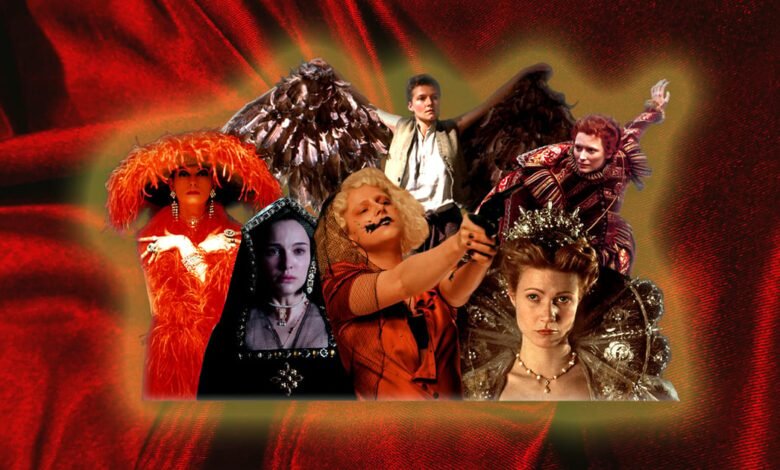

Maggie Gyllenhaal’s reimaging of James Whale’s 1935 classic The Bride of Frankenstein marks 40 years in the singular career of costume designer Sandy Powell.
Throughout her career, Sandy Powell’s work in costume design has been described through poetic juxtapositions – grandeur and grit, luxe and control, splendour and anarchy – that describe her singular vision of both history and its depictions on screen. Powell’s ability to imagine a past that we recognize but to which we have never been has made her a highly sought-after collaborator for some of contemporary cinema’s most celebrated filmmakers. She has designed costumes for 50 period films that collectively represent more than 500 years of fashion, resulting in a body of work that is unparalleled in its ability to straddle history and fantasy and, in the process, define how cinema understands both. Her work is both a visual feast and also a treatise on the period film itself, reminding us that the past can only offer so much of itself, and the rest must be filled with dreams.
From realist period dramas to fairytales, Powell’s work is informed by both a deep knowledge of fashion history and a creative philosophy that understands costume as a tool for creating character. Period films rely on both, requiring costume designers to consider how a period shaped a character’s life and, by extension, their clothes. But what we know about the past is limited by both what existed and what has survived. Meticulous historical research cannot entirely make up for the fact that most of our references for what people wore prior to the late 19th century are commissioned portraits that only the very wealthy could afford. This may not be an issue on films such as Justin Chadwick’s The Other Boleyn Girl, which takes place among the aristocracy, but it posed unique challenges for Powell on John Madden’s Shakespeare In Love, which is set primarily in the seedy underworld of 16th-century public theaters. In such instances, costume design is a melange of research, educated guessing, and invention – all of which must be guided by an investment in the people who once lived and died in the shadow of those histories that were deemed worth preserving. Even films like Carol, which had a wealth of mid-century street photography to draw on, are always only approximating a world that no longer exists. “No period costume can ever be 100% accurate because fabrics and techniques have changed,” Powell says, noting that clothing like that in Shakespeare in Love would have all been hand-stitched.
To see this as inaccuracy is to miss the poetry inherent in the period film’s ability to put history in conversation with itself, to find commonalities across centuries of difference. Nowhere is this poetry more clearly expressed than in Orlando, which follows an idealistic young aristocrat (Tilda Swinton) who pursues love and self-knowledge across four centuries, changing genders and navigating social norms while moving from the end of the Elizabethan era to the 1990s.
The film is a costume designer’s dream, requiring not just designs for four different periods in British history, but also a broader vision of how one person might express themselves sartorially within each of them. Orlando as a boy is more concerned with poetry than clothes, yet his clothes communicate as much about his inner world as his poetry does. When Orlando is changed into a woman, the extremely wide panniers fashionable during the Georgian era constrain her movements and physically isolate her from others. However, even though it depicts historical realities, Orlando is less interested in the past itself than in our fantasies of it.
If historical accuracy is the guiding principle of most period films, then Orlando is guided by what might be better described as historical anarchy. Orlando refuses to remain within a single era, but the film itself moves in all directions at once, dragging history and its various depictions along with it. Like a character in a Shakespearean play, the 17th century boy Orlando vows to kill himself over an impossible love; in the 19th century, the woman Orlando finds herself swept up in a Brontëan romance. And yet, these scenes call to mind Franco Zeffirelli’s 1968 Romeo and Juliet or the 1983 BBC adaptation of Jane Eyre (Julian Amyes) as much as the original texts themselves. With Orlando, the period film isn’t a lens on the past – it’s an infinity mirror.

While Powell’s work on Orlando is utterly singular, it was not the first time that she had worked on a film that challenged our sense of historical time and how it’s represented. Her collaborations with Derek Jarman on Caravaggio (her first feature film), Edward II, and Wittgenstein use the structure of the period film as a prism splitting “history” into a kaleidoscope of events, images, and ideas assembled into a story about the past that may be inaccurate, but which is nevertheless true. “People thought Derek’s Caravaggio was a period film,” she remarked in 2019, “but it absolutely was not: it was kind of set in the 1940s and inspired by the Italian neorealist films of that time.” Powell’s costumes are an irreverent mix of vintage and modern styles and fabrics, all distressed to evoke the economic depression Italy faced in both the late-16th and mid-20th centuries. Yet, it’s hard to see anything other than Baroque sensuality in Jarman’s reproduction of Caravaggio’s iconic works – a resemblance owing as much to Powell’s command of texture and drapery as to the cinematography. The sparse sets give her costumes room to do the work of weaving together the various periods and artistic influences that give the film its identity. The level of visual cohesion that she achieved is a remarkable accomplishment for any designer, much less one working on their first film. And now, 40 years later, Powell has given us The Bride!.
The past several years have seen Powell fearlessly interpret beloved costumes worn by Snow White, Cinderella, and Mary Poppins – characters that have transcended their film origins to become myth. In many ways, The Bride! is the culmination of Powell’s body of work thus far. Her approach to styling The Bride (Jessie Buckley) in Gyllenhaal’s film trades the iconic shapeless white gown and bandages worn by Elsa Lanchester for a loud mix of 1930s styles: a bias-cut silk evening dress in bright orange, electric blue stockings, and red heeled boots. The odd ensemble communicates both Ida’s rebellious spirit (colors would not have been coordinated in this way at the time) and her place at society’s fringe. It’s the only dress that Ida actually wears, and it becomes increasingly disordered as the woman wearing it becomes further confused about who she was before she was brought back to life, and who she is becoming.
As in Orlando, costume in The Bride! not only responds to events as they unfold, but actively changes the film’s narrative, repeatedly pulling the lovers out of their present and into the fantasy space of cinema. Frank’s (Christian Bale) need to go to the movies (relatable) is what moves the plot along, and as they drive to theaters across the country, they also watch themselves on screen, moving as protagonists through the landscape of 1930s musicals, horror films, and romantic dramas. The silver screen becomes a place where they can see themselves, and in the one place in the film where they are able to be themselves – a subterranean club filled with social outcasts from an array of historical periods – it’s through a partnered dance number that that feeling is expressed. Each of these meta-cinematic moments calls attention not just to how costume is used in The Bride! but to costume’s central role in creating cinema itself. It’s through costume that characters, worlds, and fantasies are built, and in almost 140 years of film history, few have built them as well as Sandy Powell.
Source link