 Saratoga Springs is a community shaped by ambition, wealth, and strong personalities. Its streets and landmarks bear the names of early settlers, political leaders, and presidents — Bryan, Clark, Clement, Putnam, Walworth, Waterbury, among others.
One name, however, is notably absent despite its once-towering presence in the city’s history: Henry Hilton.
Hilton played a central role in one of the most dramatic and controversial chapters of Gilded Age Saratoga Springs. His rise to power, fueled by proximity to immense wealth, was matched only by the speed and scale of his fall.
The story begins with Judge Henry Walton , an early landowner who inherited vast acreage in what would become Saratoga Springs. Walton sold portions of his land to early settlers but retained a large forested estate he named “Wood Lawn.”
In 1878, that estate — approximately 600 acres — was purchased by Henry Hilton, who promptly renamed it “Woodlawn.” Hilton expanded the property to more than 1,100 acres, transforming it into a park-like landscape with over 20 miles of carriage trails, multiple lodges and barns, and an athletic field and running track known as the Woodlawn Oval.
Today, that land forms the campus of Skidmore College, and Hilton’s Woodlawn Oval is home to The Wesley senior living community. Yet Hilton himself has largely vanished from local commemoration.
Henry Hilton (1824-1899) was born in Newburgh, New York, the youngest son of Scots-Irish immigrants. At age 15, he moved to the city of New York to complete his education while working as a law clerk.
He was admitted to the bar in 1846 and quickly advanced through prestigious law partnerships, eventually becoming a partner at Campbell & Cleveland, a prominent New York City firm.
One of the firm’s most important clients was Alexander Turney Stewart (1803-1876), the legendary “Merchant Prince” of 19th-century America.
Stewart revolutionized retail by creating the American department store, built factories in Europe and the United States to supply his dry goods empire, and expanded into wholesale trade. Through his legal work, Hilton met Stewart and married a cousin of Stewart’s wife in 1849.
By 1850, Hilton had become Stewart’s personal attorney, gaining access to extraordinary wealth, influence, and social standing. Over time, Hilton evolved from trusted adviser to confidant and, effectively, surrogate son.
Hilton’s public career rose alongside his private fortunes. He served as a Judge of the Court of Common Pleas from 1858 to 1863, was listed on the rolls of Tammany Hall in 1860, and was appointed a commissioner of New York City Parks in 1870.
During his tenure, Central Park was under development, allowing Hilton to learn park design principles firsthand from Frederick Law Olmsted and Calvert Vaux — experience he later applied at Woodlawn.
His reputation, however, suffered its first serious blow during the so-called “Hawkins Scandal.” English sculptor Benjamin Waterhouse Hawkins had been commissioned to create dinosaur sculptures for public display.
Tammany Hall viewed the project as a threat to plans for what would become the American Museum of Natural History. Hawkins’s studio and sculptures were destroyed by vandals.
Although William “Boss” Tweed was initially suspected, responsibility ultimately fell on Hilton. Nothing was ever proven, but Hilton resigned from the Parks Commission shortly afterward.
Stewart remained Hilton’s greatest protector. By the 1860s and 1870s, Stewart earned an estimated $2 million annually — roughly $36 million today — and left an estate valued at $50 million, equivalent to tens of billions in modern terms.
Stewart used his wealth philanthropically, particularly to benefit working people. He purchased 10,000 acres on Long Island to create Garden City, built the Central Long Island Rail Road to serve commuters, and constructed a hotel for working women that offered safe, respectable, and affordable housing.
Stewart also purchased Saratoga Springs’ Grand Union Hotel in 1872, transforming it into the largest and most luxurious hotel in the world, complete with elevators and indoor plumbing. He appointed Hilton chairman of the railroad board and relied on him extensively in business affairs.
When Stewart died in 1876, he left Hilton a bequest of $1 million and named him executor of his estate, with explicit instructions to divest Stewart’s widow of all commercial holdings.
Litigation from Stewart’s relatives followed immediately. Within a year, Hilton had exchanged his $1 million inheritance with Mrs. Stewart for full control of Stewart’s vast business empire.
The consequences were swift and damaging. In the summer of 1877, financier Joseph Seligman — an investor in Stewart’s railroad and a longtime Grand Union patron — arrived in Saratoga Springs with his family, only to be denied lodging at the hotel.
The incident ignited national outrage over antisemitism. Hilton, now managing the hotel, claimed to be motivated by personal grievances: resentment over not being invited to a celebration hosted by Seligman honoring President Grant’s reelection, and anger over Seligman’s involvement in anti-Tammany Hall reform efforts.
Hilton further inflamed public opinion by completing Stewart’s hotel for working women, only to close it within months, claiming financial losses. The backlash was severe. Businesses once associated with Stewart’s benevolence and success saw sales collapse.
Amid this turmoil, Hilton retreated to Saratoga Springs, purchasing and expanding Woodlawn in 1878. That same year, Stewart’s body was stolen from its grave.
Hilton offered a reward for information, but no credible ransom demand emerged until 1884, when Mrs. Stewart independently paid $20,000 for a bag of bones that was interred at St. Paul’s Cathedral in Garden City, Long Island.
In 1883, the former A.T. Stewart empire, now under Hilton’s control, declared bankruptcy. Hilton transferred remaining assets to his five children. Mrs. Stewart died in 1885 and was buried in the cathedral she and her husband had built — beside the remains recovered years earlier.
Henry Hilton’s name may not appear on Saratoga Springs street signs, but his legacy endures in its landscape. Woodlawn, once a private symbol of power and retreat, remains a defining feature of the city — a reminder of ambition, controversy, and the volatile fortunes of the Gilded Age.
Michael Murray is a 4th generation Saratogian fascinated by the history of Saratoga Springs and the people who made that history. His previous article about growing up near Woodlawn Oval led to a request for a presentation by the Wesley Community which led to research of Henry Hilton and Woodlawn which led to this essay.
This essay is presented by the Saratoga County History Center.
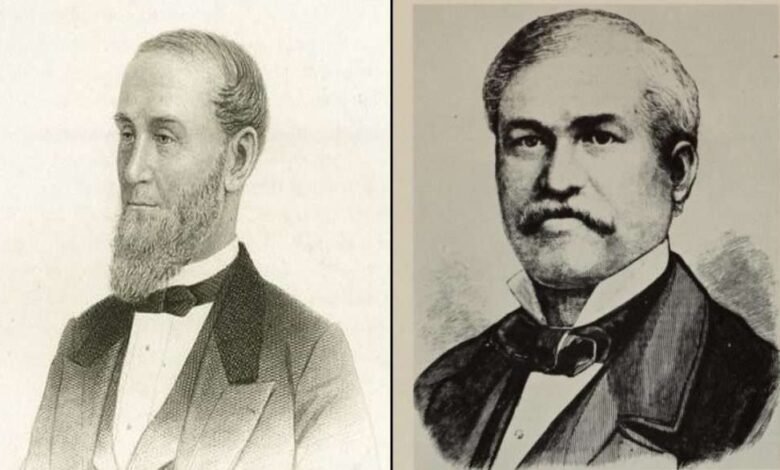
Illustration: Alexander Stewart (left) and Henry Hilton.
Source link