 The Clean Ferries Bill (A11303/S10381) sponsored by Assembly Member Jo Anne Simon and Senator Brian Kavanagh has been introduced in the New York State Legislature.
The bill calls for publicly funded ferry companies to purchase only zero-emission vessels starting in 2028, and for other public vessels in New York State waters to be zero-emission by 2032.
In New York State, the transportation sector accounts for almost one-third of all greenhouse gas emissions and has one of the nation’s largest passenger ferry markets, rivaling Washington state’s ferry system.
New York’s major passenger ferries run largely on diesel fuel. NYC Ferry alone emits 180,000 kg of nitrogen oxides (NOₓ) a year, equivalent to 116,000 cars. NOₓ contributes to ozone pollution linked to hundreds of premature deaths and thousands of emergency visits annually in New York City, and diesel ferry exhaust increases the risks of asthma and cancer.
In additional to gradually transitioning New York ferries to zero-emission vessels, the bill also calls for the New York State Energy Research and Development Authority (NYSERDA) to study electric charging stations along the Hudson River and canal system to support the transition, which is expected to include canal work boats (including tugs and barges) in the future.
“According to one estimate, zero-emission vessels could save NYC Ferry nearly $250 million over a 15-year period, with a payback of eight years. NYC Ferry’s operating subsidies are considerably higher than those of the New York City Subway. This bill is a leading example of affordability, where clean technology saves taxpayers hundreds of millions of dollars with the vital additional benefit of eliminating air and water pollution,” said Wayne Arden, of the Sierra Club’s New York City Group.
Julie Raskin, President and CEO at Waterfront Alliance, which supports the expansion of ferry service for commuters and tourists, said “waterways are the lifeblood of the communities that surround them.” She noted the ferries operating on Long Island Sound, in the Hudson and East Rivers, and across Lake Champlain as examples.
The technology is already here. SeaStreak, a ferry company providing services between Monmouth County in New Jersey and Manhattan, last year received a $55 million EPA grant to deploy three zero-emission ferries and two high-speed shoreside charging systems.
In August 2025, New York City launched its first hybrid-electric ferry — the Harbor Charger — offering its passengers a cleaner ride to Governors Island. The ferry is expected to save the city more than $200,000 per year in fuel costs.
Several European countries are well on their way to transitioning their ferry fleets to zero-emission, including Norway, which now has 102 electric ferries and passenger boats operating across 67 routes and has implemented a policy requiring all ferries operating along its coastline to transition to electric propulsion by 2030.
Electric ferries are also seeing rapid uptake in Asia, with Bangkok deploying the first of 27 planned large electric ferries in 2020 and South Korea on its way to replacing 140 state-owned diesel-powered ferries with all-electric alternatives by 2030.
Read about New York State’s Ferries and Ferry History.
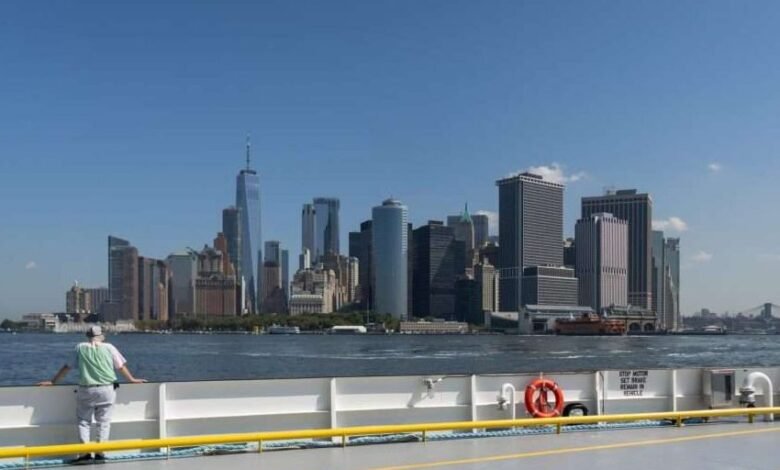
Photo: The view of Manhattan form the Harbor Charger, an electric ferry, ca. 2025 (courtesy Siemens Energy).
Source link