 The emergence of the bottling industry in New York State occurred due to the rise of the leisure economy and the fashion for the kind of mineral waters available at natural spas.
Prior to the availability of chlorinated water, inhabitants of many highly populated areas of the world avoided unmixed water from most sources for fear of contamination.
Due to growing populations, land management practices, and an inadequate theory of germs and disease, the quality of many water sources in Europe deteriorated over the course of the Middle Ages, necessitating the consumption of hopped beer and other alcoholic beverages or water mixed with a small amount of alcohol for hydration.
 Although a select number of elite Europeans had visited balneotherapeutic spas at places like Bath and Vichy to “take the waters” since their development by the Romans, the majority of Europeans avoided the consumption of water, and the precaution followed European settlers to the American colonies.
During the eighteenth century, the emergence of the merchant class in Europe led to a sharp rise in the popularity of spas throughout the continent, and the social status conferred by the leisure activity soon spread to the American colonies.
In the 1760s and 1770s, the American elite began visiting spas in the Northeast, including those at Stafford Springs, Connecticut, and Bristol, Pennsylvania, to take advantage of the health and wellness effects of the mineral springs there.
Above all, the development of first Ballston Spa and then especially Saratoga Springs at the end of the eighteenth century solidified the association of mineral springs with the most fashionable circles.
As the nineteenth century progressed, the emergent middle class in the United States desired to visit spa towns in imitation of the members of elite society, but not all those aspiring visitors could afford the trip to the relatively remote resorts offering mineral water cures.
[Other mineral spring spa communities in New York included Sharon Springs and Lebanon Springs, and even small communities like Poestenkill, in the hills of Rensselaer County, which had a small bath house industry.]Thus, in the early part of the century, enterprising merchants constructed bottling plants at places like Saratoga Springs to cater to those consumers unable to visit or looking to take the water home with them.
 Bottled mineral water remained a fashionable commodity for the following century, and bottlers took advantage of access to the mineral springs scattered throughout the Northeast, borrowing bottling techniques used for alcoholic beverages and delivering the water to consumers.
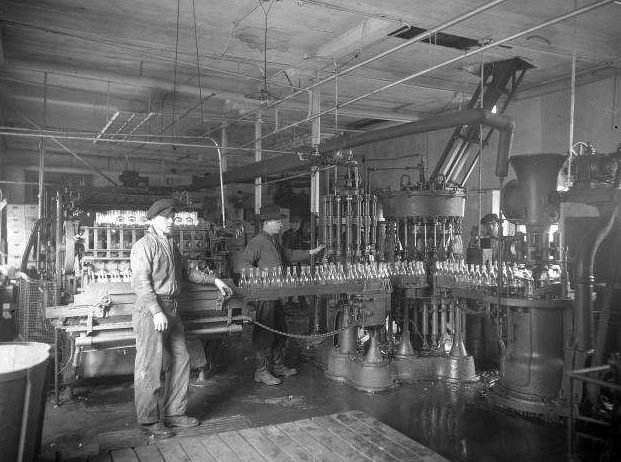
The typical spring water bottling plant included access to a water source and a pump, an area for cleaning bottles, a bottling line including a stoppage mechanism (first corking and later crown capping), and a packing and storage area.
Many bottling operations delivered their products directly to consumers and thus required an area for wagons and draft animals and, later, for automobiles.
Bottlers also reused bottles, collected from consumers for the return of a deposit, and thus required adequate bottle storage until the adoption of disposable or recyclable packaging in the second half of the twentieth century.
Other Carbonated Beverages
As the fashion for mineral water and its association with medicine grew, so too did the market for other carbonated beverages.
The ability to artificially carbonate water in the middle of the eighteenth century, pioneered by William Brownrigg and developed by Joseph Priestly, made possible the invention and production of numerous sweetened and medicated beverages.
Over the course of the nineteenth century, entrepreneurs in Europe and the United States introduced many of the soft drinks now found in grocery aisles throughout the world, including ginger ale, root beer, cola, and citrus-flavored sodas.
 Beginning around the middle of the century, druggists and chemists installed soda fountains in pharmacies to offer their own proprietary beverages mixed with drugs such as cocaine, morphine, and caffeine, and these became especially popular with ailing veterans of the American Civil War.
The introduction of pharmaceutical sodas furthered the association of carbonated beverages with wellness, a notion that peaked at the turn of the twentieth century.
Although the popularity of soft drinks has never waned since their introduction, theoretical and technological developments in the early twentieth century led to a decline in the demand for bottled mineral waters.
The progression of germ theory and the study of microbiology encouraged the introduction of liquid chlorine into municipal water supplies. Beginning in 1913, Philadelphia began chlorinating its drinking water, and other cities soon followed suit.
The City of Troy began chlorinating its water supply in 1925, ensuring the abundance of clean drinking water wherever its pipes supplied water. The wide availability of clean water reduced the demand for bottled water, which had previously protected against waterborne pathogens.
The availability of modern pharmaceuticals proved far more effective at treating disease and conditions previously remedied by the intake of mineral water, further dampening the demand for the once-fashionable bottled mineral waters.
While the status of and demand for bottled mineral waters fell during the early twentieth century, the concurrent rise of the Temperance Movement ensured that bottling plants remained commercially stable ventures.
 Whether Americans opted to reduce their consumption of alcohol or were forced to do so by the passage of the Volstead Act of 1919, largely prohibiting the production and consumption of alcohol, they sought alternative beverages beyond tap water in the decades leading up to World War II.
Although the popularity of medicated soft drinks waned over the course of the twentieth century, the Temperance Movement and Prohibition fueled the demand for “temperance beverages” like ginger ale, sarsaparilla, root beer, and unflavored soda water.
While Prohibition forced the closure and consolidation of breweries in the United States, the surge in demand for bottled beverages encouraged the rise of independent bottling companies in cities and towns throughout the country.
By 1940, over 6,000 bottling plants operated in the United States, and the number peaked at around 6,660 the following decade.
After the conclusion of World War II, material innovation and corporate expansion led to a fundamental shift in the beverage industry in the United States. Larger bottling operations, benefiting from economies of scale and often from relationships with major brands, purchased smaller competitors and often folded into the growing national beverage corporations.
 From a peak in 1950 at over 6,600, the number of independent bottling companies in the United States fell steadily over the course of the second half of the twentieth century, with only about 500 remaining in operation in 1999.
Meanwhile, the increasing prevalence of advertising campaigns for nationally distributed beverages drew market share away from their local counterparts, forcing local beverage producers out of business. Innovations in packaging accelerated this process.
Drawing lessons from the beer industry, bottlers abandoned the predominant model of local bottle delivery, pickup, and reuse in favor of the one-trip bottling paradigm, in which steel or aluminum cans and later plastic bottles were distributed to supermarkets and sold without expectation of return.
This essay was drawn from the National Register of Historic Places Registration Form of the Whalen Bottling Plant in Troy, NY.
Illustrations, from above: Four men operate a mineral water bottling plant run by the New York State Conservation Commission in the New York State Reservation (now Saratoga Spa State Park) in Saratoga Springs, November 1918 (NYS Archives); Water Cure therapies or “Hydropathic applications” according to R.T. Claridge’s Hydropathy, 1842; High Rock Spring, Saratoga Springs, postcard ca. 1875; soda fountain counter at Clarkson and Mitchell Drugstore, Springfield, Illinois, ca 1905 (Abraham Lincoln Presidential Library) and 1894 ad for an ornate fountain; a standard bottling plant of the Coca-Cola Company in 1932; and the former 1885 Whalen Bottling Works in Troy, ca. 2025, recently nominated to the State and National Historic Registers.
Source link