
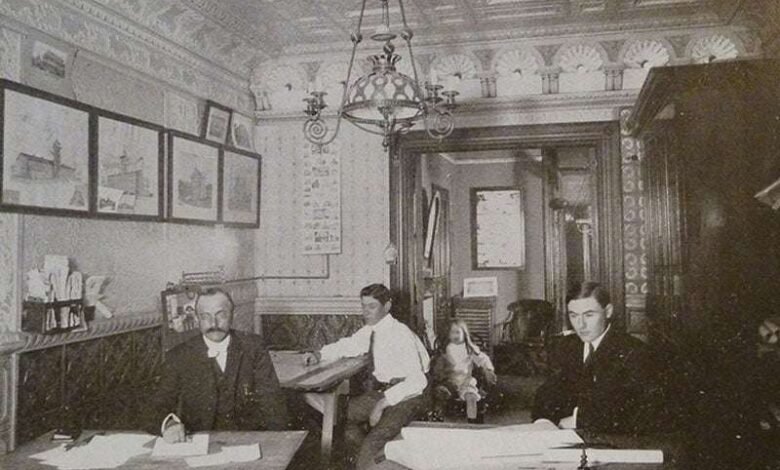
 On July 13, 1905, the Columbia Weekly Republican reported that the prominent Hudson, NY architect Henry S. Moul (1857-1925) had prepared the plans and specifications for construction of the Railway Steel Spring Company’s new foundry building; he presumably also designed the sand house that supported its operations.
Moul was from a family with a long history in the Columbia County area. The son of a masonry contractor, Moul came to Hudson in 1875 and apprenticed with James E. McClure, a local carpenter and builder, while studying architecture in the evenings. He was subsequently employed by McClure and took over the latter’s business after McClure’s death in 1888.
In partnership with Frank B. Lasher, Moul formed H.S. Moul & Company in 1894 and quickly made a transition from building contractor to architect. Within three years, he ceased the contracting part of his business and focused solely on design services.
Prior to that shift, however, his company constructed the impressive John F.X. Brennen Residence at 39 West Court Street in Hudson (1894-95) to the designs of fellow architect Michael J. O’Conner.
Moul’s architectural practice focused primarily on designing private houses in and around the City of Hudson.
 Working in an eclectic mode characteristic of this era of American architecture, he incorporated elements of styles popular during the Late Victorian period of the late nineteenth and early twentieth century, including the Queen Anne, Shingle, Stick, and Colonial Revival modes.
In addition to his residential commissions, Moul also designed several blocks of attached commercial structures (such as 424-428 Warren Street, ca. 1897), the fourth Columbia County Courthouse (1900; destroyed by fire 1907), the former Anshe Emeth Synagogue at 14 Warren Street (1913), and the Macawomuc Engine House (date unknown) across the river in the Village of Athens, Greene County.
Images of only two of his industrial projects are included in the booklet Modern Buildings by H.S. Moul, Architect, the Union Branch Mill (Union Mills Company) in Hudson and the Athens Knitting Mill, neither of which is extant.
Outside the Hudson area, Moul designed a wide range of building types — residences, commercial buildings, and churches, as well as a hotel, theater, YMCA, and library — in a variety of styles.
 Moul relocated his home and business to Gloversville, New York, in the Sacandaga Lake area, where he died in 1925.
Moul’s Railway Steel Spring Company has recently been nominated for State and National Registers of Historic Places.
This essay was drawn from the National Register of Historic Places Registration Form of the Railway Steel Spring Company Foundry and Sand House in Hudson, NY.
Illustrations, from above: Office of Henry S. Moul at 405 Warren, Hudson, NY (Columbia County Historical Society); Residence of Miss Amanda Limbrick, Hudson, NY, from Photographs of buildings designed by Henry S. Moul Architect, ca. 1900 (Hudson Area Association Library – New York Heritage Digital Collections); and the Railway Steel Spring Company Foundry and Sand House in Hudson, ca. 2025.
Source link