
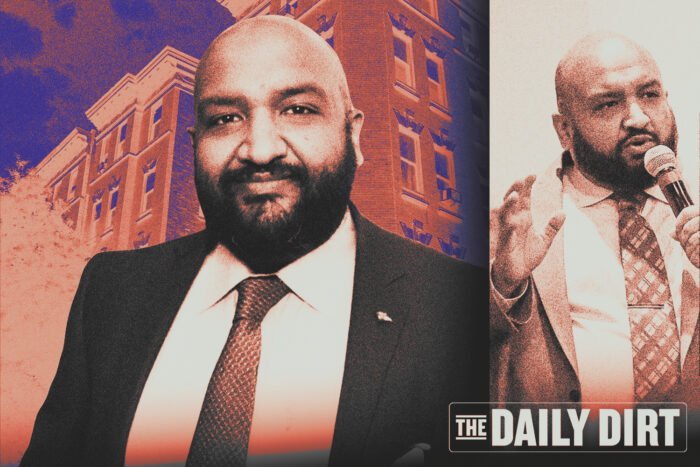

Ahmed Tigani has returned to the Department of Buildings as the boss.
The last time he worked for the agency he was chief of staff to Melanie La Rocca, who was DOB commissioner under Mayor Bill de Blasio. After that he served in a number of roles at the Department of Housing Preservation and Development, most recently as its acting commissioner.
Tigani has taken the helm as developers figure out how their projects could be shaped under the City of Yes for Housing Opportunity text amendment, and as the agency rolls out long-percolating changes, including reforms to façade inspections and the redesign of much-derided sidewalk sheds. On the latter, Tigani said DOB is “moving full steam ahead,” as the agency prepares to release the design specs for new sidewalk sheds and crafts rules changing the frequency of façade inspections.
He said the agency is also taking a look at its major projects program and how to improve its customer service.
“I recognize that if we do the bread and butter stuff, we do the customer service, the customer delivery, then we get permission to do bigger things,” he said.
I sat down with Tigani last week to ask how he is approaching the new role so far. This conversation has been edited for length and clarity.
Why were you interested in the DOB role?
There are a lot of different factors that made this the right move. First and foremost, this DOB is different from previous DOBs, not only in the work that we’re taking on, but just its positioning in the policy and enforcement lineup of City Hall. DOB’s role will always have an operational perspective. We are there in emergencies. This is a core piece of how we serve New Yorkers. But in this administration, seeing DOB move over into the housing and planning space, giving it the opportunity to leverage its experience as the steward of the zoning resolution, being a voice in more effectively and efficiently preserving the buildings of New York City, and being an entity that can contribute even more thoughtfully to the economic development goals and economic growth of the city, makes this an incredibly exciting place to be in this administration.
I’ve heard from some folks with pending projects that there have been some questions around whether they can selectively opt into changes under City of Yes for Housing Opportunity or if they have to take an all-or-nothing approach. What role does the agency play in resolving those issues?
DOB is a steward of the zoning resolution, so we have the responsibility of making sure people know clearly what the rules are and how they have to comply with that. We’ve been working with industry partners on exactly that question. We’ve been looking at it on a case-by-case basis, and we’ve come up with what I think are really reasonable compromises that have allowed projects to move forward.
Can you describe any of those compromises?
Sometimes it has to do with compliance with the affordability requirements, discounts related to the building envelopes, what they can count as floor area for purposes of being in compliance with zoning. These are projects, many years in the making, working under different zoning regimes. And so we’re looking at history, the new zoning — there’s a lot there, which is why it was important to do case-by-case in the beginning, as we work through the interpretation. I think those experiences have really given us clarity on how to guide people in a more general sense, moving forward.
Do you think DOB NOW will ever replace the need for expeditors?
I’m not sure whether any role will look the same way that it does today, but I think there’s always going to probably be a role for people who help folks navigate the construction project management process. DOB NOW certainly is doing more to make the forms and process easier for individuals to take on themselves. But we’re definitely continuing to see people who have expertise in the process play a role in helping people navigate that system. We’re still rolling this out. It’s always going to be hard to say what the role of those individuals will be, until all of it’s out there.
What’s the biggest difference between working for this administration versus the last?
I’m really excited that this administration’s focused on affordability. [There’s] collaboration between agencies, between outside partners like nonprofits or advocacy groups. [We’re] seeing tenants and owners and homeowners talk about the supply problem and the need for us to work together. There is an abundance of optimistic energy about working together to get things done that makes coming to work very exciting. The other part about this administration that is different from the last administration is the role of DOB at the leading edge of planning and housing.
How are you thinking about the agency’s finances, given the mayor’s preliminary budget?
Those conversations are still happening with the Office of Management and Budget, but I’m optimistic because I think this mayor really sees DOB as a partner and as an important part of the process. He’s working very hard to make sure we have the resources we need. But we are in a difficult budget situation, so we’ll also be thinking about cost savings so we can fund things that are critically needed.
You’ve attended the mayor’s rental ripoff hearings. Have you heard from any property owners?
I’ve heard from a number of property owners too. They also have frustration about getting things fixed, and they want to know what services we have available to help them. How can we make it clear about navigating the process, making sure that they understand what’s involved in inspection? There are things that I’m hearing from both sides that have to be on our punch list.
What we’re thinking about: Are you figuring out what provisions of City of Yes will apply to your project? Have an example of a big change to your plans based on City of Yes? Send the details to kathryn@therealdeal.com.
A thing we’ve learned: The city reopened applications for its Plus One ADU program, which provides up to $400,000 in financing to homeowners looking to add backyard cottages or so-called granny flats to their properties. The $2.7 million in city funding allocated for fiscal year 2026 is going toward the 35 or so ADUs that the city expects to help fund in its first round of the program. No loans have closed yet. It’s unclear how many ADUs the next round will fund, but the mayor’s preliminary budget appears to anticipate $11.8 million in loans for the program next year.
The city also launched a website, “ADU for You,” which allows owners to check their address to see if their lot allows an ADU and to peruse potential designs that have already been reviewed by the DOB.
Elsewhere in New York…
— Mayor Zohran Mamdani has appointed a new sanitation commissioner. Mamdani tapped Gregory Anderson, who most recently served as Gov. Kathy Hochul’s deputy director of state operations, Gothamist reports. Anderson previously worked at the sanitation department from 2014 to 2023.
— The Metropolitan Transportation Authority on Tuesday sued the Trump administration over $58.6 million in withheld reimbursements for the Second Avenue Subway project, Politico New York reports. The lawsuit alleges that the federal government violated its contract by freezing grant funding committed to the project.
— Police Commissioner Jessica Tisch told the City Council on Wednesday that NYPD executives abused the department’s Confidential Rental and Leasing Office, which provides rental cars to officers working undercover, Politico New York reports. She said an internal probe found that some executives had rented multiple cars themselves.
Closing Time
Residential: The largest residential sale on Wednesday was $13 million for a 4,000-square-foot co-op unit at 115 Central Park West. Lauren Muss, John Giannone and John Credaroli III with Douglas Elliman had the listing.
Commercial: The largest commercial sale was $28 million for a 129,087-square-foot office building at 21-02 49th Avenue in Long Island City.
New to the Market: The highest price for a residential property hitting the market was $7.2 million for a 2,831-square-foot condominium unit at 50 Riverside Boulevard on the Upper West Side. Joseph Taplitzky with Compass has the listing. The unit last sold for $6.7 million in October of 2015.
Breaking Ground: The largest new building permit filed today was for a 409,234-square-foot 481-unit mixed-use project at 484 Eighth Avenue in Midtown. Thomas Furman with SLCE filed the permit on behalf of Vornado.
— Matthew Elo