 America has been the world’s most diverse nation since its founding 250 years ago. New York has been the nation’s most diverse city. New York has led the way in welcoming immigrants, integrating them into American life and, at the same time, enabling them to retain something of the culture that they brought with them from abroad.
New York City’s America’s Making Exposition just over a century ago undertook to demonstrate the contributions of various national and ethnic groups and to show how they contributed to and enriched American society.
America had triumphed in World War I in 1918. But there was national unease about whether the millions who had entered the country (many through New York) were being “Americanized” into the culture of their adopted country.
Congress passed legislation restricting immigration in 1921. Another law, in 1924, heavily favored immigrants from Western and Northern Europe, reduced those from Southern and Eastern Europe, and mostly excluded those from Asia.
But New York was out of step with the nation. More than a third of the city’s residents in 1920 had been born abroad. The city was diverse and cosmopolitan, more tolerant and welcoming of newcomers than the country at large.
Implementing A Vision
Canadian born New Yorker Franklin Knight Lane (1864-1921), who had served as Secretary of the Interior from 1913 to 1920, reflected this concern. In a 1919 speech, he described “Americanization” as the process of turning newcomers into members of the national community. He included adopting the English language, reflecting the nation’s values, and identifying as an American rather than someone from a foreign land.
 Over the next couple of years, though, Lane’s perspective shifted. He came to see America as a great cooperative enterprise, a land of one people, gathered from many countries. They each brought something of their own culture, their creativity, and their willingness to work.
A good way to increase public understanding of that concept, Lane thought, would be a grand pageant to highlight the contributions of various ethnic and national groups. New York, the nation’s most diverse, cosmopolitan city was the perfect place to do that. He called it “America’s Making.”
Lane died early in 1921 before he could implement his vision, however. But the cause was taken up by city school superintendent William. L. Ettinger and state education commissioner John H. Finley.
They saw a need to demonstrate immigrant contributions to students in the schools. They shaped “America’s Making” into a city-wide public pageant running from October 29 through November 12, 1921 that would involve teachers and students.
Ettinger and Finley assembled a citizens’ committee to provide support and guidance for the project. They secured space for the pageant in the 71st Regiment Armory at Park Avenue at 33rd Street in the heart of the city. Representatives of 31 national and ethnic groups, were chosen to showcase what people from their countries had contributed to America.
There was some bickering at first. Christopher Columbus was claimed by both Italy (his country of origin) and Spain (which sponsored his voyages). The Dutch wanted prominence (they were the first European settlers) but so did the English (founders of the colonies that became the nation and the source of its language and laws).
 The Scotch and Irish both claimed president James Monroe as one of theirs. Ettinger and Finley soothed feelings, worked out compromises, and appealed for unity, the project’s underlying theme. The press reported on the planning and built widespread public interest.
Ettinger arranged for a thousand New York school students to send invitations to President Warren Harding to attend the opening on October 29. He declined because of a schedule conflict but sent a greeting:
“We, of America, have no racial entity [sic] and we are making therefore, a people which is born of national inspiration. We are a blend of all the peoples in the world.”
A Grand Opening
Governor Nathan Miller opened the pageant on October 29. “You are going… to see what each race has contributed,” he explained to the crowd that had assembled for the opening. (In those days, “race” often meant ethnicity or national origins.)
Miller continued that “we have talked about what America does for the immigrant. We are now going to direct our thoughts to what the immigrants have done and are capable of doing for America.”
The governor hoped that the project “will help eliminate racial [national] lines and distinctions and create that unity and amity between all of our citizens which is essential to our well-being.”
The opening festival, right after the governor’s speech, began with a grand parade of people representing the countries of their ancestors, and dressed in clothing from those countries, and short tableaux on the armory stage.
The organizers added to the historical connectedness by finding a few people who were actual descendants of the people they portrayed.
Alexander Hamilton’s impersonator was his great-grandson, also named Alexander Hamilton. Franklin Bache Huntington paraded as his ancestor, Benjamin Franklin. Dolly Madison LaMontague represented her great-grandmother, Dolly Madison.
The first part of the parade, called “The Foundations Laid,” represented the beginnings of national existence. First came a Native American who threw his arms wide and declared “in this land where once were only Indians are now men of every color – white, black, yellow, red – yet all one people.”
 The role of Indigenous People and their disposition from ancestral lands, were left unaddressed. Black Americans were included as “honorary immigrants” in “Americans of Negro Lineage” programs organized by W.E.B. Du Bois, James Weldon Johnson, and Eugene Kinckle Jones among others.
There were scenes from explorations and discoveries by Lief Erickson, Portugese explorers, Christopher Columbus and, as The New York Times reported, “the whole army of English, French and Spanish adventurers.” Next came representatives of the first European settlers – Spanish, Dutch, English, French, Swedish, Finnish, Welch, Scotch, Irish and Swiss.
Then, a Liberty Bell boomed and the curtains parted. In came a representative of the group that signed the Declaration of Independence.
The Armory went dark and then began “the long procession of the races” (as noted above, races at this time meant ethnic groups or nationalities) in their typical dress.
This was designed to remind New Yorkers of the current diversity of their city and the contributions of recent immigrants. The parade included Belgians, Italians, Danes. Portugese, Hungarians, Russians, Ukrainians, Czechslovaks, and others.
A final dramatic scene, “The Prophecy,” closed out the parade. The figure of an angel appeared with outspread wings and at her feet a boy, representing America. Her arms were spread wide as if to gather all the assembled races before her into her arms.
Above here a words reflected on the wall: “These shall be thy people.”
Days of Celebration
It was a moving ceremony, kicking off several days of parades and presentations by people in ancestral dress. For instance, Czechoslovak night featured gymnasts who sang songs from their homeland.
On another evening, it was Russians’ turn, doing the distinct dances from their homeland. Each nationality had space for exhibits in the Armory, which opened October 30 and ran for the duration of the celebration.
 The official program showed the variety and how each group chose to represent its contributions. For instance, Americans of Czechoslovak lineage featured mounted an exhibit that showed “the Czechoslovak part in the industry of America.”
“The influence of Dutch immigration has been profound,” said that group’s exhibit. “Many of our social customs and games have come to us through our forefathers from Holland.”
Americans of English lineage were not modest. “The English colonists contributed to American life its ground-work of language, literature, social customs, education, political and economic structure and the entire body of English law.”
The French emphasized their explorers and mounted a replica of “Liberty Enlightening the World” – the original name of the Statue of Liberty.
The German exhibit stressed contributions in science, music, and the arts. But in addition “many pioneer industries were opened up by German immigrants… many inventions… were made by Americans of German descent.”
Americans of Italian lineage noted that “a vast amount of unskilled labor has been available in America from Italian immigrants.” Italians also contributed popular foods, music, and other aspects of what were now ingrained aspects of American life.
Over the next few weeks, teachers and students conducted research on national origins. Over 68,000 adults witnessed more than 1,700 programs of music, processions and pageantry were presented in school auditoriums, parks and playgrounds to demonstrate the part played by various nationalities in the building of the United States.
In the final celebration at the armory, students from 45 schools joined with adults in re-presenting the great lesson of unity. The school events “featured education’s persistent purpose of perpetuating justice, modesty, honesty and a patriotism based on truth and fair play,” said the official program.
Impact?
What was the impact of “America’s Making”?
It was a high-visibility event. The official program estimated that more than two million people saw one of the processions, attended a school presentation, or walked through the armory and saw the exhibits. Its various elements made the case for American success being dependent on its rich, diverse mix of immigrants.
That was different from the popular notion of the “Melting Pot” which held that foreign-born abandoned their national traits when they came here and became true Americans.
The pageant’s theme was also much different from the rising immigrant exclusion theme of the 1921 and 1924 federal laws.
“America’s Making” helped shift public attention to a new idea, which might be called “cultural pluralism.” That concept was being developed and advanced by several people, most notably Horace Kallen (1882-1974) who joined the faculty of The New School for Social Research in New York in 1919.
Kallen argued that minority groups could maintain some of their own distinct cultural identities and at the same time fit into and contribute to the majority culture. America would be like an orchestra, a “culture of cultures” in a sense, richer and stronger because of the newcomers.
Today, with the ongoing national debate over immigrants, is a good time to revisit “America’s Making.”
Read more about immigration in New York State.
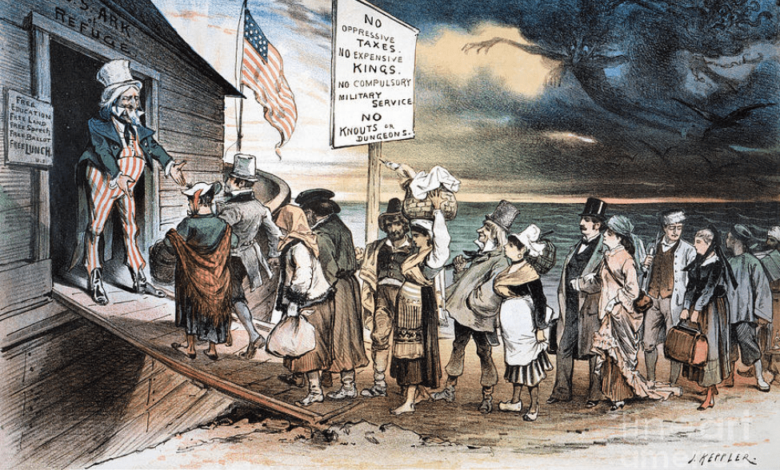
Illustrations, from above: “Welcome to All” pro-immigration cartoon, from Puck, April 28, 1880; A plaque erected near Franklin K. Lane’s birthplace in DeSable, Prince Edward Island; Warren G. Harding meets with foreign-born New Yorkers at the White House inviting him to the America’s Making Exposition (Daily News, Nov 5, 1921); America’s Making poster reprinted in The Book of America’s Making Exposition (City and State Departments of Education, 1921, Smithsonian Libraries); and the cover of The Book of America’s Making Exposition.
Source link