 Economic history is a tale of bubbles and booms in which assets such as commodities, land, or stocks, quickly inflate in price above their intrinsic value. Such sudden movements, driven by greedy investors and speculative hype, are invariably followed by a bust. Loss of confidence causes a collapse in prices, resulting in a crash of “panic selling.”
There are many such examples, most of them well-documented. Tulip-mania in the Dutch Republic during the 1630s was the first real financial bubble. Then there were the Mississippi and South Sea Bubbles (1720), both followed by a spectacular crash. More recently, we have seen the Dotcom Bubble, driven by mad speculation in internet-based stock.
While the assets may change over time, from tulips to technology, the factors of greed and fear are the ever-present psychological drivers of economic upheavals. Of all the bubbles known to historians, the “Plume Boom” is one of the more obscure tales.
Feather & Fan
Feather fans in Chinese culture date back to ancient times. The fan’s original use was functional as a cooling tool in the heat. The addition of bird feathers brought a level of elegance. Dignitaries began to carry feather fans as a sign of rank and status.
Once introduced to Japan from China, fans became part of the nation’s culture. They appeared in stage performances, helping to create visual and auditory effects (the fluttering of wings or the swaying of trees) to heighten the dramatic impact.
Feather fans arrived in Europe in the sixteenth century through expanding contacts with China and Japan. These early fans, made of ostrich or peacock feathers, were regarded for their exotic beauty and restricted to Royalty and aristocracy.
 In England, they became fashionable during the Elizabethan era. In most painted portraits of Queen Elizabeth I, she holds a “fixed” fan (a fine handle with a variation of feathers). Originating in Japan, folding fans were developed later; by the end of the century, they had superseded fixed fans.
During the Renaissance and Baroque periods, feather fans enhanced the non-verbal theatrics of court life. A fan relayed secret messages on a “language” of over two dozen gestures (leaflets to master the code were available).
Holding it to cover one’s face showed shyness, fanning oneself vigorously signaled irritation. Fans were used to flirt or show contempt; their color was imbued with significance. White symbolized purity; red stood for passion; black represented mourning.
France was the center of éventaillistes (fan makers and designers) during the seventeenth century, and the craft involved Huguenot specialists. Following the 1685 Revocation of the Edict of Nantes, many Protestant artisans fled the country, taking their skills of silk weaving and other decorative arts to England and elsewhere.
Refugees boosted high-quality fan making in Spitalfields, East London, and turned the craft into a thriving enterprise of family-run firms. François (Francis) Chassereau and his descendants were prominent fan makers, running The Fan & Crown in Hanover Street, Long Acre, throughout the eighteenth century.
 Funerals, Fashion & Feathers
In the sixteenth century, men used feathers to symbolize status and rank, notably in court attire and military regalia. Ostrich feathers adorned cavalier hats and military plumes. By the 1660s, French courtiers wore small hats adorned with feathers.
Military regiments used them too. The Scottish Highland Infantry worn a “feather bonnet” from about 1763 until the outbreak of World War One (now mostly worn by pipers in regimental bands). In the late Victorian era elaborate “fluffy” plumes were in vogue. They became an essential part of lavish funeral processions.
At the funeral of Arthur Wellesley, 1st Duke of Wellington, in September 1852, twelve black horses pulled a massive hearse, each sporting a plume of black ostrich feathers.
 Their inclusion in the parade determined Victorian funereal customs. English mourning rituals were copied in the United States with the death of Abraham Lincoln.
After lying in state at both the White House and the Capitol, the President’s body was returned to his native Springfield, Illinois. The funeral train stopped in eleven cities along the way (including Albany).
The procession in New York City on April 25, 1865, was a massive event, drawing some one million people. The procession moved up Broadway to Union Square and then to the Hudson River Railroad Depot, featuring sixteen grey horses carrying large ostrich plumes pulling the hearse.
The fashion trade was by far the biggest market for ostrich feathers. In the 1860s the French elite began wearing colored feathers on hats, dresses, jackets, and boas. Where Paris went, the world followed and soon the demand for ostrich feathers outstripped supply.
Up until that time, ostrich feathers sold on the London market were plucked from wild birds hunted in South Africa and across the Sahara (until the “Arabian” ostrich was driven to extinction by excessive hunting). Live plucking was a particularly cruel process.
 Pushed by the demand for feathers, farmers at the Cape began to domesticate the ostrich, plucking the bird twice a year without harming it. Experiments began in the Oudtshoorn region.
The invention in 1869 of incubators to hatch chicks was a breakthrough and the number of specialized farms expanded rapidly. By the 1880s ostrich feathers had become South Africa’s fourth largest export after gold, diamonds, and wool. Some traders built opulent properties, known as “feather palaces.”
London became the focus of the feather market. Huge crates would arrive each week from the Cape in addition to a smaller number of the Arabian subspecies. Warehouses owned by the East India Company at Cutler Street and Billiter Street, East London, displayed the wares for merchants to inspect before being auctioned in sale rooms at Mincing Lane. Feathers were big business.
Status & Elegance
In December 1882, a herd of twenty-two ostriches were sailed into New York Harbor, having arrived from Cape Town.
These creatures were the sole survivors of two hundred birds that had been sent to sea by Charles Sketchley, a South African ostrich exporter who had decided to expand his operations into America, thus avoiding the cost of shipping and skip the twenty percent duty charged on foreign feathers.
Once disembarked, the birds were loaded on a train destined for Anaheim where Sketchley had founded the California Ostrich-Farming Company, the nation’s first farm of its kind.
He did attract attention. The farm became a national curiosity, drawing journalistic reports in The New York Times, Harper’s Weekly, and Scientific American. Competitors rushed to set up their own farms throughout the southwest.
The economic future was an ostrich. The plume trade thrived as it stopped the slaughter of wild birds that had sparked the creation of the Audubon Society and the eventual passage of the 1918 Migratory Bird Treaty.
 Ostrich feathers represented status and elegance in American society. By the 1890s, stylish women wore hats, boas and fans adorned with elaborate feathers. Dyeing them had become an art form.
Manuals such as Alexander Paul’s The Practical Ostrich Feather Dyer (1888) set out methods for creating an extraordinary variety of colors including lemon, salmon, bronze, lavender, and olive, as well as more exotic tints such as gendarme blue, Russian green, Bismarck brown, terracotta, or seafoam, transforming natural feathers into fashion items.
The Plume Boom did not last as fashions changed. By the time of World War One, the price of ostrich feathers had plummeted, the market crashed, most farms went bust, but the ostrich would make a return in Montmartre and on Broadway in the post-war era.
Fan Dancers
Once the Great War was behind them, Parisians rebounded in a carnival of hedonism, an era referred to the années folles (crazy years). The period coincided with an influx of young Americans who embraced the city’s permissive morality and creative energy.
Feather fans became symbolic of those flamboyant years, blending luxury with the theatrical style of the flapper generation. Women carried fans attending jazz clubs, cabarets, or evening parties.
Fashion, feathers, and performance were in interlinked. So-called “fan dancers” used them as a means of revealing and concealing (hide-and-seek) body parts during their routines.
Parisian houses set the trend and manufactured refined and dramatically sized fans. Founded in 1827, Jean-Pierre Duvelleroy had revived the fashion after the French Revolution, becoming a supplier to European Royalty, including Queen Victoria.
Known in the 1920s for its Art Nouveau designs and creative collaboration with artists, the firm re-established its prime place in the industry.
On September 15, 1925, young Josephine Baker joined twenty-five black performers (thirteen dancers, twelve musicians) who set to sail for Cherbourg on Cunard’s SS Berengaria. Rehearsals for their Revue Nègre took place during the crossing.
The show opened at the Champs-Élysées on October 2nd and was a smash hit. Dancing with Senegalese partner Joe Alex, she performed a “Danse Sauvage” (wild dance) in which both performers were scantily clad with ostrich feathers and beads.
 Dancers like Los Angeles-born Faith Bacon (1910-1956), who had begun her career in Paris, used large white plumed fans for her dramatic performances. Having returned to New York late in the decade, she appeared on Broadway in July 1930 as a “principal nude” in Earl Carroll’s revue Vanities.
The latter’s indifference to legal boundaries landed him in court several times on charges of public indecency which offered added publicity to his theater at 753 Seventh Avenue. The Feather Fan became synonymous with Broadway’s art of the burlesque.
As the moral climate changed, censorship in the late 1930s forced these “naughty” shows off stage.
While Manhattan stayed a hub of cultural innovation, the prevailing mood was one of anxiety and caution which filtered through to stage and screen productions. Even Broadway stuck to a restrictive moral code that called for traditional values, conservative policies, and a regime of law and order.
The immorality of feather fans was no longer tolerated. By 1937, Mayor Fiorello LaGuardia had ordered the closure of major burlesque houses, classifying them as “filth.” It finished off the feather fever.
Read more about New York Fashion History.
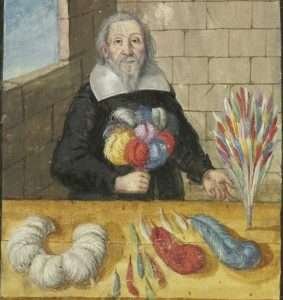
Illustrations, from above: Unknown artist, Portrait of the featherworker Johann Wurmbein, Nuremberg, 1667 (Stadtbibliothek im Bildungscampus Nürnberg); Marcus Gheeraerts the Younger, “Queen Elizabeth I,” ca. 1592 (National Portrait Gallery, London); William Lockhart Bogle painting of Piper Kenneth MacKay at the Battle of Waterloo in 1815, with feather bonnet; Funeral car at the Duke of Wellington’s funeral with feathers, 1852; Advertisements for ostrich feathers in the Millinery Trade Review, vol. 30, 1905; A selection of feathers from Alexander Paul’s The Practical Ostrich Feather Dyer (1888); and Faith Bacon posing with her ostrich feather fans.
Source link