 The Ken Burns documentary film Henry David Thoreau is airing on PBS. This renewed focus on Thoreau’s life provides an opportunity to present an excerpt of Ed Zahniser’s speech “Wilderness and Our Community of Life,” delivered at Vassar College on March 31, 2004.
Novelist Andrew Lytle writes that prophets do not come from the city promising riches and wearing store-bought clothes. No, prophets have always come from the wilderness, stinking of goats… and telling of a different sort of treasure. Wendell Berry writes that “if change is to come, it will come from the margins… It was the desert, not the temple, that give us the prophets.” And in Hebrew scripture, as in New Testament Greek, the words we translate as desert and wilderness are the same word.
This prophetic role of wilderness experience – how wilderness can call us back to right relationships, to right living, to social justice – this prophetic role of wilderness also figures in the history of the Wilderness Act of 1964. For this we step back to the Transcendentalist reformers Margaret Sarah Fuller, Ralph Waldo Emerson, and Henry David Thoreau.
[My father, Howard Zahniser] was a lifelong student of Emerson and Thoreau. He served as president of The Thoreau Society for the 1956-57 term. One of my father’s public school teachers had her students memorize an Emerson quotation every week.My father’s focus eventually shifted more toward Thoreau, who has since perhaps eclipsed his friend and mentor Emerson in the popular imagination.
It was Thoreau who, in his 1862 essay on “Walking,” inscribed the Zen koan-like rallying cry of conservation that… “in Wildness is the preservation of the World.” In his book Walden, in his books Cape Cod, and The Maine Woods, and in his millions of words of the journals, Thoreau meditates on the necessity of wildness.
Wildness as necessity, not luxury. And isn’t it intriguing how Thoreau does not say we preserve wildness. He says wildness preserves the world.
And for Thoreau, who read French German, Latin and Greek, this word world is the Greek word kosmos, meaning not only world but also beauty, pattern, order… in Wildness is the preservation of the World, Beauty, Pattern, Order.
Until Women’s Studies took hold, Margaret Sarah Fuller was far less known than Emerson and Thoreau. Some now credit Fuller as the greatest Transcendentalist thinker, however. She was the great aunt of the wildly inventive R. Buckminster Fuller.
Margaret Fuller’s book Woman in the Nineteenth Century may be, still, the best statement on that subject. She edited the Transcendentalist magazine The Dial. She was the first female book reviewer for a New York newspaper. She was a thoroughgoing reformer.
Fuller even went to Europe to take part in the Italian republican revolution. She died in a shipwreck just off the U.S. coast coming back to America. Emerson asked Thoreau to go look for her body and effects, her book manuscript on the revolution. None was found.
Margaret Fuller is intriguing for Wilderness Act history because her 1840s reform agenda so uncannily prefigures the legislative agenda of Hubert H. Humphrey in the 1950s.
Margaret Fuller advocated American Indian rights, ending slavery, women’s suffrage, women’s rights, education reform, rehabilitation of women prisoners, and valuing nature.
Fuller’s reform agenda and Senator Humphrey’s legislative agenda – of which the Wilderness Act was one important element – show that wilderness is not at the periphery of society but is a core concern of a whole society, holistically construed.
Fuller and Humphrey’s agendas round out the truth of Thoreau asserting that “in wildness is the preservation of the World.”
The Wilderness Act was part of Senator Humphrey’s legislative package that included the National Defense Education Loan Act, Voting Rights Act, the landmark Civil Rights Act, and other laws that came to fruition as the Great Society program of the 1960s.
Wilderness and wildness are necessity, not peripheral luxuries of a holistically construed society.
Bob Marshall, who was Jewish, early fought for access to wilderness as a minority right. Bob also fought for a fair shake for labor and other social justice issues.
On his death at age 38 in 1939, one third of Marshall’s estate effectively endowed the Wilderness Society. But two thirds went to advocate labor and other social justice issues.
To me this underscores how Congress declares the intent of the National Wilderness Act to be “for the permanent good of the whole people.”
Wilderness and wildness are integral to what Wendell Berry calls “the circumference of mystery.” Wilderness and wildness are integral to what poet Denise Levertov calls “the Great Web.” Wilderness and wildness are integral to what the Rev. Dr. Martin Luther King calls our “inescapable network of mutuality.”
Wilderness and wildness are integral to what God describes to Job as the circle on the face of the deep. Wilderness and wildness are integral to the biosphere, to that circle of life, which is also this circle of life, our circle of life, our full community of life on Earth.
The prophetic call of wilderness is not to escape the world. The prophetic call of wilderness is to encounter the world’s essence. John Hay calls wilderness “Earth’s immortal genius.” Gary Snyder calls it the “planetary intelligence.”
Wilderness calls us to renewed kinship with all of life. In Aldo Leopold’s words, “we will enlarge the boundaries of the community, we will live out a land ethic only as we feel ourselves a part of the same community.”
By securing a national policy of restraint and humility toward natural conditions and wilderness character, the Wilderness Act offers a sociopolitical step toward a land ethic, toward enlarging the boundaries of the community.
Ed Zahniser’s lecture was republished in full in The Forest Preserve, the magazine of the Association for the Protection of the Adirondacks, Oct. 2004.
Read more about Henry David Thoreau and Transcendentalism.
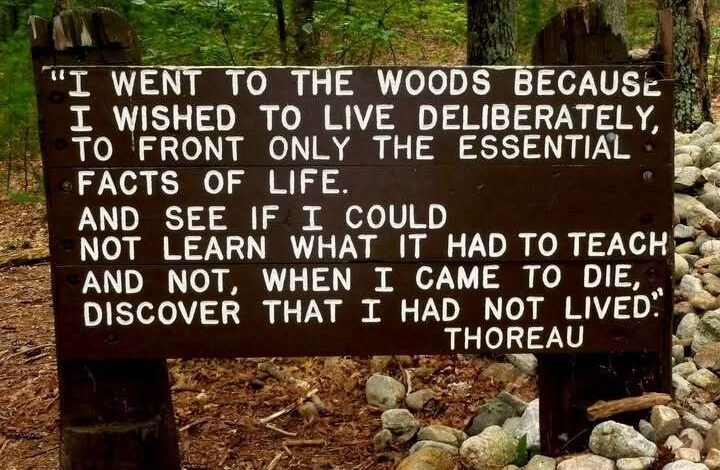
Photo: Henry David Thoreau quote on a sign located near the site of Thoreau’s cabin at Walden Pond in Concord, Massachusetts.
Source link