 History is often kindest to people who leave something permanent behind — a building, a business, a name etched onto a marquee. Their legacy remains visible. But those who built careers around live entertainment worked in a far more fleeting medium. The worlds they created existed in sound, light, energy, and memory, disappearing almost as quickly as they arrived.
Harry Altman (1890-1966) was one of those people: a once-prominent Buffalo nightclub owner and entertainment promoter whose name has largely faded from New York’s cultural memory, despite decades spent shaping the nightlife of Western New York.
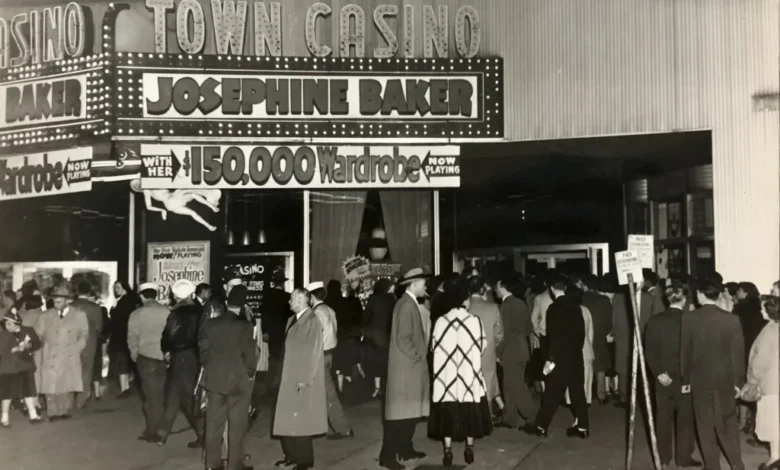
From the 1940s through the 1960s, Altman operated the Glen Casino in Williamsville and the Town Casino in downtown Buffalo, venues that attracted nationally known entertainers including Josephine Baker, Sammy Davis Jr., Vic Damone, Jayne Mansfield, Johnnie Ray, and Al Martino.
At their peak, the clubs were prominent enough to receive regular attention from entertainment columnists and trade publications across the country. Yet today, many longtime Western New Yorkers know the Glen only as a park, while the Town Casino building has passed through many incarnations within Buffalo’s theater district.
When the music stopped decades ago, the man who helped build that world faded with it. That disappearance from the historical record became part of what drew me to Altman’s story. The project began not in an archive, but during a winter walk through Glen Park in Williamsville.
The amusement park that once shared space with the nightclub had been part of my childhood memories, though by then it was already in decline. What stayed with me most was walking past the burned remains of the old Glen Casino with my father after the 1968 fire that destroyed the building during its brief rock-and-roll era as “The Inferno.”
Years later, when I began researching the site’s history, I discovered something surprising: Altman barely appeared in the local historical narrative at all. That absence became nearly as compelling as the man himself.
 Altman’s life reflects several important New York stories at once, including immigration, urban entertainment culture, Jewish assimilation, working-class leisure, and the rise and collapse of regional nightlife before television and Las Vegas permanently reshaped American entertainment habits.
Born to Eastern European Jewish immigrants on Buffalo’s East Side, Altman grew up in one of the city’s dense immigrant neighborhoods, where Jewish storefronts, kosher markets, and tightly connected family networks helped newly arrived families adapt to American life.
He left school after the eighth grade and eventually found work in Gloversville, NY, then the center of America’s glove industry.
His early adulthood coincided with a period when New York State still supported a thriving network of regional entertainment circuits stretching between New York City, Buffalo, Chicago, and smaller industrial cities in between.
One of Altman’s earliest inspirations was Buffalo theater impresario Michael Shea, whose vaudeville houses helped make Buffalo an important stop for performers traveling between New York City and Chicago.
Before television centralized entertainment, regional venues were not simply places where culture arrived from elsewhere. Cities like Buffalo actively produced nightlife, audiences, careers, and local celebrity culture of their own.
Altman understood that world instinctively. By 1912, he was already organizing elaborate Mardi Gras-style events in Buffalo civic spaces. Over the next several decades, he continually reinvented himself through dance halls, roller rinks, restaurants, ballrooms, and nightclubs.
Some ventures survived while others disappeared almost immediately, but together they formed the foundation of his education in show business. What emerges from the historical record is not the story of an overnight success, but one of relentless adaptation.
Altman spent years experimenting with whatever form of entertainment suited a particular cultural moment. During the Great Depression and Prohibition years, ballroom dancing became an affordable form of escapism for working-class audiences.
 Later, he embraced nightclub entertainment on a larger scale, eventually transforming the Glen and Town Casinos into a major destination venues.
Importantly, his clubs were never designed exclusively for elites. Like Michael Shea before him, Altman deliberately kept prices accessible for blue-collar patrons while still surrounding them with glamour.
He scheduled late-night performances for second-shift workers who otherwise would have missed the shows entirely, a detail that says a great deal about the kind of entertainment culture Buffalo once sustained.
The clubs offered ordinary people the feeling of participating in something sophisticated and larger than everyday life.
At its height, Altman’s world connected Buffalo to national entertainment culture in ways that now feel difficult to imagine. Celebrities stayed in local hotels, national columnists covered performances, and major acts regularly traveled through Western New York.
The Town Casino was once promoted as one of the most important nightclubs outside Chicago and New York City itself. Yet entertainment history is inherently fragile and much of his career has been forgotten.
Unlike architecture or politics, nightlife leaves behind very little. A performance exists while it is happening and then disappears into memory. Even highly successful venues can vanish quickly once audiences shift elsewhere.
By the 1960s, television and the explosive growth of Las Vegas had fundamentally altered the economics of live nightclub entertainment. Regional clubs struggled to compete as audiences changed and the old business model collapsed.
 Once the marquees disappeared from their buildings, much of the public memory attached to them faded as well. That may help explain why Harry Altman slipped so thoroughly from the historical record despite decades of prominence. His work existed in motion. He built experiences rather than institutions designed to preserve his name.
Researching his story required reconstructing a world through fragments: newspaper advertisements, entertainment columns, business filings, surviving photographs, ticket stubs, and family archives.
Time and again, I found evidence of things that had once been highly visible but were never built to endure. In many ways, that impermanence became the real subject of the project.
We often assume that significance guarantees remembrance, but history rarely works that way. Entire cultural worlds can disappear within a generation if nobody actively preserves them. Buffalo’s nightclub era was one of those worlds, and for decades Harry Altman stood near the center of it.
Susan Fenster is a nonfiction author and historian whose work focuses on New York State and the evolving cultural life of the region. With degrees in history and journalism from Buffalo State University, she draws extensively from archival research, newspapers, business records, and local collections to reconstruct overlooked stories from the past. She has spent more than 30 years writing about Western New York history and lives in Williamsville, New York, near the site of the former Glen Casino.
Her new book, Harry Altman: Buffalo’s Master Showman, explores the rise and disappearance of one of Buffalo’s most influential entertainment figures. Learn more at SusanFenster.com.
Read more about New York’s Nightclub History.
Illustrations, from aboive: Harry Altman’s Town Casino in Buffalo featuring Josephine Baker, April 1951; Altman and Danny Thomas (Brad Altman); the Town Casino’s interior; and Al Martino and Marilyn Monroe at the Town Casino (courtesy the Estate of Al Martino).
Source link