
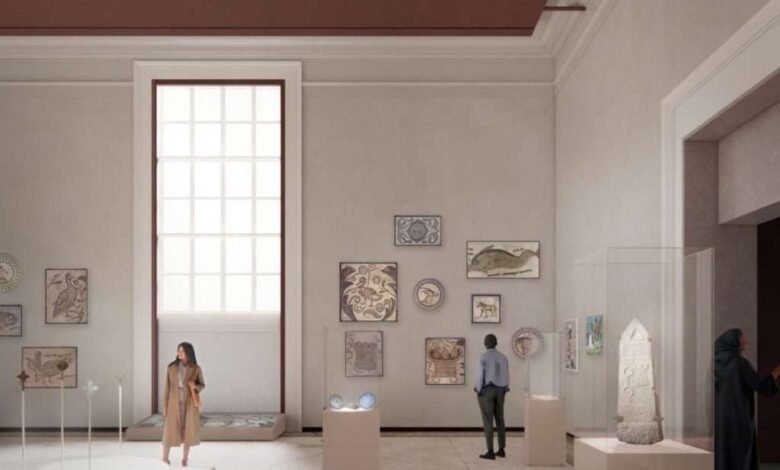
 The Brooklyn Museum is launching a major new project to renovate and design permanent galleries for its historic African art collection, one of the largest and most renowned in the United States.
The revamped 6,400-square-foot galleries, located on the Museum’s third floor, adjacent to the iconic Beaux-Arts Court, is expected to feature an inaugural installation of over three hundred works from antiquity to the present.
The project marks a new milestone for the two-hundred-year-old institution, as it transforms previously underutilized spaces, which served as onsite storage, into galleries that will bring more art on view.
For the first time, the installation will connect with the Museum’s Egyptian art galleries, uniting North Africa with the rest of the continent, offering visitors an expanded and cohesive vision of Africa’s rich artistic legacy.
To realize this vision, the Museum has partnered with the Brooklyn-based architectural firm Peterson Rich Office (PRO), known for adapting established institutions for twenty-first-century audiences, in consultation with Beyer Blinder Belle on historic preservation.
The approximately $13 million project is funded by the City of New York and federal grants, with additional support from the Ford Foundation, the Sills Family Foundation, and individual supporters.
Renovations will begin in summer 2026 and the galleries are expected to open in fall of 2027.
Originally designed in 1893 by the architects McKim, Mead & White, the Brooklyn Museum has undertaken a number of renovation projects in the last twenty-five years, including the comprehensive decade-long transformation of the second-floor galleries dedicated to Arts of Asia and the Islamic world; the renovation of the first-floor Great Hall in 2016; the establishment of the Elizabeth A. Sackler Feminist Center in 2007; the opening of the Visible Storage and Study Center in Luce Center for American Art in 2001; and the major reconstruction of the Rubin Pavilion and Lobby in 2004.
A critical component of this latest project will be the reopening of an original enfilade that once connected the spaces around the Museum’s iconic Beaux-Arts Court.
By removing doors and clearing infilled openings, PRO will restore both the visual sight-lines and historical circulation paths that were once part of the Museum’s 1893 design, creating a continuous loop of exhibition spaces.
History of the Brooklyn Museum’s Arts of Africa Collection
The first works from Africa entered the collection in the early 1900s, making the Brooklyn Museum one of the first institutions in the United States to build a collection of African art.
In 1923, under the stewardship of Curator of Ethnology Stewart Culin, the Museum displayed works from the African continent, emphasizing their artistic qualities rather than treating them as ethnographic specimens.
The presentation was not only groundbreaking for its novel approach to contextualizing African creativity, placing it on the same plane as other cultural collections — a first for an American museum in the twentieth century — but also by being one of the first museum presentations of African art in the United States.
Throughout the century, the collection continued to grow and was featured in various exhibitions, including Masterpieces of African Art (1954–55) and African Art of the Dogon (1973).
Over its one-hundred-year history, the Museum’s holdings have expanded to include modern and contemporary African art alongside historical works. By the late twentieth century and early 2000s, the African holdings covered approximately 2,500 years of history.
Today, the Museum’s Arts of Africa collection is one of the largest and most renowned in the country, comprising over 4,500 objects.
The Brooklyn Museum is located at 200 Eastern Parkway in Brooklyn, NY.
Image courtesy of Peterson Rich Office.
Source link