On a Theatrical Pilgrimage to See Carolina Bianchi and Cara de Cavalo’s Chapter II: The Brotherhood

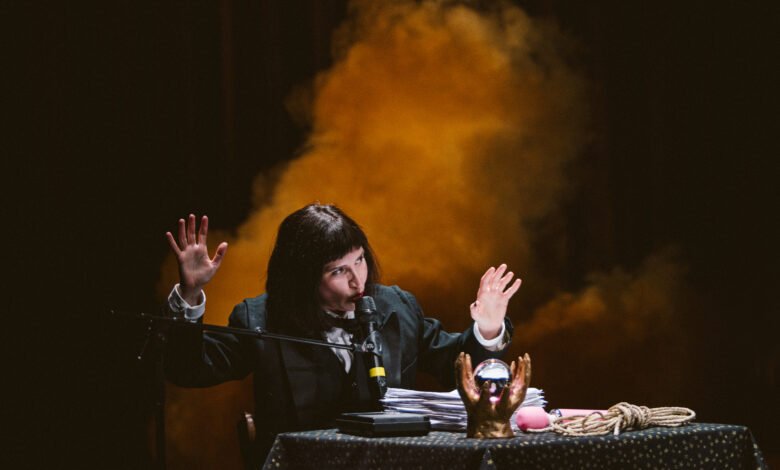
But hope is not the goal. In fact, why should there even be a goal? As declared in The Bride, “F— catharsis.” Here in The Brotherhood, the declaration is “Dirty Pathos.” Forget orienting towards a goal. Instead, immerse in an environment. The scholarly panel turns into a club, rank and foggy. Masked yet naked, the men dance and grind, a combination of seduction and threat, a visual metaphor for the emotions that arise in the presence of misguided masculinity and dangerous patriarchy. In the absence of a goal, the audience does not follow a protagonist or ensemble on a journey of transformation—rather, we sit with feelings that are messy, confused, overflowing. In the inertia, space is created for reflection.
The space allows for examination of these entangled emotions, such as faded admiration for a former artistic hero with a predatory reputation. Bianchi proclaims how she, as a student and young theatremaker, adored Jan Fabre’s work. “I loved looking at that intensity,” she muses, but then later wonders, given the allegations and conviction against him: “Are all of his photos stained?” The theatre that we know and love, The Brotherhood puts forth, is formed through the idea of “Brotherhood,” the fraternity of male bonds and communication. The systems of socialism, capitalism, colonialism, neoliberalism: all Brotherhood. At every turn in these systemic labyrinths, it is the monster that stalks its hostages. But are we prepared to let go of this theatre we know?
“What do you want from theatre, Carolina?” the men on the panel ask, Bianchi herself absent from the stage. I hear the question echo back to me. What do you want from theatre, Amanda?
As I write this, the world feels formless, anxious, and full of incomprehensibility, in no small part due to so much global political violence and economic turmoil. This year, friends of mine around the world and across multiple industries have lost their jobs. My artistic peers and I question why we should make art in such a chaotic time.
I offer that we need not force ourselves to make theatre or write, but that we can channel our uncertainties into self-reflective actions or a journey such as a theatrical pilgrimage. In times like these, we can and should actively seek out the artists and work that stir within us feelings of solidarity, recognition, and power.
Theater can only provide so much. But when I place it in this larger constellation—of travel and place; self-reflection as an artist, critic, and spectator; and the passionate desire to witness the formless take shape—I feel something in the labyrinth.
Travel for a specific theatre artist or experience, especially across oceans, may seem decadent or frivolous. It takes curious alignment of timing, finances, and other social experiences to make a trip feasible. For me, Bianchi’s performance also coincided with an opportunity to meet—in-person, for the first time—Oana Hodade, a Romanian playwright whose work I’ve co-translated with my father, who also happened to be in Paris for a workshop of her work. It was also a chance for me to stay with and visit my family members.
I spoke to other theatre artists about times they traveled far for theatre and found the same sense of alignment. New York and Hawaii-based actress Sienna Aczon described a theatrical pilgrimage she took in 2016 from London to Madrid to see Lorca’s Yerma when she was an exchange student. With a break in classes, a cheap flight, and a desire to see theatre she was passionate about, she found the solo trip empowering and healing. Furthermore, she noted how theatre artists often have an intuition or sensitivity for good timing, and with this kind of intentional travel, “You open yourself up to opportunities as they happen in real time, and that also seems inherently theatre.”
This quality of being open to experiences in real time—and also having the schedule, resources, and social support align in order to plan a journey—seems crucial for countering uncertain futures. Through the physical journey, the traveler can not only test their patience for a new world around them, but be open to transformative encounters. And most importantly, through the traveler’s intuition and intention, they can decide if a trip and the timing constitute a theatrical pilgrimage and, therefore, an embodied venture into self-reflection.
By the time the show ended, the dark park was colder, quieter. I dodged a biker as I walked towards the metro, my mind swimming with images of The Brotherhood and my heart wading through my memories. From one of the many intros, I mentally replayed one of the lines: The love you need is not the love theatre can give you.
It’s true. Theater can only provide so much. But when I place it in this larger constellation—of travel and place; self-reflection as an artist, critic, and spectator; and the passionate desire to witness the formless take shape—I feel something in the labyrinth. The small, strong thread of guidance, held by a feminine presence at the threshold. Tonight’s The Brotherhood has ended. Chapter III awaits.