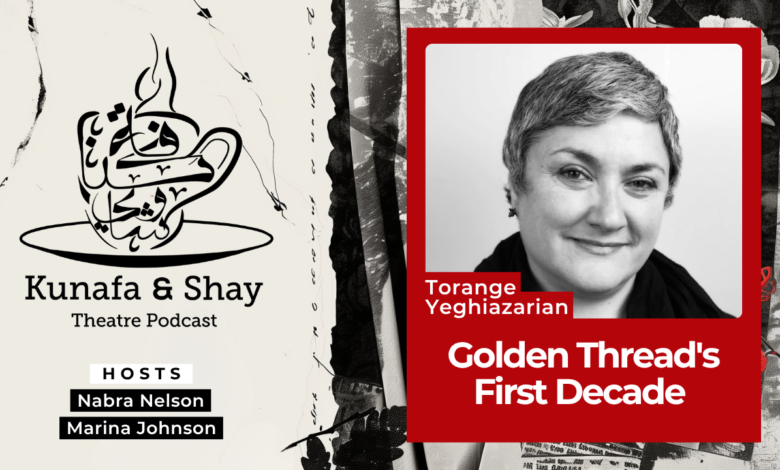
Nabra Nelson: Salam Alaikum! Welcome to Kunafa and Shay, a podcast produced for HowlRound Theatre Commons, a free and open platform for theatremakers worldwide. Kunafa and Shay discusses and analyzes contemporary and historical Middle Eastern and North African, or MENA, and Southwest Asian and North African, or SWANA, theatre from across the region.
Marina Johnson: I’m Marina.
Nabra: And I’m Nabra. And we’re your hosts. Our name, Kunafa and Shay, invites you into the discussion in the best way we know how, with complex and delicious sweets like kunafa and perfectly warm tea, or in Arabic, shay.
Marina: In each country in the Arab world, you’ll find kunafa made differently. In that way, we also lean into the diversity, complexity, and robust flavors of MENA and SWANA theatre.
Nabra: Season six of this podcast marks a double milestone, the thirtieth anniversary of Golden Thread Productions, the oldest MENA theatre company in the US, and my first year as the theatre’s new artistic director. Across ten episodes, we use Golden Thread as a case study to revisit landmark productions from 1996 to 2026, and trace shifting tropes, political urgencies, and aesthetic strategies that shaped the company’s early decades.
Marina: This season also expands to reflect on the past three decades for MENA theatres across the US, not as a closed chapter, but as a living archive, one that illuminates where we’ve been and where we’re headed.
In this episode, we return to the beginning, both to the founding of Golden Thread Productions in 1996, and to the early plays of its founder, Torange Yeghiazarian.
We revisit the works she wrote and staged between 1996 and 2006, tracing how they laid the artistic and political groundwork for what would become the first professional Middle Eastern theatre company in the United States. What did it mean at that moment to insist on complexity, humor, and cultural specificity in a landscape shaped by absence and stereotype? Through these early plays, we glimpsed not just the birth of a company, but the formation of a movement that was scrappy, visionary, and determined to build the stage it needed.
Torange Yeghiazarian is a playwright, director, and translator, passionate about building community through theatre. Her artistic practice reflects her values of radical hospitality and inclusiveness aimed at disrupting stereotypes of the Middle East, both within the community and outside of it. Dubbed the Margot Jones founding mother figure of Middle Eastern American theatre, Torange founded Golden Thread Productions, the first American theatre company devoted to the Middle East, and served as its artistic director for twenty five years, developing visionary programs such as ReOrient Festival, and helping launch the careers of countless artists. Torange’s writing is featured in New Iranian Plays, Middle Eastern American Theatre, Performing Iran, Salaam Peace: An anthology of Middle Eastern American Drama, and Casting a Movement, among others. She has translated works by leading contemporary Iranian playwrights, including Naghmeh Samini, Mohammad Yaghoubi, and Reza Soroor, and adapted to the stage a short story by Iran’s modernist master, Sadegh Hedayat, poems by leading feminist poet, Simin Behbehani, and epic romance poetry by Nizami Ganjavi (Layla & Majnun, published on Gleeditions.com). Torange Yeghiazarian has directed, devised, and collaborated on numerous plays, including original short plays for young audiences. Her articles have been published in the Drama Review, American Theatre Magazine, Amer-Asia Journal, Encyclopedia of Women and Islamic Cultures, and the Cambridge World Encyclopedia of Stage Actors. Torange is a founding board member of Middle Eastern North African Theatre Makers Alliance, MENATMA, and serves on the board of the Consortium of Asian American Theatres and Artists. Torange has been recognized by Theatre Bay Area and Theatre Communications Group. She was honored by the Cairo International Theatre Festival and the Symposium on Equity in the Entertainment Industry at Stanford University. Born in Iran and of Armenian heritage, Torange has a Master’s in Theatre from San Francisco State University, and you can check out her website for more information. TorangeYeghiazarian.com
Nabra: All right, well, thank you so much for joining us, Torange. We could not have a conversation about Golden Thread without talking to you, obviously.
Torange: Hi, thank you so much for having me. It’s always a pleasure to talk about Golden Thread and speak with you, Nabra and Marina.
Nabra: So, take us back to 1996. What was the spark for founding Golden Thread?
Theatre for me has always been that golden thread that helps me find my way through the labyrinth of life.
Torange: So, I was at San Francisco State completing my master’s study in Theatre Arts. The graduation requirement was to either write a thesis or direct a show. I naively thought directing a show would be easier than writing a thesis. So, at the time, one of my master’s seminars was on Greek classics, and I really enjoyed discovering the richness of that whole era, and the poetry of the writing really resonated with me. And then I also discovered the Greek comedies. So, I decided to direct a contemporary adaptation of Lysistrata for my master’s thesis, and that became Operation No Penetration.
For some reason, I can’t tell you why, I thought that essentially saying a company is producing this show would make it more legitimate than just, you know, me producing it. So, I said, okay, well, let’s, you know, I’ll give it a theatre company name and because I was so steeped in Greek mythology, the myth of Ariadne really touched me. You know that myth? It’s about the labyrinth. There is a monster at the end of the labyrinth, a minotaur, and the town has to sacrifice a virgin to this monster every year. And whenever these heroes go to fight the monster, they either get lost in the labyrinth, they can’t find their way out, or they, you know, the monster eats them.
So, Ariadne falls in love with Theseus and gives him a ball of golden thread to help him find his way through the labyrinth. And that really resonated with me because I felt like theatre for me has always been that golden thread that helps me find my way through the labyrinth of life. So, I named the company Golden Thread, and we called it Golden Thread Productions because originally we thought, because, you know, I was in community with visual artists and filmmakers and dancers, we thought that we would, that it would produce not just theatre, but also a variety of art forms.
So, Golden Thread Productions was, like, born overnight. I produced my master’s thesis outside of San Francisco State for two weekends, contemporary adaptation of Lysistrata, which we called Operation No Penetration. In it, Israeli and Palestinian women unite and go on a sex strike to force the men to sign a peace treaty. And, yeah, and that became the beginning of Golden Thread Productions.
You know, 1996 is when the Oslo Accords were happening, and I was a little worried that, oh, there will be peace between Palestinians and Israelis, and my play would no longer be relevant, which, you know, sadly and tragically, we know, unfortunately, that is not the case. Yes, and so, yeah, and, yeah, that’s how we started.
Marina: That’s amazing. And who is the we that you were talking about? So, like, I know.
Torange: So, I was, at the time, I was working in biotech.You know, I studied theatre. I mean, I didn’t, I practiced theatre. I did a lot of different art things, plays, dance, choreography, a little bit of singing, although there were such beautiful singers in my family that they mostly, like, rolled their eyes at me, so I didn’t sing as much. But I loved the arts, the performing arts, and, but, you know, as a sort of an immigrant in the US, I was concerned about financial independence, so I decided to actually get my degree in something that would pay me, that I wouldn’t have to worry about, you know, basically pursue a career that, where I could make money, and so, and I love sciences as well, science and mathematics.
At one point, I wanted to become a doctor. So, anyway, all that to say, I did theatre on the side while working in, as a microbiologist, first at a hospital, and then later in biotech, so I was working in biotech when I went to San Francisco State to get my master’s in theatre, and produced Operation No Penetration, and started Golden Thread while I was working full-time in biotech, and that community around me, some of them folks, my colleagues in biotech, who then became, like, audience members and supporters of Golden Thread also served on the board of Golden Thread, but there were also artists around me, filmmakers, visual artists. My sister was a painter, so, you know, it was a very artistic community.
Marina: That’s amazing. Oh, I love learning this history about you that I didn’t know at all.
Torange: Yes.
Marina: Was there Middle Eastern theatre to speak of at this time?
Torange: Not Middle Eastern theatre, because, you know, as you know, the term Middle East is problematic, and we can get back to that, but at the time, I grew up on the East Coast, so Boston, Boston Bay Area, as opposed to San Francisco Bay Area.
Boston Bay Area, I was involved with the Armenian community and the Iranian community, and I performed in theatre in those communities, in those languages, Persian and Armenian.
And then when I moved to San Francisco Bay Area, there was an Iranian theatre company in the Bay Area called Darvag that has a history that dates back to the 1960s.
And they had, they were still active creating original plays in Persian, in Berkeley, and I knew them from when I was in Boston. I had collaborated with one of their directors in Boston, and so when I moved to the Bay Area, I did, I collaborated with them.
I also performed in an Iranian play or play in Persian, which was a translation of a Dario Fo play.
I performed that in Persian. That was like my first public performance in the Bay Area was a Dario Fo play in Persian. As you probably know, my mom was a famous film star in Iran (Vida Ghahremani). After moving to the US, she moved to LA, and she continued to be active in film, TV, and theatre.
And when I moved to the Bay Area, she also moved to the Bay Area. And it was a colleague of hers, a theatre director from Iran, who then invited, you know, I think she mainly wanted to work with my mom, but she invited me also to be part of the show. So the evening performance, half of it was me performing this Dario Fo piece, and half of it was my mom and then another actor performing an original piece.
Nabra: Did you collaborate with your mum a lot? I know that she was connected with Golden Thread Theatre for a while but before that, can you talk about that collaboration?
Torange: Yeah, yeah, she, in a way, you know, I didn’ t grow up with my mom because my parents separated when I was like eleven. So I reconnected with my mom through theatre, you know, in many ways. That was probably our most intimate and our most loving and fruitful aspect of our relationship was when we worked together in theatre.
So she, my mom designed a costume and props for Operation No Penetration. My boyfriend at the time edited the sound and ran the soundboard.
My sister’s boyfriend built the set. My co-worker at Chiron, the biotech company where I worked, she was the stage manager, and then one of our actors stepped out, so she also did a cameo on stage. And one of my colleagues in Berkeley who was involved with Darvag, she is a choreographer, she choreographed the dance for us.
So, you know, it was, from the beginning, it was very community-based, and I think two or three people who participated, the scenic designer and a couple of the actors were from San Francisco State students.
Nabra: Wow, that’s so exciting to hear. I mean, I didn’t know, you know, so many of the details about Operation No Penetration, but I watched the video of it when it was released recently as video on demand.
Torange: Oh my God, I’m so embarrassed.
Nabra: No, everyone should watch it. It’s so fun. And I was, you know, it is really like raunchy, of course, and provocative. And I’m wondering, what was the reaction by audiences? Like, how did this, I guess, shape the reputation of Golden Thread from the very beginning?
Torange: I was really surprised by how much audiences loved it. We performed it in a church. There was a church, what was it called? Next Stage, I think, was in a church on the corner of Bush and, what, something. I don’t remember the address right now. But it was a very sort of Gothic stone building. And so, you know, it kind of had this ancient feel to it. So I think that really helped, you know, create the ambiance for the show. And also, but the space that they had turned into a theatre, I think, only sat maybe sixty people. And we performed only two weekends, but every performance was packed. And audiences loved it. They, like, they laughed and then stayed and had conversations with all of us. And they wanted to know, like, what’s the next show? But we did get the one review that we got was in SF Weekly, and it was really terrible. It, like, really, you know, it focused on all the technical weaknesses of the show. That it was, you know, clunky. The costume design was, like, terrible. Somebody’s, I don’t know, sleeve was falling off or whatever. Like, there were, you know, she didn’t comment on any of the things that really worked in the show. And some of the actors in the play were really upset by the review. And I think they wrote to SF Weekly. I don’t know what came of it, but they were very upset. But, you know, the review didn’t really impact, like, the second weekend of the run. It was packed. Audiences loved it. They, everybody wanted to know what our next show is and how they could be in touch and all of that. So it was very encouraging.
I was discouraged by the review, of course. You know, so I was depressed for a few months, but then I picked myself up.
Nabra: And what was the next show? And I know that ReOrient started, like, that year, I believe. Everything kind of seemed to happen very quickly that continued to this day. So what happened after Operation No Penetration?
Torange: Well, the company started in 1996, but our first production, which was Operation No Penetration, was in ‘97. It took that long to get all the resources together and be able to put a show together.
Then I, you know, was depressed by the review and I didn’t want to talk to anybody about theatre. But then, like, in a few months, I, you know, missed theatre again. And so, so I did, again, at San Francisco State, I staged an adaptation of a short story by an Iranian writer, Sadegh Hedayat, who’s very famous. He’s, like, the founder of modernist literature in, in Iran, or one of the founders.
I wouldn’t say he’s the founder. But anyway, it was, and so that, that play was called, the name of the short story is The Doll Behind the Curtain. And then my adaptation was called Behind Glass Windows.
It’s about a young man who falls in love with a mannequin, which later became a Hollywood movie, I guess. I don’t know if they read that same short story or not.
But anyway, so that was our, so then I did the version that I directed of Behind Glass Windows at San Francisco State was, I think, maybe about fifty minutes. That’s, we had a program called Brown Bag, where the students would produce their own shows. And, and, and I think it was fifty minutes. Then I, I sort of extended it, added a few scenes, and it became, I think, an hour and a half. That was our second production in 1998, Behind Glass Windows.
And that one was done in Berkeley at what, at the time, was Darwag’s theatre space, which was called, I think, Adeline, Adeline Stage, I think it was called. It was on Adeline Street.
And so then, basically, at that point, then we were talking about, you know, for me, from the very beginning, you know, I’m mixed. I’m Armenian and Iranian. I grew up Christian and Muslim. I speak Armenian and Persian. And, you know, growing up, our household in Iran was filled with artists from all over the world. So we had a very, like, we were exposed to a very worldly culture, you know, many different cultures across the globe.
And, and we had, in our family, we had friends who were all kinds, you know, Baha’is, Zoroastrians, Jews, Kurds, you know, all kinds of folks and wide range of political beliefs.
And so this sense of diversity was always very, it’s sort of innate to me, and it was important to me that that be reflected in Golden Thread Productions. That’s why we chose to call it a Middle Eastern company, not Iranian or Armenian, right?
I didn’t want to perform only for or produce only for Iranians or only for Armenians. From the beginning, it was, for me, it was really important to reflect the diversity of the Middle East and to bring all of our communities together, very much inspired by Asian American theatre movement, Latinx theatre movement, where, you know, people whose roots are in countries that are either in current conflict or historic conflict, they actually, they actually, in the US have the opportunity to come together and collaborate in theatre.
And in the Middle East, we rarely have the opportunity, I mean, certainly Palestinians and Israelis, I guess, they used to have the opportunity to work together. But, you know, even, let’s say, Iranians and Afghans or Turks and Iranians or, you know, we don’t really collaborate.
But here in the US, we all get to, we are here. So we might as well, you know, work together. And so that was, that was important to me. And even though the term Middle East is, you know, a colonial term, we ultimately decided to use it to define our mission, because it has the most recognition in terms of, you know, what the idea of this region is. And, but, you know, from the beginning, we always defined the Middle East broadly and inclusively to include, you know, the Caucasus, the Western Asia, North Africa, all of that.
So that idea of diversity was really important. And, you know, we were like, okay, so if we’re going to be a company devoted to the Middle East, how can we reflect that diversity with just one production a year?
We can’t do that. And that’s, so we came up with the idea of a festival of short plays, so that in one evening, you could experience multiple cultures, multiple perspectives on one stage. So that’s where the ReOrient Festival came about.
Marina: Oh, that’s amazing. And what year did ReOrient start?
Torange: Sorry, I’m coughing. Let me have a little water.
Marina: Yeah.
Torange: I think one of your questions was, when did we decide that this is a company that’s going to last? I think that was 1999. It was the first year that we did a Women’s Day event, and then the first year that we did a Festival of Short Plays.
Both of those events in 1999 had a different name than what ultimately became that program. So the Festival of Short Plays was called Six Plays on Short. And then in 2000, we decided this is going to be an annual festival, and we’re going to call it ReOrient. And then our first Women’s Day event was called From the Inside, which was a collaboration with Taraneh Hemami, with my sister, so visual artists, dancers, theatre performers.
And that was in the East Bay. And for many years, our annual Women’s Day event was our one event that we used to do in the East Bay. But then it became, it grew, the audience grew, and we had to move to a larger venue. So at that point, we moved to Bravo.
Marina: Wow. I think it’s so telling that these events, like the Women’s Day event, this Festival of Short Plays, began and are still continuing now. Different names, but really the same impetus, like really putting women center, showcasing the different aspects of the Middle East, that there’s not this monolithic, quote, like Middle Eastern identity of any kind. That’s really beautiful.
Torange: Yeah. And sorry, Women’s Day, I mean, you know, I’m sure you have experienced this: you know, in the US, they’re constantly talking about how oppressed and silent or silenced Middle Eastern women are. And I find that really frustrating because, you know, nobody in my family or the women around me, none of them were oppressed or silenced.
I mean, some had marital problems, but, you know, nothing like systematic, you know, oppression. And so especially the women in my family are all pioneers, you know, in education, in the arts. And so it was important to me to really, again, reflect that.
It’s partly a reaction to the, and I guess in so many ways, what we do at Golden Thread or what we did at Golden Thread is really a response to the stereotypes that dominate mass media in the US and the goal of countering those images and presenting alternative images and voices.
Marina: Yeah, it’s incredible that this is still a continuing problem. I mean, even now, people are talking about, well, we have to bomb them to save the women. What? That is not a sentence that should ever be uttered.
So very frustrating to see that those problems continue, but heartening to see that the responses, you know, the Women’s Day event always has a huge turnout because people want to see what women are saying. And there’s been this showcased event at Golden Thread since the beginning.
Torange: And it’s our one event that, you know, that is dedicated to women, but in terms of artistic discipline, it’s more expansive. So it includes film and music and dance in addition to theatre.
Nabra: And it seems like your, the aesthetic of the company was really rooted in this multiculturalism and also some multidisciplinary elements, like What Do the Women Say? And ReOrient kind of making sure that there’s expansive representation.
Was there anything else in the nineties that you were really consciously building as the aesthetic for this company, or was it more about urgency or survival or responding to the moment?
Torange: We were responding to the moment in the sense that, you know, these stereotypes were dominating the media. So in that sense, we were responding to the moment. But, more than anything else, what was important to me was to share our stories and to share our voices. One of the things that, you know, in the US, like I came to the US when I was fourteen. Within a few months, the US hostage crisis happened. Iran was on the news every night. Yet nobody, none of my neighbors knew where Iran is, who Iranians are. They didn’t know the difference between Iran and Iraq, or not even like Iran and Egypt. Like they didn’t know, you know. And that’s like mind-boggling to me because we live in a country that, you know, has the biggest military, biggest budget, most influence in terms of global politics, such direct political involvement in the Middle East, Middle East and North Africa. And yet the people who in this country, the citizens who actually vote and, you know, ostensibly elect their leadership, they are not knowledgeable about these countries that are so deeply impacted by their vote.
And they don’t even know, they don’t realize that their vote has that power. They’re not just voting on like domestic issues. They’re voting on international policy. And, you know, if you don’t know, you know, if you’re bombing Afghanistan and you can’t even find it on a map, I mean, really, you don’t have the right to be involved there. Why are you there? What do you know about those people? And so in that sense, Golden Thread was very much responding to this lack of, you know, knowledge, lack of engagement.
And I wasn’t interested in like educational, like lectures and things. I wanted stories because I think stories, personal stories, human stories are the most powerful instruments of change and emotional impact. So that’s where I invested my energy.
Nabra: Yeah, that deeply resonates with me as well. I really see art as culture change. And you’ve articulated so beautifully how it is culture change. If the general population does not know our stories and our people at a human level, then how are we supposed to make policy changes or legislative changes or voting changes in any way, shape or form? It’s so necessary to shift those conversations on that level of story and human interaction.
Torange: Yes, absolutely.
Nabra: And of course, I mean, a huge shift must have happened after 9/11, as it did across our communities and even in communities adjacent to our communities. So can you talk about that shift and how in the early 2000s, Golden Thread really, you know, responded, I guess, or if the, how the art maybe changed and what was really difficult and necessary at that moment?
Torange: The thing that changed was that we became more visible. Before that, we were pretty invisible. We were pretty much like, you know, the thing about San Francisco theatre is that you can do anything, but nobody knows about it. But you have all this freedom to experiment and the community is very supportive. But at the end of the day, really, you know, it’s very difficult to be San Francisco-based and have national impact and have national visibility. And what 9/11 did was it brought national visibility to our company because as far as I know, that year in 2001, we were the only Middle Eastern arts organization that moved forward with our programming.
The Arab Film Festival canceled, the other ASWAT Choir canceled. But we, ReOrient Festival was scheduled to open in October and we, you know, had a company meeting and had a conversation and decided to move forward because we felt like, in fact, it’s times like this that this work is, you know, really needed and most necessary. A couple of the actors left the company at that time. One of them was afraid for his personal safety. Another one lost a sister in the towers. So we replaced them and we moved forward with the festival. The opening night of the festival in 2001 coincided with the US bombing Afghanistan. And we dedicated that performance to Afghanistan and the people of Afghanistan and opened with an Afghan music ensemble performing that night before the actual theatre performances.
When we decided to move forward, we reached out to the theatre community in the Bay Area, theatre companies, our fiscal sponsor at the time was Intersection for the Arts, Theater Bay Area.
We reached out to them and asked for letters of support for the company. We also talked to San Francisco Police Department and said, we’re doing this. Can you, like, have some, I don’t know, patrol cars in the neighborhood in case something happens? Because people were reporting, you know, attacks on Middle Easterners, attacks on Middle Eastern cultural institutions. So we, you know, it ended up being one of our most successful, definitely to date, the most successful event that we had done. The whole theatre community in the Bay Area rallied behind us and we had no, you know, no negative incidents that happened that year.
That was, I think, that was, I think, the year that we also had more post-play conversations with the audience. People wanted to stay. There was a need for community, to be in community, to support each other. That the element of dialogue became even, or the need for dialogue became more palpable, I think, starting in 2001. And also, the thing that happened to me was that, you know, the New York Times called me and asked for, like, my comments on 9/11. And, you know, I’m, you know, I’m from Iran. Like, in Iran, we talk politics all the time. And, I don’t know, I guess some people self-censor. Well, I don’t. And so, I said to this journalist, I said, well, you know, the US built up the Taliban and armed the Taliban and trained the Taliban. And now, the Taliban is behaving in a way that you’re not controlling and you’re, you know, sort of crying wolf in a way.
And she was very upset by my comment. And I don’t, and the New York Times has never called again. So, and, and what that, what that showed me was, was this challenge that we have in the US, which is, and maybe this happens in all countries, I don’t know. But, you know, this audience, as long as you give them what, what reflects what they already know, and what, what their opinion already is, then it’s all good.
But when you challenge that perception, and you challenge that opinion, that, then people get really defensive. And, and so, and so that, that, that continues to be something that, you know, it continued some, that continued to be something that we needed to manage at Golden Thread.
By 2003, the ReOrient Festival in, so what happened also, we didn’t, we didn’t put out a call to playwrights to say, you know, what is your response to 9/11? But organically, what happened was that playwrights started reflecting on 9/11, on the Patriot Act, on the aftermath of 9/11, US’s invasion of Afghanistan, US’s invasion, invasion of Iraq. And these plays started coming to us, especially short plays that were, you know, were responding to the situation.
And so, like, in 2003, we had, we, like, it was such a rich year that year, ReOrient Festival, really diving deep into the war in Iraq. And, with the difference being, you know, our plays, you know, our stories are told from the perspective of the people in the Middle East.
To this day, there’s really very little cultural production in the US that reflects the experience of anyone outside of the US. Like, all the movies that were made about US’s involvement in Iraq are from the perspective of, like, you know, American soldiers. And, you know, great, that’s valuable. But there’s, like, this whole other side of the story that we never, you know, we never learn about in our popular media.
Sorry, I went on and on.
Marina: No, I mean, that was incredible. And I think, I mean, I’m, just as a side curiosity, did the New York Times run your comments?
Torange: I think they did. I think they called me something that I will not repeat, but I don’t know. It was, it wasn’t complimentary.
Marina: I’m sure, but I have so much respect for you. And just the way you were. Actually, here’s a history lesson on your country for you really quickly.
Torange: Yeah, I mean, now people actually know that history and maybe they’ve forgotten, but, you know, I think it did come out that the, you know, US’s relationship with the Taliban or, you know, like, and it’s not unique to the Middle East. Like, think of Central America. You know, what happened with Guatemala and El Salvador and Nicaragua. It’s like, you know, please, people, or even Vietnam. Like, why don’t we know our own history? It really bothers me.
Marina: No, it’s a great point. Well, so sometimes what we’re talking about is a little bit of like the fact that you continued the mission sort of regardless of what was happening or because these things were happening, the community was really needed.
Yeah. But sometimes that affects funding. Did it affect funding for you? How was Golden Thread securing funding in these early years? And how did that reflect or shape the choices that you were making?
Torange: I mean, it may have affected funding. I don’t know. We had a, we had a, we very quickly secured funding from California Art Council and some local San Francisco foundations.
And, you know, basically, I think our first individual fundraising was maybe in 2000 or 2001. So we started sort of cultivating local philanthropy among our, in our community and, and individual donors. Um, but our budget, you know, stayed around two hundred thousand for many years. Um, and I wasn’t able to pay myself till 2003. 2003 was the first year that I actually wrote a grant for my own salary. And that, uh, by that time I had already stopped working in biotech while full time. And then I got a part-time job in biotech for a couple of more years, but, um, but, you know, I sort of committed to, uh, committed full time to Golden Thread. And that required me being able to pay myself a salary. We moved into an office that was a shared office space, um, spearheaded by Z Space, which, uh, was a new play development center at the time.
They weren’t producing at the time.
They were just developing plays and this shared office space, Z Space was like the main leaseholder, but there were all these small theatre companies sharing offices and rehearsal space and, um, a conference room.
Um, and that we started, you know, supporting each other. We shared funding resources, we shared, donor cultivation practices, we shared, um, I don’t know, new play development commission resources. Um, so that lifted, Golden Thread a bit.
And it also made us a little more visible because, you know, that may, maybe still is a, is a challenge when you’re culturally specific, the general population, including other theatre companies, may not think of you as relevant to them necessarily.
So by moving into that shared office space and interacting with a bunch of other theatre companies, we got to know each other and we got to develop an appreciation for each other artistically, operationally, and all of that. So that was in 2003, that was a bit of a, you know, uh, positive shift, I think I would say for the company. Um, still, we did not have access to a lot of national funding, I would say. And I can’t tell you if that’s because of our politics or just small size or remoteness or what.
And of course, you know, so much of philanthropy is led by the Jewish community, which tends to be the most liberal and the most progressive and a major supporter of the arts. And there were some Jewish foundations that had issues with, with our, with our politics and refused to fund us, but they were open about that and, and we understood, and it was fine.
We didn’t, you know, there were others who supported us, so it didn’t really, yeah, I don’t know. It wasn’t an issue, but access to national funding, I think didn’t happen until maybe a grant from TCG or something kind of lifted us up.
Nabra: And then regarding the national landscape and how you were positioned at this time in the early 2000s, other MENA theatre companies and collectives were started popping up. We have Silk Road and Noor, of course and Arab American Theatre Works came a little bit later. Um, but also like Nibras and the, uh, Arab comedy festival in New York, there seemed to be a lot of activity there.
Were you also in collaboration with them in any way or in conversation? What did Golden Thread look like in the national conversation about MENA theatres?
Torange: So the idea of Middle Eastern American theatre was really born with Golden Thread. There was no Middle Eastern American theatre. In fact, when we adopted that mission, people laughed at us. They’re, they’re like, what? There’s no theatre in the Middle East. There is no Middle Eastern American theatre. So, you know, we had to not only prove that to them, but also prove it to ourselves.
Nibras and, uh, I was in touch with the actors in Nibras and I was in touch with the Arab Comedy Festival because we reached out to them about ReOrient and they did submit some short short plays to ReOrient festival.
I think we produced, I want to say maybe two pieces that came from the Arab Comedy Festival. I developed personal relationships with some of the artists in Nibras who I think they formalized themselves after 9/11. Silk Road was founded in 2002. So they also, in response to 9/11. And Noor was founded in 2010.
So Lameece actually emailed me and said they’re, they want to start a company and they’re sort of, they’re adopting Golden Threads’ mission. And I, you know, wished her luck and we, you know, stayed in touch and were very much engaged, especially because in 2010 we developed a partnership with Silk Road and the Lark.
So Silk Road in Chicago and the Lark in New York, the Middle East America National New Plays Initiative.
And at that point we invited Noor to, you know, participate in some of our gatherings and convenings in New York. They were also doing, like, their forty-eight-hour festival, so we, you know, supported that. So yeah, we have definitely had a relationship, but Noor didn’t have the resources for a co-production. With Silk Road, we, Jamil and I, it turns out, had, had very different artistic tastes. And Jamil, so anyway, they, I, you know, we, in theory, we wanted to do more co-productions, but I think Night Over Erzinga is the only play, which was the Night Over Erzinga was the first Middle East America awardee and the first commission of that program.
And it, and I think still is the only play that our two companies partnered on.
Nabra: And when was that?
Torange: The actual, the program was launched, I think, in 2010, 20, no, the program was launched in 2008, before my sabbatical, and the production of Night Over Erzinga was in 2011.
Marina: Well, and so talking about the new play initiative, I mean, I think, especially in the early years, you were writing a lot of the plays, uh, I think you said that Yussef El Guindi was part of, um, writing some of the plays for the, the first decade or so.
Can you talk about the process of, was it commissioning these plays, or were you writing in collaboration with the ensemble that you were working with?
Torange: Uh, so I was you know, what, once we started getting plays from Yussef, I think we stopped producing anybody else’s work because his writing blew me away. And it was so of its time in terms of really depicting the mindset and experience of the Arab American male in, in the US post 9/11.
Um, so, once I, you know, once Golden Thread was thriving and I, you know, the, the job of running a theatre company, Nabra, take note, the job of running a theatre company takes up a lot of your time and brain space, so I didn’t actually have time to write a full length.
So I would write short plays and that became, so the ReOrient Festival really became my only, you know, opportunity for producing my own plays at, at Golden Thread.
I didn’t really, I didn’t really get to finish a full length after Behind Glass Windows, which was in 1998, I think was my last full length play produced by Golden Thread until 444 Days, which was after my sabbatical in like 2013.
So all of those years, I wasn’t actually able, I didn’t have the bandwidth to focus on writing a full length play, and I wrote a bunch of short plays which was great, but, and, and so did Yussef. So the two of us, I think, were, I think Yussef is more produced than me by Golden Thread.
The process was very open. In fact, Yussef, I think, worked as literary manager for us for a few years. But, you know, we had an open submission policy. I read most of the plays and I made the selections.
Some years, some years we had like a team, some years we didn’t, it was a little, it wasn’t very formalized. A couple of years, I think Yussef read a bunch of plays and recommended some. A couple of years, we would have an intern, for example, read plays and recommend or write summaries of. And we didn’t have the, uh, resources to produce so many plays.
We only produced, like, one or two full lengths and then the ReOrient Festival. And even that was, we didn’t have enough funding for, you know, a real like, you know, we paid artists such meager stipends. It was really terrible now that I, you know, look back, it was really, but, you know, people were, were happy for the opportunity and happy to be involved with the company.
And we thought we are doing, you know, a good job. So, again, that, that was the mindset of the time. And Golden Thread was not unique in sort of that practice of really building our theatre company on the backs of our artists, which is what Michelle Mulholland said at one point.
But the selection process was mainly mine, uh, ReOrient Festival, also open submission with the ReOrient Festival, I started sort of collaborating with some of the directors that ended up being like repeat directors in, in selecting the plays.
Nabra: So looking back at 1996, this might be a bit of a selfish question for me stepping into this role, but what is one piece of advice you would give yourself back when you started this company about sustaining a political theatre company?
Torange: Not so much the political aspect of it, but just the practical nonprofit theatre model. I knew nothing about that. I knew how to write a play. I knew how to direct a play. I knew somewhat how to produce a play, but I knew nothing about how to run a nonprofit theatre. I had to very quickly learn how to write grants. I had to very quickly learn how to write a budget, uh, how to do fundraising from individuals. For the, for many years, I was really embarrassed to ask people for money because it always felt like I’m asking for me.
It wasn’t until, like, after our strategic planning when we worked with a fundraising consultant that, I mean, he really trained me to, to think differently and really focus on the company and, and separate myself which is difficult. You know, you’re the founder, so many people relate the company to you, like they, it’s hard for them to separate those two.
So, so those were the challenges for me was really the nonprofit landscape, the nuances of fundraising, especially individual, fundraising from individuals and board development.
Initially, my approach to putting, you know, inviting people to serve on the board was to tell them, oh, don’t worry, you don’t have to do anything. And then people were like, wait, the board has to, you know, use the board to do things, you know, use the board to do your fundraising, use the board to, you know, X, Y, Z, whatever.
But you know, in the early years, my way of working was to try to do all of it by myself. And, you know, I realized much like a play, you know, it’s not a, it’s not a solo thing. It’s a, it’s a collaboration, it’s a partnership, it’s a community. I learned to look at it as inviting people to join our community. I was told that I’m doing people a favor by inviting them and I have to treat it that way. But it, you know, it took me like that took me a long time. You know, in the early years, I kept thinking that people are doing me a favor by helping the company. So, you know, I had to change that mindset.
Nabra: Well, that shift, um, definitely reflects, I think, in where Golden Thread is today. It really feels like a community coming together. There’s so much support. And it feels like the company is integrated into the local community, but also nationally. And so it’s amazing to hear this whole genesis story in the early years, because it does really reflect in how Golden Thread feels today.
So thank you so much for, for taking this time and sharing all of these incredible stories and these insights into that first decade.
Torange: My pleasure. Thank you for the opportunity. Thank you.
Nabra: This podcast is produced as a contribution to HowlRound Theatre Commons. You can find more episodes of this show—and other HowlRound shows—wherever you find podcasts, including on noncommercial open source apps like Anytime Podcast Player for iPhone and AntennaPod for Android. If you loved this podcast, please share it with your friends. You can find a transcript for this episode, along with lots of other progressive and disruptive content, on howlround.com.
Marina: Have an idea for a meaningful podcast, essay, or TV event that the theatre community needs to hear? Visit howlround.com and submit your ideas to this knowledge commons.
Marina and Nabra: Yalla! Bye!