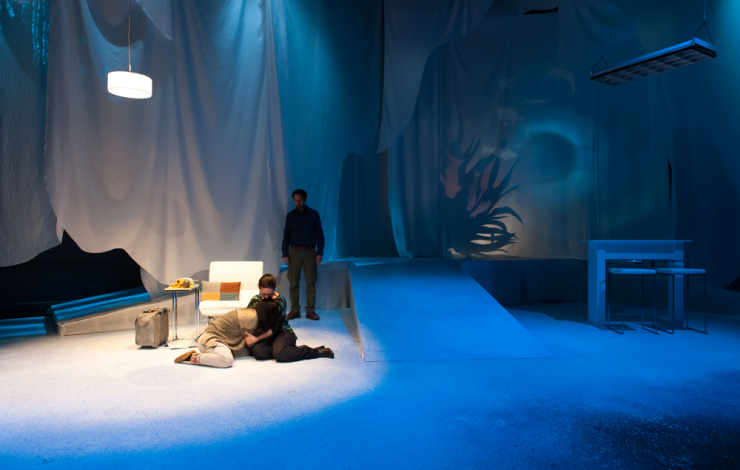
Will these plays magically change the world and set us on a path towards rapid decarbonization and sustainable living? Very unlikely. Aside from Broadway musicals, the theatre has become too marginalized in North America to have a large-scale impact. Are these plays essential tools in our efforts to help communities live with uncertainty, address climate anxiety, become more adaptable, and build resilience? Absolutely. Within our communities is where we can have the most impact. The more stories we tell about these challenging times, the more we put down our phones to engage with one another, the greater our chances of holding those in power accountable and building a more just and sustainable world.
In his transformative book Sand Talk: How Indigenous Thinking Can Save the World, author Tyson Yunkaporta writes:
Stories are powerful tools and can be even more powerful weapons in the hands of malignant narcissists. If you want to take control of your life or work toward some kind of sustainable change in the world, you need to harness the power of story.
We don’t have to look far for examples of malignant narcissists using stories as weapons. But we can take that control back. Stories add up and become culture. Culture dictates society’s beliefs and values. And these, in turn, shape our identity and behavior. Even if we can’t yet invalidate the weaponized stories, we can tell our own. We can imagine what should be, so we are ready when the time comes to implement that vision. Yunkaporta also writes “… powerful metaphors create the frameworks for powerful transformation processes…” Is our world a network or a machine? Is nature a resource to be exploited or a gift to revere? Is our primary purpose to produce wealth or to live in harmony with others? What stories we tell and how we tell them matter. Even if it sometimes takes generations to see tangible results.
So. Here we are.
Ten years and several streaks of gray hair later, I am passing the baton. I am proud that the Theatre in the Age of Climate Change series achieved what it set out to do: to “reflect on the ways in which [theatre artists, practitioners, and scholars] use their imagination to create the stories that will support us through, and lift us out of, this transformative moment.” I am incredibly grateful to everyone who contributed and shared their insights. Together, we created a living archive of alternative stories at a pivotal moment not only in our lives but in human history. That is something. I also owe a huge thank you to everyone I worked with at HowlRound—most recently Jamie Gahlon, Ramona Rose King, Vijay Mathew, Ashley Malafronte, and Taylor Lamb. Without their trust, encouragement, support, and friendship, this series would not exist.
The work is not over; on the contrary, it is just beginning. I am not turning my back on it—it has defined my career for almost two decades—but I am shifting how I engage with it in response to broader shifts in our industry and beyond. Last fall, I started a PhD program at the University of Victoria in Canada. I am bringing my years of experience as a practitioner to scholarly research aimed at better understanding how to harness the power of stories to, as Yunkaporta puts it, effect sustainable change in the world. As part of my studies, I will continue writing my series of plays about the Arctic.
Before I leave, I have a request. I would like to invite you, fellow theatre artists, to step forward and propose your own climate or environmentally-focused series to HowlRound. Given the dismantling of so many hard-won national efforts to reduce carbon emissions and the rolling back of so many crucial policies that will shape our lives for years to come, it is more important than ever that we keep the conversation alive. What questions do you have? What new angles should be explored? What voices and perspectives should be foregrounded? It has been an incredible honor for me to curate this series. Consider what I have done as a starting point and take it further. There is still so much to do.