 Christianity banned beer from the sacred domain as the Roman clergy continued the Latin habit of drinking wine. The opposition: Christian wine versus pagan beer, was upheld even in the north of Europe. Believers accepted wine’s sacramental role, whatever their climates, social habits, or drinking customs.
The Catholic Church was, at the same time, actively involved in the lucrative business of beer making. The Reformation was not just a schism that breached the unity of the Church, it was also a revolt against clergy-imposed customs that brought about a drastic change – from herbs to hops – in beer production and consumption.
First recorded in the late tenth century, the word “gruit” stems from the Low Countries and refers to a mixture of herbs and spices used for flavoring and preserving beer.
In the eleventh century, Holy Roman Emperor Henry IV awarded privileges of production and sale to different local authorities, creating competition and variety.
Until the Reformation, brewing was a Catholic monopoly. Monasteries controlled the gathering and taxation of ingredients. As hops were considered an unwanted (invasive) weed, they were not taxed. For Martin Luther and other reformers using (wild growing) hops to brew beer was an act of rebellion.
When Luther married the runaway nun Katharina von Bora (ca. 1499-1552) in June 1525, the Wittenberg town council presented the couple with a barrel of “Einbeck” beer (the hops used in this Lower Saxony brew made the drink popular throughout the region and beyond).
Katharina was a competent person. Running a large household, she also managed a brewery. Luther considered beer a blessing to be enjoyed but not abused (he condemned drunkenness).
The boycott of “gruit” led to a shift in brewing practice and taste preference in the Low Countries and those parts of Europe where the Reformation took hold. Hopped beer became the rage.
There was a valuable economic factor to the “Beer Reformation” as well: hops provided a natural preservative, allowing beer to be shipped and exported more readily.
 Massachusetts & Manhattan
English ale was a malt brew made from barley. The habit of livening beer with hops was introduced by Flemish refugees during the fifteenth century. There was initial resistance.
Henry VIII instructed the court brewer to ignore hops, and it was not until 1552 that Edward VI passed legislation to allow its application. The use of hops became so widespread that the Flemish/Dutch word “brouwerij” (brewery) replaced the English “brew house.”
Puritan settlers in Massachusetts viewed beer as a daily staple. Due to the long journey, the quality of imported beer was poor. Colonists had brought brewing skills from home but lacked a steady supply of ingredients.
In 1629, the Massachusetts Company began transporting cultivated hops from Europe, but producing its own was a priority. By 1640, observers noted that hops grew “fair and large” in the colonies. Massachusetts stayed a hop supplier for well over a century before production shifted to New York State.
In early urban settings polluted water was a health hazard. People drank thin or small beer instead (heavier beers were consumed on special occasions).
Most European towns had their own breweries that supplied local demand and that of surrounding countryside. Brewing and beer exports laid a foundation for Amsterdam’s prosperity. Dug in 1585, the Brouwersgracht (Brewers’ Canal) was the focus of the city’s rapidly expanding beer industry.
Settlers in New Netherland had a thirst for hopped beer. Manhattan’s first brewery was set up in 1612 in a log house by Dutch explorers Adriaen Block and Hans Christiansen, but it would take another two decades before the start of a permanent industry in New Amsterdam.
In 1633, the West India Company set up the first of several breweries at a location that would become known as Brouwers Straet (Brewers’ Street), close to the Heere Gracht (Gentleman’s Canal), a timber-lined stream constructed in about 1646 that provided water from natural springs.
It ran through what is now Broad Street, extending from the East River up to Pearl Street, ending near Beaver Street, and was dug to drain marshland whilst allowing ships to transport goods from the docks into the heart of the trading post.
Pollution was a problem. The tidal canal was described as a “foul-smelling open sewer,” but it did not impede the flow of beer. Brouwers Straet became the focus of the brewing industry. Oloff Stevense van Cortlandt was a prominent participant.
According to legend, his horse-drawn carriages spread so much dust that locals petitioned for the street to be reconstructed with cobblestones. Completed in 1658, this was New York City’s first paved street (now known as Stone Street).
 Early brewers produced hopped beers. With the expansion of New Amsterdam, demand for the ingredient grew. New York State would become the nation’s main hop producer, supplying the demand of brewing giants in New York City via the Erie Canal after its opening in 1825.
Activities were set in motion in 1808 when James Coolidge planted the first hop yard in Bouckville, Madison County, and thrived until Prohibition after which production shifted to the Pacific Northwest.
Vigne & Valenciennes
Located in the Hainaut region, Valenciennes was a center of early Reformation in the Spanish Netherlands. After the fall of the besieged city to the Duke of Alba’s army, French and Walloon Huguenots (Protestants) suffered severe repression under Habsburg rule.
Throughout the 1570s, as persecution intensified, refugees from Valenciennes and the surrounding Artois region fled in large numbers toward safer areas, including the Dutch Republic.
By the late sixteenth century, Amsterdam had developed into a hub of religious refugees and economic migrants. In a mix of Flemish Protestants, Walloon Huguenots, German Lutherans, and Iberian Jews, immigrants formed a significant part of the population.
 Housing these newcomers was a burden to the city authorities. At the same time, the WIC had serious labor shortages in the colonies. Offering families “opportunities” in New Netherland was one way of alleviating the issue.
The original Company plan was to send a small group of men to set up a fur trading post on Manhattan Island. The arrival of displaced Huguenot families in Amsterdam brought about a change in planning the colony’s future.
These refugees either volunteered or were encouraged (pushed?) to make the long journey into the unknown. In 1614, Hoorn-born Cornelis Jacobson Mey captained the Fortuyn (Fortune), a ship that sailed along the coast of what is now New Jersey. Cape May is named in his honor.
In 1625, Mey took charge of the Nieu Nederlandt (New Netherland) and landed the first thirty Walloon families in the colony.
Amongst them were Joris Janszen Rapaelje and his family, refugees from Valenciennes. Sara Rapaelje was born in June 1625, the first European girl seeing life in New Netherland. Guillaume Vigne and his wife and daughters were another family selected by the WIC. They too originated from Valenciennes.
 The Vignes established a farm along the East River. Not long after their arrival, Jean (Jan) Vigne was born. He was the first European male born in New Netherland.
Jean Vigne prospered as a farmer and brewer. He was a prominent resident which prompted Peter Stuyvesant to select him as a “schepen” (magistrate) of the New Amsterdam settlement. That appointment highlighted an ominous contradiction in the running of the colony that would impact upon its future.
Vigne was one of New Netherland’s foundational generation, many of whom had escaped persecution at home to search for socio-religious freedom in America. Peter Stuyvesant by contrast was a hard-line Calvinist who was tasked to restore order in the chaotic colony.
His opposition to New Amsterdam’s religious pluralism added to the challenge of ruling the city. Authority degraded into authoritarianism.
Stuyvesant’s Prohibition
Prohibition refers to a ban on the manufacture and sale of alcoholic beverages and was in effect from 1920 to 1933 under the 18th Amendment. Its supporters formed an odd alliance.
Members of the evangelical clergy championed prohibition because of their faith; social reformers joined in because of the devastating effects of drunkenness on society; anti-liquor sentiments expressed by Ku Klux Klan sympathizers were rooted in the movement’s post-war hatred of (German) immigrants.
Conceived by Wayne Wheeler, leader of the Anti-Saloon League (ASL), the amendment aimed to reduce crime, alleviate poverty, and improve workplace efficiency. The complementary (Andrew) Volstead Act provided its enforcement guidelines. In America, the taps went dry.
The measure led to the rise of illegal bars (speakeasies) and bootlegging. It added a range of innovative terms to the US English vocabulary, but “prohibition” was not one of those linguistic inventions.
In fact, Peter Stuyvesant himself had introduced the term in his political and legalistic jargon, while trying to restrict activities that were believed to be a threat to the colony’s stability and/or the authority of the Dutch Reformed Church.
Director-General of New Netherland from 1647 to 1664, Stuyvesant began to collect taxes on the production and sale of beer, despite opposition from both brewers and residents.
In a crusade against drunkenness, he implemented draconian regulations to impose moral discipline in New Amsterdam. His policies focused on limiting alcohol consumption (banning the sale of liquor to Native Americans), restricting religious freedom, and enforcing strict Sunday observance.
He issued “prohibitions” against the settlement of Quakers whom he considered agitators. When residents of Flushing, Queens, challenged his authority (leading up to Flushing Remonstrance of 1657), he punished the town by implementing a “prohibition in future of all town meetings” without his permission.
Stuyvesant tried to dictate individual behavior by enforcing specific moral standards with acts and statutes (mandated morality) but ran into a wall of defiance. Even if the ends of his endeavor may have been acceptable to some, the means to achieve those were not.
Stuyvesant gave the word “prohibition” a negative connotation that lingered in the city’s collective memory.
 Prohibition in New York City became a stand-off between federal law and individual liberty. New Yorkers rejected the ban of alcohol as an attack on personal freedom.
Immigrants, for whom local taverns and saloons served as hubs of mutual support, stood in the vanguard of protest. Many of them defied the law, demanding an end to the “Noble Experiment” (as Prohibition was nicknamed) by pointing out that its imposition hit the poor, the marginalized, and immigrant communities.
High rates of disobedience, mass consumption of illicit alcohol, rampant criminal activity, and the desperate need to increase tax revenue, caused the repeal of 18th by the 21st Amendment (ratified on December 5, 1933, the only Amendment to ever be repealed).
When the law took effect, an estimated 1.5 million barrels of beer were sold within the first twenty-four hours.
Read more about Prohibition in New York State.
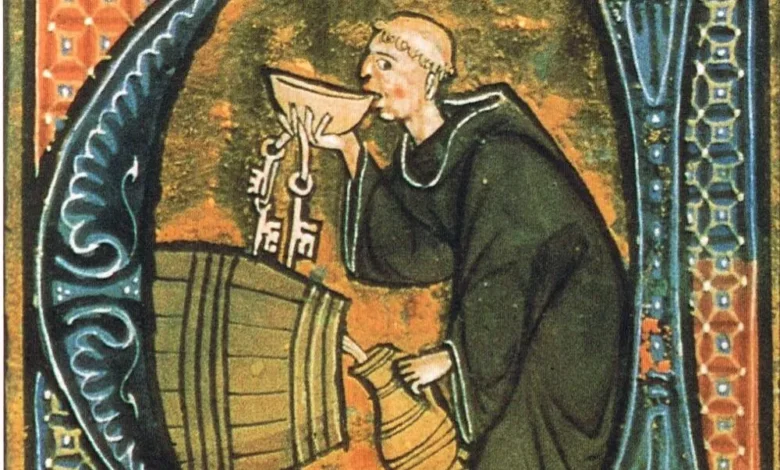
Illustrations, from above: An illuminated manuscript showing a 13th century monk testing (or possibly stealing) wine (or possibly beer) from a copy of Li livres dou santé by Aldobrandino of Siena (British Library); Hops being grown at Genesee Country Village & Museum in Central New York; Historic sign marking James Coolidge’s 1808 hop yard in Bouckville, Madison Count, NY; Grieve’s Brewery, a working 19th-century brewery at Genesee Country Village & Museum; and Prohibition agents dumping illegal beer (Library of Congress).
Source link