The Exercises (So You Can Repeat Them Tomorrow)
At the Phiz-Drama sessions, we developed a compact toolkit of exercises that participants could take into their lives:
1. Speed Scale
Participants move within a designated area, modulating their speed along a scale from zero, representing complete stillness, to ten, indicating maximum, explosive movement. The facilitator announces numerical values, prompting the group to embody the distinct physical qualities associated with each level. For example, level three corresponds to a deliberate crawl, whereas a level seven reflects a purposeful stride.
This activity cultivates impulse regulation and situational awareness, enabling individuals to deliberately select their internal rhythm amid demanding social or professional contexts rather than responding on autopilot.
2. Dot-and-Dash Sequences
In pairs or small groups, participants create a physical “sentence” composed of “dots” (brief, staccato actions) and “dashes” (continuous, fluid movements). The challenge lies in maintaining a clear, intentional shift between these two movement types even during rapid changes. This approach refines communicative precision by encouraging the segmentation of complex tasks or dialogues into discrete, comprehensible units, thereby preventing the core message from being obscured by ancillary motions.
3. Shadow Work
A pair of participants assume the roles of “Leader” and “Shadow.” The Leader performs slow, intentional movements, while the Shadow attempts to mimic the Leader’s actions with a purposeful delay of half a beat, paying attention not only to limb positioning but also to variations in weight distribution and muscle tension.
Shadow Work fosters deep empathy and attentive listening. It compels participants to anticipate their partner’s rhythms and requirements, cultivating a form of distributed attention crucial for effective collaborative leadership and collective problem-solving.
Each of these exercises contains exits: freezing, observing, or stop signal. In our rehearsals, slow, focused exercises were interspersed with moments of play and laughter so that the work could retain its elasticity.
The Showing: 360 Degrees of Absurdity and Objects
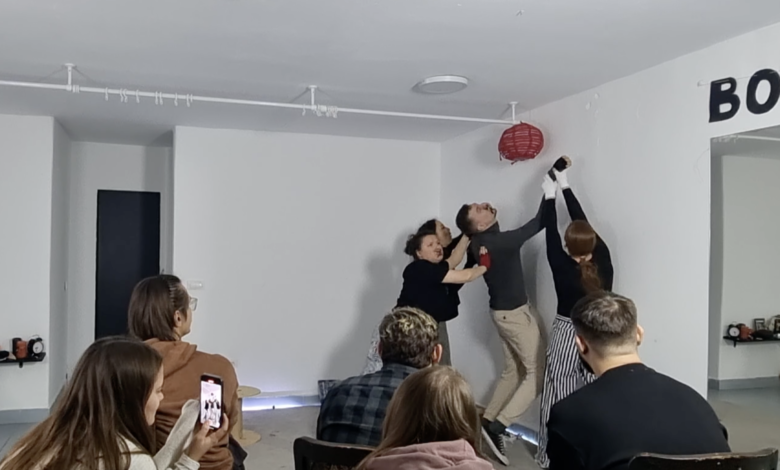
Our silent final performance lasted just fifteen minutes. The audience sat at the center, and the action revolved around them. We combined three texts of Daniil Kharms—The Old Women, Tyuk (Hit!), and Four Illustrations of How a New Idea Baffles a Person Unprepared for It —with the objects that had also made this journey across the border. Each piece emerged from these fundamental exercises and was gradually distilled to its essence. Our momentum came from rhythm and physical objects, which propelled the story forward. A book could transform into a shield at the passport control point, a mug into a listening device on the wall, and a blanket into a portal where someone disappeared and returned as a vampire.
When interpreting The Old Women, we relied on the Speed Scale to highlight the unyielding, almost mechanical quality of the characters’ persistence. For example, instead of depicting a quick, accidental fall, we chose to perform the act of leaning out and losing balance at a slow, deliberate tempo—a level two pace that stretched the moment painfully. This drawn-out slowness gave the absurd wish to “fall out of the window” a strangely expressive inevitability. At such a pace, what the audience witnesses is not a mishap but a repetitive, ritualistic cycle. The tension arises from the clash between the seriousness of the physical action and the irrationality behind it—and this is where the peculiar Kharmsian atmosphere takes hold, making the characters’ stubborn pursuit of the void feel almost hypnotic.
In Tyuk!, we concentrated on patterns resembling Dot-and-Dash Sequences. The sharp, staccato movements of the characters—the dots—stood against their stretched, frozen gazes—the dashes—capturing the fractured nature of Kharms’s reality with striking rhythm.
Lastly, in Four Illustrations of How a New Idea Baffles a Person Unprepared for It, we turned our attention to the profound vulnerability inherent in a creator’s ego. Kharms’s narrative presents a sequence where various professionals (including a Writer) confidently assert their identities, only for a mere passerby to dismissively label them as “shit.” This stark rejection serves as a “new idea,” embodying a reality so profoundly unsettling that it becomes, in the story’s context, a fatal blow. Our production utilized the technique of Shadow Work to illuminate the Writer’s inner turmoil as he grappled with this abrupt disintegration of his perceived self. When he proclaimed, “I am a writer!” his accompanying shadows—performers mirroring his every action with a deliberate half-beat delay—did not simply imitate; rather, they imposed a palpable heaviness on each movement, thereby converting an intangible slight into a physical encumbrance. This deliberate lag in the shadows’ responses created a kind of visual dissonance, underscoring the poignant, almost absurd chasm between the Writer’s steadfast self-perception and the jarring “new reality” that inexorably envelops him.
For the final beat, the five of us came together and shouted, “I am an artist!” three times and stopped abruptly, much like the sudden shock that pushed each of us to leave our old countries.
Context, Care, and Everyday Deescalation
Considering the delicate political situation of migrants in Belgrade, I felt a strong responsibility to ensure the safety and well-being of the participants. Although the group came together through trusted connections, we carefully managed attendees of the final performance. Invitations were tightly regulated, and we chose to exclude media presence altogether. This approach helped protect the participants navigate the sensitive environment. Participants also maintain full control over the images documenting their work, a choice we made to prevent any sense of exploitation and create a space of trust and respect. This control was especially important because the performances generated what we called “buzzing”—a lingering sensory and emotional aftereffect that often follows intense physical expression.