 Human presence in the Adirondacks, including Warren County, dates back thousands of years. The rugged peaks, valleys, and lakes of the Adirondacks were the hunting grounds for several Native American people, notably the Mohicans, Mohawk, and the Abenaki.
The Haudenosaunee arrived in the region around 1,200 to 4,000 years ago. Both the Mohawk and Oneidas claimed the Adirondacks as part of their territory.
The Algonquin-speaking Mohicans also claimed the mountains. However, the Mohawk, one of six nations in the Haudenosaunee Confederacy (Iroquois), appear to have been the dominant ruler of this territory.
The Haudenosaunee’s loss of land, due to unfair and illegal forced sales and cessions, triggered the Native American diaspora, with many abandoning their ancestral territories to move to safer places of refuge, such as Canada.
European encroachment weakened the Mohawk Nation’s occupation. The 1797 Mohawk Cession Treaty sounded the official death knell of the Mohawk’s Adirondack dominance.
Settled in 1765 by Quaker Abraham Wing, “Wing’s Falls” centered on the crucial Hudson River falls location on the transportation route known as the “great carry,”
reaching north to Lake George, Lake Champlain and Montreal, and south to Albany and the Hudson Valley.
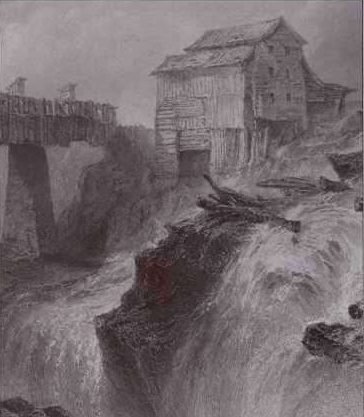
The location was renamed Glens Falls in 1788, and Johannes Glen established mills powered by the falls (which played an important part in James Fenimore Cooper’s Last of the Mohicans, published in 1826), ushering in the prosperity based on the Hudson River for waterpower and transportation, along with access to Adirondack forests to harvest lumber.
 Most notably, the Finch Pruyn Company began in 1865, producing lumber and black marble before turning to paper manufacturing about 1900. The company, which still exists and employs hundreds, has resisted contraction of the industry by continually introducing different paper products.
The Glens Falls Feeder Canal, a seven-mile waterway connecting to the Champlain Canal in Fort Edward, was built in 1824 to provide water to the canal, it quickly became a vital transportation route for local industries.
Glens Falls was incorporated as a village in 1839, then re-incorporated in 1874 and 1887 before becoming a city in 1908. Population grew exponentially, leaping nearly 33 percent from 1880 to 1900, reaching a population of 12,613. The population continually increased, reaching a peak of 19,610 in 1950.
(The population of the city was 14,830 at the 2020 census, with recent estimates placing it between 14,600 and 14,700. The broader Glens Falls metropolitan area has a population of over 125,000.)
By 1876 there was a railroad spur of the Delaware & Hudson Railroad entering from the east. The Adirondack Railway Company, the D&H predecessor, was formed in 1865 with the laying of forty-four miles of track from Saratoga Springs, north to the town of Hadley.
Purchased by the D&H in 1889, the Adirondack branch ultimately formed the backbone of freight transport, stretching north to Montreal and south to Wilkes Barre, PA.
 Important connections served Glens Falls, most notably the paper mills and Lehigh Cement. The D&H ran past a freight house, an engine house and a turntable before terminating at a passenger depot to the west.
By 1890 a small spur line had grown, with over half a dozen sidings reaching industrial sites that included Standard Oil Co.; James Singleton Coal, Lime and Cement; Glens Falls Storage Co.; Glens Falls Machine Works; and a garment factory, as well as a freight house that replaced the earlier passenger depot and stretched the width of the block between Walnut and Cooper Streets.
This essay was drawn from the National Register of Historic Places Registration For for Liddle Warehouse in Glens Falls, recently nominated to both State and National Registers. You can find the full document, including footnotes, here. John Warren contributed to this essay.
Illustrations, from above: An early bridge and mill at Glens Falls on the Hudson River (courtesy Chapman Museum); “Distant view of the village of Glenn Falls” [sic], 1841; and Glens Falls Portland Cement, situated along the Feeder Canal, ca. 1910 (Chapman Museum).
Source link