 Every year I know that spring has arrived when it’s time for my family to forage for ramps on a two-acre patch on the hill above my house. We have just a few weeks to enjoy their spiciness before they disappear from the landscape, along with other spring ephemerals.
While we prize many spring ephemerals for their fleeting beauty – flourishing before the overstory trees leaf out, then dying back as the shade season begins – they also are important to nutrient cycling in woodlands.
Ecologists Robert Muller and F. Herbert Bormann first suggested that spring ephemerals contributed to nutrient storage and release while conducting forestry research in the Hubbard Brook Experimental Forest in New Hampshire in the 1970s.
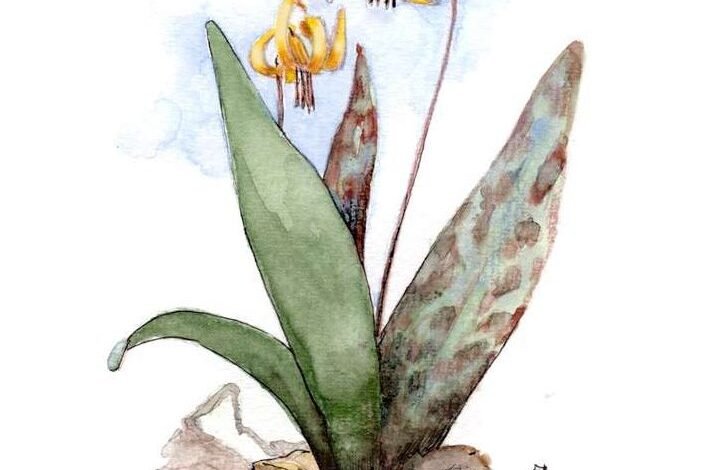
Muller and Bormann observed that American trout-lily (Erythronium americanum), a common spring ephemeral, grew the fastest when nitrogen and potassium losses from the soil were at their highest (during the spring melt).
While trees are still dormant and unable to use these nutrients, melting snow and spring rains wash these nutrients out of forest soils.
Muller and Bormann proposed that spring ephemerals could capture critical nutrients when they might otherwise wash away and then return those nutrients to the soil when they died back during the summer shade.
They called this the “vernal dam” hypothesis, because the ephemerals act as a dam, retaining the flow of nutrients before releasing them back into the soil.
In the 1980s, further studies by Muller and other ecologists showed that spring ephemerals could efficiently take up nitrogen and potassium. For example, by tracking the life history, biomass, and nutrient levels of trout-lilies in the Hubbard Brook forest, Muller showed that these spring ephemerals can triple or quadruple their biomass during their brief growing season, and their shoots contained higher levels of nitrogen compared to summertime plants.
These numbers supported the idea that even small, ephemeral plants like trout-lilies could impact nutrient levels enough to act as a vernal dam.
However, other studies show that the relationships between plants and nutrients are complex. Plants take in fewer nutrients when they aren’t photosynthesizing, so plants in areas with more cloudy days will use less from the soil than plants in sunnier locations.
Some early spring bloomers, such as Virginia spring beauty (Claytonia virginica), are efficient at storing nutrients in their below-ground tissues, which do not die back over the summer. Plants investing in underground storage retain nutrients in the spring and don’t return them to the forest in the summer.
Also, late spring freezes, which are more likely in more northern forests, disrupt the vernal dam effect by damaging or killing new plant tissues, hampering their ability to retain nutrients.
Working in Michigan in the late 1990s, ecologist David Rothstein set out to test two foundational assumptions of the vernal dam hypothesis: first, do growing spring ephemerals take up nutrients that would otherwise be lost to spring thaw water runoff, and second, does their subsequent decomposition increase nutrient uptake for summertime plants?
He focused on the nutrient nitrate, since it’s an important source of nitrogen for plants that also easily leaches out of soil. The dominant ephemerals in his test area were those same spicy ramps that I like to forage.
Rothstein did not observe that the presence of ramps prevented nitrate leaching, nor did they act as a nitrogen source for other plants in summer. Instead, he found that the decomposing action of soil microorganisms was most important for making nitrogen available to growing plants.
Similar evidence from forest disturbance studies also supports the possibility that soil microbes might be equal to – or sometimes more important than – ephemeral plants for forest nitrogen retention.
While everyone agrees that northern forests lose more nutrients during the spring thaw than at any other time, there remain many open questions about how, when, and where spring ephemerals create a vernal dam for forest nutrients.
It’s an intricate picture arising from the varying abilities of different spring ephemerals to hold onto different nutrients under diverse conditions across varied habitats.
While spring ephemerals appear delicate and fleeting, they – like all the members of a forest community – play a role in forested ecosystems that can be felt across the seasons.
Read more about spring ephemerals.
Rachel Sargent Mirus is a teaching artist and writer. Trout lily illustration by Adelaide Murphy Tyrol. The Outside Story is assigned and edited by Northern Woodlands magazine and sponsored by the Wellborn Ecology Fund of New Hampshire Charitable Foundation: nhcf.org.
Source link