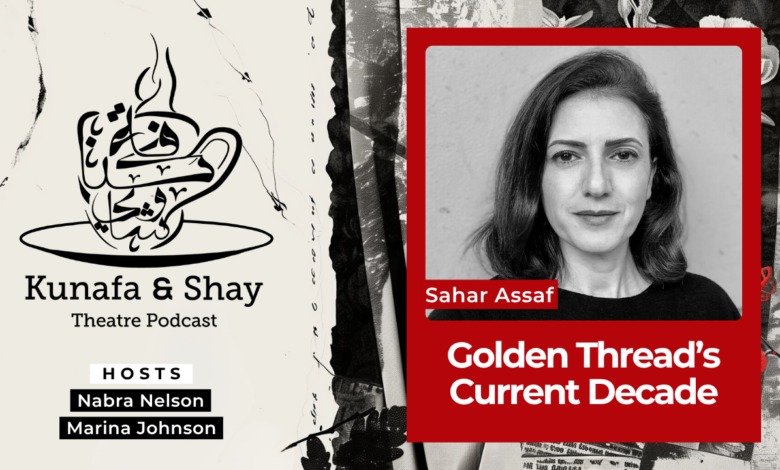
Nabra Nelson:Salam Alaikum! Welcome to Kunafa and Shay, a podcast produced for HowlRound Theatre Commons, a free and open platform for theatremakers worldwide. Kunafa and Shay discusses and analyzes contemporary and historical Middle Eastern and North African, or MENA, and Southwest Asian and North African, or SWANA, theatre from across the region.
Marina Johnson: I’m Marina.
Nabra: And I’m Nabra. And we’re your hosts. Our name, Kunafa and Shay, invites you into the discussion in the best way we know how, with complex and delicious sweets like kunafa and perfectly warm tea, or in Arabic, shay.
Marina: In each country in the Arab world, you’ll find kunafa made differently. In that way, we also lean into the diversity, complexity, and robust flavors of MENA and SWANA theatre.
Nabra: Season six of this podcast marks a double milestone, the thirteth anniversary of Golden Thread Productions, the oldest MENA theatre company in the US, and my first year as the theatre’s new artistic director. Across ten episodes, we use Golden Thread as a case study to revisit landmark productions from 1996 to 2026, and trace shifting tropes, political urgencies, and aesthetic strategies that shaped the company’s early decades.
Marina: This season also expands to reflect on the past three decades for MENA theatres across the US, not as a closed chapter, but as a living archive, one that illuminates where we’ve been and where we’re headed.
Hi, Sahar. So glad to have you back on Kunafa and Shay with us.
Sahar Assaf: Thank you so much for having me. I’m very excited to be here. Thanks, Marina, and thanks, Nabra.
Marina: So we’re covering Golden Thread as a case study in these three different decades, as we’re now in the thirtieth year. So by 2016, which is our third decade that we’re looking at, Golden Thread had real institutional memory and real scars. When you stepped into Golden Thread during this period, what kind of company did you encounter? And also, what felt urgent for Golden Thread to hold on to, and what felt ready to be reimagined as you were stepping in?
Sahar: I stepped into my role in 2021, just before Golden Thread turned twenty seven, and it was the middle of the pandemic or, you know, kind of in the pandemic. We were living in the aftershocks of the Me Too movement, We See You White American Theatre, the global reckoning following the murder of George Floyd. So it felt really like a tectonic moment. It was painful and it was, you know, destabilizing, but also deeply hopeful, or I felt that systems were being questioned from the roots up. So Golden Thread by then had already persisted through previous tectonic moments, post-9/11 backlash, cultural marginalization throughout, funding precarity, you know. So of course, as you said, it had institutional memory and also real scars.
What I encountered was an impressively resilient company. A company I felt deeply rooted in community, with a powerful founding vision, grounded in representation, but also resistance. I found a small but fiercely loyal ecosystem of artists, board members, donors, community partners who believed in this space, both as a sanctuary kind of, and also as a platform.
And for me, what really felt urgent was to hold on to exactly that, this ethical core. So community accountability, the insistence on plurality within the MENA identities, the refusal to tokenize or simplify the moral clarity that Golden Thread had earned through decades of showing up. So yeah, you know, at the same time, like those moments of ruptures, I feel like are scary, but an opportunity.
For me, at a personal level, I had just crossed oceans to join the work. So a large part of my heart still lives in the Middle East. And stepping into Golden Thread felt like an invitation to bridge worlds more tangibly. So I saw an opportunity there to stretch our scale, our ambition, and to go a little bit national and international, to imagine international relationships, especially with the Middle East. So to expand, in a way, how far our stories could travel.
Nabra: So tell us a little bit about Golden Thread in this decade. It really feels like it was very hybrid. It resisted the neat categorization of a theatre company that does plays. There were festivals, readings, community center projects, youth theatre. What do you think that says about where Middle Eastern theatre in the US was and maybe still is artistically?
Sahar: Yeah, that’s a very interesting question. I mean, for me, this really, it’s a refusal kind of to be contained. I’ve always felt like we have an allergy at Golden Thread to neat categorization. And as you know, as we know, for a long time, MENA theatre in the US had to fight first for visibility.
It felt like there was an implicit pressure to explain ourselves, to contextualize, to translate, to justify our presence. And for many, stories were only legible in the US when attached to conflict, whether geopolitical or identity conflict, which, of course, is important work, but also, in my mind, very limiting. So I feel like Golden Thread made it clear throughout that our interior lives, our complexity as humans, were just as worthy of stage time.
I think in general, in the past decade, the field had matured into something more confident and less apologetic. So this hybridity you’re talking about, whether festivals, convenings, readings that sometimes functioned as laboratories or community-centered projects, devised work, projects that in general blur the line between performance and gathering and community events reflect this kind of refusal to be contained. It mirrors, in a way, our diaspora itself. We’re layered, we’re transnational, we’re not easily boxed.
So artistically, it says we were no longer interested in performing our identities for approval. We’re interested in complexity, in aesthetics that don’t flatten us, you know, into just case studies.
Personally, coming from documentary theatre, from interdisciplinary practice, and more recently, I’m exploring how neuroarts and neuroscience can inform and impact performance. I’ve always been drawn to forms that kind of live between these categories. So Golden Thread, becoming a space where hybrid forms thrive, felt organic. It allowed the company to function as a producing house, but also as this cultural ecosystem, this place of coming together, experimenting, engaging in dialogue, trying to understand.
And in many ways, I feel like this resistance to categorization is very political. You know, when our region, the Middle East, has been relentlessly simplified in mainstream media and public discourse, this complexity and the insistence on our complexity as human beings becomes an artistic stance and a political stance.
So I think that’s where MENA theatre in the US is now. We’re less concerned, I feel, with proving that we belong, that we are here. You know, we are here, and we’re just claiming that space. We’re interested in understanding or expanding this kind of belonging and how it looks like.
Marina: I love that. And I love the way that you were able to articulate sort of this expansiveness as a political stance, as an ethical stance, as something that’s grounded in how Golden Thread began and how it really continued to be this way in light of all of these, you know, changes that are happening in the world. Are there particular kinds of story that Golden Thread said no? Or maybe even actually, like, what are the stories that Golden Thread was choosing to say yes to, because of this stance around not flattening and making sure that these complex identities were apparent on stage?
Sahar: I love that question. And honestly, to frame it a little differently, it’s not like stories we said no to, although there’s a lot of, you know, in our kind of work, whether we like it or not, there is gatekeeping. There is, like, as much as we open the doors, we don’t have enough space to include all and every story that is waiting out there to be told. So there’s always a choice. And in this kind of selection, curation that you’re making for a season, you are making political choices every day.
For me, I would frame it as what are the stories that I was interested in as an artistic director? And now Nabra coming into this role, she’s going to probably steer the company in a different direction because of her own artistic interests. So for me, I’m not interested in narratives that simply confirm, like, what people already thought they knew about us, about the Middle East.
I have lived experience in the Middle East, and I see this chasm between what is really happening in the Middle East, what are our concerns, our everyday struggle, what are our aspirations and desires, and what people outside think about us and about these aspirations and desires and concerns. So for me, stories that really reproduce stereotypes or even instrumentalize our traumas, I wasn’t interested in them. Not to say, like, you know, trauma in particular is not. It is at the center of also, like, our practice is trauma-informed because of that lived experience.
But I wasn’t interested in my curation in stories that simplify our complex communities that aim to educate, in particular, white audiences. I feel like there are other institutions and theatres in the US who were interested in what I call, like, the safe stories, you know, about the Middle East. I was more interested in stories that really spoke to me as a human being, as a Middle Eastern, to our communities, to the vibes that I was getting from our community members. So, yeah, it’s not like no two stories. It’s more like, what do we want to tell in a particular moment of time? And that changes with the times, right?
Nabra: Yeah, and I have to completely agree with you on everything you’ve said. And this decade really seemed to foreground interiority, gender, queerness, really the everyday. And the geopolitical questions that are within that, but instead of this, like, education, it was much more interior to our communities, which I really appreciate and resonates with me very deeply.
And another, you know, important mainstay of all thirty years of Golden Thread Productions is the ReOrient Festival. And it seems it becomes especially important during this period. It grew with the addition, as well as the MENA Theatre Makers Alliance convening, being a part of that at times. And so what is the importance of a short play festival in the landscape of MENA Theatre in the US more broadly, and how you are approaching your time at Golden Thread?
Sahar: Yeah, absolutely. I mean, that’s one of our signature programs. That’s like the flagship of Golden Thread. And I should speak maybe about the initial drive. You know, what I understood, the drive that led Torange to really start the festival. And I believe that drive was expansion, quite simply, to create more room, more stories, more voices, more tonal range. You know, a short play festival allowed us to widen the aperture, so to speak, because, you know, as you know, we have capacity to produce two, at max three main stage plays a year. And there’s, you know, a big number of plays out there, as I said, like waiting to be told. So that festival became like an entry point for emerging writers and first time collaborators to work with us. It was a space where artists could test ideas and take risks and experiment with form. So in many ways, it functioned as an aesthetic laboratory.
But beyond its developmental function, what feels most meaningful to me is how the festival builds ensemble culture. I love the production model of this festival, which is really quite interesting, where we bring in an ensemble of actors. We bring in designers, you know, one designer per department and a group of directors and then a group of dramaturgs and the playwrights and, you know, the crew and everyone in the same room working together to produce an evening of theatre.
So we choose these short plays, but we try to put them in conversation together. We try to create a storyline. You know, the order of the plays is a very intentional decision. So in a single evening, you’re witnessing a spectrum of perspectives from different generations, different political positions, even different artistic languages, all coexisting in one night on one stage, which in itself mirrors the multiplicity of the MENA region and our diasporic communities. I feel like it says loud and clear that we’re not a monolith and, you know, anyone who’s been at the ReOrient would feel that this is like a statement that the festival is trying to make.
Also, I want to add, like, for me, what’s important is the fact that it creates a space for gathering. And we all know that Middle Eastern communities, we love proximity. And the festival, kind of the format of the festival encourages that kind of energy, feels like it’s a communal experience. So that for me, it is it’s quite power.
Marina: I love ReOrient so much, and I had the honor of being one of the dramaturgs for one of the last ReOrient festivals and everything you’re saying about community was incredible. Also, I love the phrase widen the aperture. I think that’s something that’s so necessary. Whenever there are just limited resources to produce stories, what does it mean to show more stories and put them in conversation together? I’m curious, and I actually don’t know the answer to this, so we’ll see what you both say. But the next ReOrient festival is happening, I believe, in October, September, October. Is there anything that you both can share with us about that festival, or is this something we should wait about for a different time?
Sahar: So what do you think, Nabra? Should we share?
Nabra: Well, we’ll be covering ReOrient later in the season, so we’re going to keep it as a, I don’t know, teaser. We have some exciting things happening, and the MENATMA convening is coming back to ReOrient this year, which is really exciting.
Sahar: You know, yes, absolutely. I don’t want to add any scoops, but I would say something, Marina. We usually, as you know, you work with us as a dramaturg. We receive tens of plays. This year, the last year I produced it, we received over one hundred plays. This year we received close to eighty three plays. And it’s amazing when reading these plays, how, like, themes and categories kind of emerge naturally, and it tells you how attuned our playwrights, our MENA playwrights out there all over the globe, because this festival is open to submissions from everywhere. So we receive really international submissions. It really speaks to the times that we’re in. So one thing I’ll say is that, you know, the selection of people coming to watch will see how the festival is a strong reflection of the times and what our Middle Eastern communities are experiencing, especially, I want to say, Palestinian communities and Iranian communities.
Marina: Thank you. That’s really useful to know. I mean, the number also, I’ll look forward to hearing the whole slate later. But, well, so on that note, are there specific productions or readings or commissions from your time, Sahar, that feel emblematic of Golden Thread’s values now, even if they were smaller or, you know, not necessarily the main stage productions?
Sahar: Yeah, you know, I can name quite a few. But, you know, we take pride in helping to launch the careers of many established MENA playwrights. Today, we have presented queer stories that really shifted the tone. We experimented with style and form. So just to name two examples of some of my favorite plays that we produced, I would pick Oh My Sweet Land, which is a play written by Amir Nizar Zuabi and directed by Torange Yeghiazarian featuring Nora el Samahy. And what I love about this play is how intimate and interior that story is, which is really a great example of the kind of theatre that let interiority carry that strong political meaning, which in many ways feels quintessentially a Golden Thread trait.
And the other example I would mention would be Drowning in Cairo. I have, obviously, I’m biased to this play. It was my first, the first play I directed at Golden Thread. And we first encountered the play through a New Thread’s reading in 2018. And I believe Evren Odcikin, who is now on our board, you know, is an artist with us and now on our board and helping with marketing, he picked that story in 2018. It was partially developed. And then seeing Drowning in Cairo grow from a reading into a world premiere reflects that long view commitment we have to artists. And also what is powerful about this piece is the fact that it is rooted in a very specific historical moment, but it’s a play that is about much more than the incident it tackles or it, you know, kind of takes as its inciting incident.
So Adam, the playwright, Adam Ashraf Elsayigh, weaves romance, class dynamics, and a real historical event into the standard portrait of the three young men struggling to rebuild their lives. So the play holds queerness, class, and state violence all in the same breath without really collapsing those characters into symbols. And for me, it embodies several of the Golden Thread’s core values from centering queer MENA narratives without sensationalizing them, exploring political realities through deeply human relationships, and also trusting that complexity and trusting our audiences also with that complexity. So it reflects our commitment to being an artistic home. Adam has said on a couple of occasions that Golden Thread was his first artistic home in the US and that developing this play at Golden Thread showed him that there was space for his voice and artistry in this country. We later commissioned him through a good body grant to write a play about the life and imprisonment of Egyptian political prisoner Alaa Abd El-Fattah, which again, we developed and advanced through a workshop in 2024.
So in a sense, Drowning in Cairo represents not only, you know, the kind of plays that we produce, the productions that we’re interested in, but also that ecosystem of, you know, a place where artists are nurtured over time, where risk is supported, where stories that might not easily fit elsewhere are given the care and rigor that they deserve.
Nabra: I am so glad to hear you talk about both of those plays. I absolutely love them. And I completely agree with how they reflect what we’ve been talking about this whole episode, which is that interiority and how it reflects geopolitics, but in a deeply personal way. And, you know, it lends to this next question, which we wanted to talk about kind of what, how do you make theatre when the world is on fire? But at the same time, I’m realizing more and more that the world is always on fire. And so I guess when it’s more on fire or when that sense of responsibility for the present moment feels especially urgent, what responsibility does a company like Golden Thread carry on those moments? And we know that you responded to the genocide in Palestine in a huge way when that sense of responsibility felt especially urgent. So we would love to talk about that. And but first, more broadly, you know, what you feel is that responsibility of theatres?
Sahar: Yeah, you’re right. I mean, especially the Middle East, Nabra, I feel like this is a region. This is the region we serve. And this is a region that has always been on fire, so to speak, like at least during my lifetime. And I’ve always believed that theatre is part of the answers. What we can do is, you know, we continue telling our stories because storytelling creates understanding and understanding can create change and even sometimes healing. So that act in itself is resistance, is what we can do as theatermakers. It’s a refusal to succumb to this imposed status quo.
But to be honest, in the last two and a half years, and more specifically since the onset of the genocide in Palestine, those convictions for me felt very shaken. For a period of time, I have to admit, I felt completely paralyzed. And I was at the, I was the artistic director. I had a huge responsibility, you know, and I couldn’t find, I couldn’t find an answer in simply producing theatre and making art.
Though I could see the value of communal gathering, but that alone did not feel like a sufficient drive. It felt inadequate in the face of the devastation that was live streamed and continued to be live streamed. So, you know, you know, that, that paralysis though, luckily didn’t last. And it didn’t last because, not because life should continue or business as usual, because honestly, it shouldn’t in the, in times of genocide. But I felt perhaps the business itself has to shift tracks. We have a platform, I thought, and to deactivate a platform. And by that, I mean, either continuing business as, as usual for me would have been a deactivation of the platform or simply not producing anything because we’re devastated. Would have been, you know, while our people are being annihilated, would have been at best a betrayal of our mission and at worst complicity with what’s happening. So, that kind of took me out of that moment of desperation and led to what you’re mentioning, which is the season for Palestine. I don’t think I have a formula as to how, what, and what art can do and how can we do it as artists. But I, I do know that in 2023, when the genocide started, we had to pause for a second and re-evaluate our plans for 2024. And we made the decision to shift gears and to dedicate the season for Palestine. And that felt important to, you know, just to continue, to continue to gather that energy and the courage and to speak clearly and to articulate a moral stance, especially with all the disinformation that we’re surrounded with, especially, again, when it comes to the Palestinian cause.
So, I think we created a space that refused erasure. Like, the work may change in tone and urgency, but what’s important is our commitment to voice, to giving voice. That should never change. And I personally feel that art is political. Whatever you do, even if you’re doing a comedy in the midst of a political turmoil, that’s, that’s a decision, that’s a political choice. So, we can’t separate. I don’t think we can separate art from life. We do art because we love life, because we want to understand life. So, you know, this, this whole saga going on now with the jury at the Berlin Festival, you know, trying to dismiss a genocide and, you know, mute artists who are speaking for genocide. Because we’re here to do films and to do art is just ridiculous, to say the least.
So, I think in terms of our role, we just need to keep going and to keep listening to our hearts and trying to function from a place of love rather than fear. And when it comes to Palestine and to the erasure that’s happening, fear is out there. And it’s legit, I have to admit also, it is legit. I mean, the repercussions that our immigrant communities are facing and artists, you know, artists and the, you know, canceling that’s happening is, of course, like their livelihood. When, when a livelihood is at risk, it is fearful.
But for me, I always try to look, look at it from the perspective of the people in Gaza. I feel like whatever we go through, it’s not to be compared to what people and children and mothers and fathers and communities are experiencing in Gaza under the genocide. So, really, like, what are we afraid of? Losing funding? Other sources of funding will open up. That’s my true belief. And I can prove it. 2024, the Season for Palestine proved that for us.
I remember going into that season forty thousand dollars short for our first production, which was Returning to Haifa. And I have to thank our board of trustees for really taking a huge financial risk. They like, they could see that this is the only way forward. You know, there’s no way we could do anything else. And two community members at the time took on a crowdfunding campaign on their own to raise money for us because they knew that we’re short on funds. And then I remember during the Women’s Day event, which was opening that season, I did announce that crowdfunding event on stage and said, you know, we’re still fundraising for our 2024 season. And please, if you’d like to support us, speak to Mona Masri and Jumana Muafi, the two community members leading that campaign. And I go off stage. And then two [audience] members came to us, to me, and said, how much money do you need? We want to support you. They felt that it’s so important what we’re doing. And that, you know, that was so moving and so motivating. And it just kind of proved that following your heart and listening to the communities that you’re serving and trying to do the best you can is the way forward, you know?
Marina: 100 percent. And I mean, I think what you just mentioned is a great example of how, you know, stating a need and that need will be met. And so not operating from a scarcity mindset, but operating from knowing that these values are shared with other people and that they’re more important than anything and trusting that something will happen, which is really inspiring.
Sahar: Absolutely. And honestly, at the time, I remember thinking, like, if we’re going to lose funding because we’re standing for Palestinians going through a genocide, then that funding, we should never use that funding anyway. We shouldn’t be dependent on that funding. We need to find other ways to do our work.
Marina: Well, I have a question around the Season for Palestine, which was such a beautiful season. I think that what Golden Thread did really well was holding space for Palestinian work without collapsing it into kind of a constant crisis response, because, of course, it is responding to a crisis, but it wasn’t just showcasing trauma. It wasn’t sort of doing these tropes. Like, I think MENA theatre in the United States after 9/11 kind of responded in a way of, like, we must be humanized. And that response is very different, I would say, with Golden Thread and how the response was there. Can you talk a little bit about the Season for Palestine and sort of that response and how you showcased Palestinian work without collapsing it?
Sahar: Yeah. You know, what I’m proud of in our history as a company is that Palestinian-centered work existed throughout and not necessarily in moments of escalation. So, from the very beginning, Golden Thread engaged that Palestinian narrative. Our very first production, which was a production by Torange, she adapted Lysistrata, was intentionally centered on the Palestinian cause. So, this is a commitment. This is a foundational commitment. We’re not reactive. Obviously, the genocide moment is different. And, you know, a strong example, I feel, of how we held that line that you’re talking about, not collapsing it into just a constant crisis, although we were at a moment of crisis, was how we opened our season for Palestine.
So, usually we open our season with a Women’s Day event on March 8th, which centers women artists. And that year, I decided that that event is going to be a joyful event, although it was extremely difficult to celebrate anything, right? It was at the height of the genocide, but it also felt very important that we celebrate our humanity. So, the title and focus of the event were actually inspired by a policy issued by Itamar Ben-Gvir during the first hostage exchange in November 2024. If you remember, he issued this statement, forbidding Palestinians from publicly expressing joy as they reunited with loved ones who were released from the Israeli prisons. And that prohibition for me struck really deeply. So, I felt like this is an attempt to regulate joy, to deny even the right to celebration, which is another example of the Israeli administration dehumanizing Palestinians.
So, that inspired centering joy and our right to joy in that event. So, although, you know, the event was unfolding amid this global grief, the room itself at Brava [Theatre] held music, dance, memory. We had food, Palestinian food, in the lobby provided by a woman from Gaza who actually came to the Bay Area during that first ceasefire. Embroidery, you know, women artists celebrating one another. We celebrated Palestinian men and children. It was the first time we had men on stage for Women’s Day. And again, another statement because men were being totally erased, you know, when we were mentioning numbers of murdered civilians. We focus on women and children, not on the men, right? So, for us, really, what it means not to collapse Palestinian art into constant crisis response is this. You know, it’s protecting the full emotional spectrum that we all have as humans from grief and rage to resistance and joy.
I don’t know if that answers your question, but I feel like that’s what this event was trying to do. And the whole season was also trying to do because then we moved on to Returning to Haifa, which is a classical Palestinian play. But the closing main stage production was another community-based production, devised work, Eleven Reflections, that we co-produced with Art 2 Action. Andrea Assaf directed and devised the piece with community members where Palestinian stories were centered. So, it was really an open space for artists from all sorts of backgrounds to come together and share whatever feels, whatever felt important to them at the time. And it included music and dance and tears and laughter, too.
Nabra: Yeah, and we’re continuing that work this year with Women’s Day, also centering joy and celebration. So, it’s really wonderful to hear that context coming out of last year’s season. This year, you know, we’re dedicating Women’s Day to the people of Iran. And so, again, going back to this, the fact that our world is always on fire and we’re always needing to respond and step up to the urgency of the moment without forgetting those who are still in crisis. So, having a lot of Palestinian voices in this year’s Women’s Day, as well as other communities throughout the MENA region. So, I feel like you’ve really balanced that beautifully, bringing people together, bringing people in, holding space for both joy and grief in those moments and across the curation of Golden Threads’ work.
When it comes to the greater landscape of MENA theatre, how have you interacted with other MENA theatres in the US? I know that the MENA Theatre Makers Alliance, which we’re both on the board of, did emerge during your time at Golden Thread in the past ten years. And there are plenty of other MENA theatres across the US. What has your partnerships or conversations looked like with them? Were they involved with any of the conversations around curation or around the season for Palestine? What is the general landscape that you would describe during your time at Golden Thread?
Sahar: Yeah, I mean, I should say that MENATMA as an advocacy group emerged in 2019 during a ReOrient. And at that time, I was still not at Golden Thread, but I made sure that MENATMA had a space at Golden Thread in 2023 when we produced ReOrient that year. And that was 2023, I believe, was the year that MENATMA was launched as an organization. And I feel that this is the foundation of MENATMA marks something really significant, not only organizationally speaking, but also culturally speaking. Because for many years, the MENA theatres in the US operated in relative isolation, aside, of course, from some very successful initiatives that I came to learn about, such as the Middle East America New Plays Initiative that Torange Yeghiazarian and Jamil Khoury from Silk Road, [Golden Thread], and the Lark Theater, if I’m not mistaken, came together to create this initiative that commissioned New Plays nationally. I feel like, in general, the MENA community, the MENA theatre community were each fighting their own battles for visibility, for funding. So there was a sense of survival mode, right? So how do we protect our artists? How do we sustain our institutions? But over the last decade, I feel this has shifted drastically. Through MENATMA and other collaborations, we began to see ourselves less as separate outposts and more as an ecosystem.
Over the last decade, I feel this has shifted drastically. Through MENATMA and other collaborations, we began to see ourselves less as separate outposts and more as an ecosystem.
And by the time I got there in 2021, I could feel that there’s been a real move toward mutual support rather than competition. So sharing resources, how do we amplify each other’s productions, co-producing together. We did a lot of that, like we did during my time and even before, I would say advocating together. And I feel that shift is really strengthening all of us. So MENATMA gave us the bargaining power, right? Like funders and national institutions are now recognizing that this is a field, this is not a niche, this is an existing field, I mean, a theatre field.
We’ve been able to engage in shared advocacy around representation, equity, and policy in ways that would have been difficult to do it alone, right? So beyond visibility, we’ve started, we’ve started building kind of infrastructure. I’m very moved to see MENATMA today offering grants for MENA organizations. Like this is such a leap, you know, for this advocacy or what started as an advocacy organization and continuing to be. But I feel like also now MENATMA is becoming the leader, like at the forefront of the fight for more space, for more opportunities and resources for the MENA communities.
So if I’m to summarize, maybe the last ten years from what I experienced coming into this scene, really from a completely different scene in Beirut, I would say that it felt like we’ve moved from survival to solidarity. And that shift has impacted how we operate and how we imagine the future of Middle Eastern theatre in the US.
So I feel like we’re in such a great moment today, despite the fact that it’s such a hard time for the Middle East, politically and socially speaking, and also economically speaking. The MENA community in the US, the diasporic communities are really coming together and showing up in ways that is so powerful and will make huge shifts, I feel, in the field.
Marina: And I love from survival to solidarity, I think is such a beautiful phrase. But I’ll take us back to another moment of sort of survival of like the COVID years. I know you were coming in a little bit after the COVID pandemic had started, but I’m curious how COVID changed Golden Thread. I’m assuming that some of these changes were logistical, maybe some of them were philosophical, but I’m curious like what digital performance and remote gathering made possible and if there are some of those things that you feel like should stick around with Golden Thread in the future.
Sahar: Yeah, you know, COVID changed theatre in general, I feel, globally and how we practice theatre. And as you said, far beyond logistics, I, you know, I’m always reminded of this simple definition by Eric Bentley of theatre when, you know, A performs B for C and during COVID, we suddenly lost C in the equation. And what do we do? A performs B to who? So it was an existentialist crisis. And yes, we moved online out of necessity, but I also feel philosophically, it really forced us to think who theatre is for and how proximity functions.
So for us, Golden Thread, which is a company rooted in diaspora, the shift to digital created a kind of decentralization that felt quite important, to be honest. You know, suddenly the Bay Area was no longer the geographic center of our work. Artists across the country, even internationally now could participate without the burden of travel. And we tried to do like, you know, we started putting our productions online through video-on-demand. We did hybrid versions of the Women’s Day event, New Threads event, readings, etc.
So audiences who had never been able to attend our shows because simply they’re geographically, you know, out of our scope. Or even like audiences who, for different reasons, including, you know, disability or whatever, like cost or responsibilities, you know, now are able to be with us. So in some ways, it felt like we were getting closer. And I remember that one thing that felt, you know, in different ways, not only in theatre during COVID, it felt like vulnerability became not only accepted, but even like appreciated and almost as if celebrated, like just to be able to be vulnerable. And although theatre, like this is what we do in theatre, we’re just dropping our guards all the time. But now it became at a bigger scale.
So I’ve always felt like after we came back to producing in-person, I was like, how do we not lose this expanded circle? It felt really important that we don’t go back to pre-COVID as if COVID never existed. That this is a moment in our history that really affected us and changed us in many ways. And we came out with lots of learning. So how can we continue expanding that circle and building on what we learned?
You know, that accessibility lens, for instance, was very important. Like it kind of forced us to ask the question of who is in the room and why?
So reimagining access, not as an accommodation, but as a design principle, which impacted how we think about the mission of the organization from operations to artistic. It was a wake-up call, you know, COVID, the idea that I remember personally, I’ve never felt this before COVID, that, you know, we’ve always said the show must go on, whatever happens, right? Like if you’re sick, you come to rehearsals. Only if you, like if whatever, like if you’re, only if you die, you don’t come to a show, right? Like, and that changed. The show doesn’t need to go on. Humans do. And that was such an important wake-up call. It reminded us what theatre is really about, that human connection, which funny enough, like ironically, we lost it. We lost the physical, like being in the same physical space. But in a way, we found other ways to rediscover that human connection, that equity at our essence, you know, we all deserve to be in the room.
So I feel like these are really important things to keep, to keep them in mind as we move forward. And as we kind of, as COVID becomes a part of our history, as it’s becoming now.
Marina: I’m curious, so you’ve talked, touched on this a little bit, and I’m curious, like when you came in, so during COVID, you were inheriting a company as the second artistic director. So a very strong founding vision was in place. And what did it mean for you to come into that vision while also making space for new leadership and voices or finding your own space? Did you feel any particular pressure to protect a legacy? Did you feel freedom to stretch it? Anything you can share here would be really interesting.
Sahar: You know, I wouldn’t use pressure as a word choice. I did feel, though, a huge responsibility. You know, Torange’s founding vision was very clear, and it was courageous. It was deeply rooted in community, in representation, in resistance. You know, that kind of clarity was a gift, but also it carries weight. So I felt the urgency to protect it. You know, when you inherit a company with such history, we’re the first US company in the US devoted to the Middle East, right? Like, twenty five years. The founder has done amazing work. Like, the community trusts us.
You understand that you’re stepping into a relationship, not a role, really. Like, I had to find my way around gaining that trust, the community’s trust, the artists, the board, the staff. Like, it was a huge responsibility. So I took that first year to learn. I remember, you know, thinking and doing. Like, I didn’t make any drastic changes to the programs, to the structure. I really wanted to learn. Like, there is a system, for sure. It’s the organization not only survived, but thrived for twenty five years. So there’s definitely a system, and I wanted to learn that system first.
I remember meeting one-on-one with as many people as possible in my first six months at the company, thanks to COVID, because we were able to meet online. I’ve met with over eighty individuals, from artists to community members to donors to funders, et cetera. I wanted to learn how to do exactly what we’ve done before I move on to finding my own voice. You know, because I understood that my responsibility was not really to replicate what came before, but really to honor the values. And to achieve that, I needed to learn. You can’t break the rules before learning them.
So protecting the legacy didn’t mean, for me, like, freezing it. It meant making sure that it can breathe. So I’m a new person. I have my own vision. You know, it means making space for the new leadership, the new aesthetic, the new political realities that we’re living with, while staying anchored to the ethical core. To that mission statement that gave the company its purpose in the first place. So in many ways, that tension between protecting, you know, what I inherited, but also making sure that there’s a healthy evolution that’s happening was very important for me. And it’s kept me accountable.
Nabra: You’re really giving voice to a lot of what’s on my mind as well as I step into this role. And we did want to ask, you know, if you have thoughts about what questions Golden Thread should be asking in its fourth decade going into this new era of Golden Thread that maybe it couldn’t ask before. Or what do you see for the future of Golden Thread?
Sahar: That’s a very interesting question. I feel like Golden Thread has paved the way before. Like, we’ve done lots of first time ever for MENA communities, for MENA artists. And I feel, you know, I mean, I remember at one point discovering an Excel, so I’m going to digress to answer that question a little bit. I remember discovering this document in our Dropbox where, you know, Torange was logging in her hours. And I was like, oh, my goodness, this woman worked unimaginable hours. We’re talking about hundreds per week. So really, she carried the company as a child, like as a mother, you know. But then this child is now having, you know, eventually had a life of its own. And Torange knew this very well.
Like, when I came on board and she was handing over to me, I was very touched by the fact that she wasn’t trying to influence me in any way. Like, she was simply just handing over, like literally, like, and allowing me the space to envision things the way I want. And I feel that’s what Golden Thread has been doing for our artists and MENA communities. You know, we just, we give space. We claim space and we give it, right? So, and we allow voices to emerge and we allow contradictions to emerge and complexities. And I feel like this, you know, there’s generosity in that, in not giving answers and asking questions, whatever these questions are. And I do hope, and I feel with you, Nabra, it’s going to continue, Golden Thread will continue to expand the space even further with our really limited resources. I mean, we’re, you know, we’re now mid-size maybe company, but we’re not huge. But, and it’s amazing and it’s, it looks really impressive to, and I’ve heard that a lot, like the amount of work we do with the, with how we capitalize on our resources is amazing.
And I feel, you know, that idea of just like expanding the space, making it bigger and allowing more people and more people and more people into the room, because that’s how we grow. That’s how you create solidarity and you learn and you become even more human, if that makes sense.
So I don’t have like specific answers, like specific questions to say. I want to say like, it’s going to continue to do more boldly what it has always done with Torange, with me, and now with you, which is claiming that space and sharing it.
Nabra: So lovely to hear and beautifully said. Thank you so much for joining us, Sahar. It’s been really inspirational. And also, this is part of my listening tour and understanding and learning. So I really appreciate you joining us.
Sahar: Nabra, I cannot think of anyone really, better hands than yours to, to move us forward into the future. I really am very hopeful for the next chapter of Golden Thread. And I’m like, you know, I’m very, very proud that you are with us and you’re at the lead now. And thank you for doing this. This is such an amazing idea for a listening tour. It’s beautiful that you’re sharing this, this space, again, with a bigger community. So you’re learning and teaching at the same time. Beautiful.
Nabra: Thank you so much. That means so, so much. I appreciate it.
Sahar: And thank you, Marina, so much also for all your contributions to the MENA community and to Golden Thread.
Marina: No, thank you. I love getting to be in conversation with you both. This was a really insightful and moving episode. So thank you.
Nabra: This podcast is produced as a contribution to HowlRound Theatre Commons. You can find more episodes of this show—and other HowlRound shows—wherever you find podcasts, including on noncommercial open source apps like Anytime Podcast Player for iPhone and AntennaPod for Android. If you loved this podcast, please share it with your friends. You can find a transcript for this episode, along with lots of other progressive and disruptive content, on howlround.com.
Marina: Have an idea for a meaningful podcast, essay, or TV event that the theatre community needs to hear? Visit howlround.com and submit your ideas to this knowledge commons.
Marina and Nabra: Yalla! Bye!