 Having returned from the 30th Annual Conference on the Adirondacks, hosted by the Adirondack Research Consortium, my notes reflect some of the appeals that the State do more.
That it do more in the climate change era to pay for the lived-in, state and globally significant Adirondack Park; that it do more to invest in community development; and do more to help rural Adirondack towns and villages with small year-round populations defray the high costs of maintaining and rebuilding necessary infrastructure supportive of an influx of seasonal residents and millions of visitors like me.
Local government representatives spoke candidly at the ARC conference about the unglamorous, ever upward costs of roads, bridges, wastewater, and drinking water treatment upgrades, on top of local parks, parking, libraries, fire, and emergency responses on which residents and visitors depend.
As Keene Supervisor Joe Pete Wilson pointed out, his town represents the infrastructure hub serving thousands of visitors passing through and stopping at trailheads every summer and fall day.
Building sewage treatment for his town on a small residential tax base is out of the question, he said. Problem-solving by partnering with state and private funders and technical experts for clean water and the multitude of other pressing community needs confronting residents and visitors is crucial, he said.
Through the state’s Environmental Facilities Corporation, the state has increased the percentage of cost sharing to pay for clean water infrastructure to 50% and established a community assistance team to assist small Adirondack towns in the competition for clean water grants and loans.
However, meeting the strict eligibility criteria and schedule of these and other funding programs requires great amounts of time, technical, and administrative expertise unavailable to most small towns and villages.
The Commission on the Adirondacks: Perhaps old can become new once again.
State cost-sharing and greater statewide taxpayer support for local government services within the Adirondack Park were high on the agenda of The Commission on the Adirondacks in the Twenty-First Century when it reported to then Governor Mario Cuomo in April 1990.
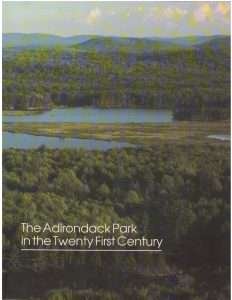
Chapters 3 and 4 of the Commission’s report, The Adirondack Park in the Twenty First Century, were devoted to quality of life, jobs, housing, health, education, and revitalizing hamlets.
George Davis, then the Commission’s executive director and a full-time resident of Essex County, wrote years later, in 2013, that “the Adirondack Community Development Corporation… has been one the most overlooked recommendations of the Commission.”
What was that recommendation? Let the report speak for itself in recommendation # 42:
“The state should establish an Adirondack Park Community Development Corporation as a public benefit corporation empowered with limited bonding authority to provide affordable housing, community facilities and water and sewage systems in Park hamlet and moderate intensity use areas,” reads the recommendation of the 1990 Commission.
The recommendation went on:
“In recognition that the Adirondack Park is a special place of statewide interest, the state should provide technical support and cost-sharing through the Community Development Corporation to help local governments develop the capacity to compete for state and federal funds for housing infrastructure and community facilities.”
The Commission proposed that the Community Development Corporation be funded by a one percent tax on construction and transfers of residences in the Park above certain dollar thresholds and indexed for inflation, with transfers among families exempt from the tax.
Referring to inadequate resources for local governments, the 1990 Commission’s narrative (page 34-35) states:
“To the extent that state action has aggravated the mismatch between resources and need, the people of the state should assume responsibility. State taxpayers as a whole should expect to provide special financial assistance to Park communities adversely affected by their Park location; that is the price we must all pay for preserving the beauty and natural character of the Park, a region that inevitably requires restrictive land use planning and the discouragement of inordinate population growth.”
“The state government also should restructure its local aid programs to make them more equitable to Park communities. It should help local governments develop additional revenue sources, particularly ones that advance environmental protection goals. To insure the high level of environmental protection and public amenities required in the Park, the state should subsidize services mandated on communities but particularly difficult to provide in a park setting.
“Basic to the Adirondack Park Agency Act was the idea that local governments would be full partners in the administration and management of community planning programs. The commission believes that this is crucial today and that local governments should be given the technical and financial help to get this job done.”
Additional recommendations related to Local Government Services (#50):
“The Legislature should revise the general purpose revenue sharing local aid program to include seasonal residents in the population measure used in distributing the aid within the Park.”
And this (#53):
“The Legislature should authorize APA and local governments to impose impact fees on developers for the purpose of transferring to new developments the full cost of new roads, sewer, and water facilities;”
And recommendation #54:
“The state should provide higher levels of aid for solid waste disposal in the Park in recognition of its special status and the waste generated by the tourist and seasonal population.”
Governor Mario Cuomo’s Commission on the Adirondacks in the Twenty-First Century was forward thinking and comprehensive. It simultaneously addressed the open space character, community economy, quality of life and ecological integrity of the Adirondack Park.
Not all of its recommendations were workable or desirable, then and now. However, as just shown by speakers at the ARC Conference in Lake Placid, much of the Commission’s work remains highly relevant today.
One of the most relevant is the 1990 Commission’s experience and recommendation that “state taxpayers as a whole should expect to provide special financial assistance to Park communities adversely affected by their Park location; that is the price we must all pay for preserving the beauty and natural character of the Park.”
Governor Kathy Hochul, State Legislature, local government leaders, and all Park stakeholders could do worse than rediscover overlooked Commission recommendations, and how they all fit together in one extraordinary, interwoven fabric.
Read more about the Adirondacks.
Illustration: Report of the Commission on the Adirondacks in the 21st Century, April 1990.
Source link