 Town of Lake George officials say construction continues on schedule for the “Repose of the Fallen” project involving the reinterment of the skeletal remains of 44 people who are believed to have been associated with a Continental Army smallpox hospital when they died during the American Revolution.
The remains will be interred in a new memorial located in Lake George Battlefield State Park that will be dedicated during a public ceremony on Friday, May 22.
The remains were discovered in February 2019 during a construction project on private property on Courtland Street in the village of Lake George.
Months of subsequent excavation work at what turned out to be an 18th Century cemetery, involving scores of volunteers overseen by archaeologists with the New York State Museum and the Department of Environmental Conservation, resulted in the recovery of 44 sets of remains, many of them believed to be American soldiers or associated personnel who likely died in 1776.
About 10,000 Continental Army soldiers from Connecticut, Massachusetts, New Hampshire, New Jersey, New York, and Pennsylvania served during the failed Invasion of Quebec during 1775-76.
Starting in early 1776, a smallpox outbreak decimated the army as it retreated from Quebec City to Montreal, then south to Crown Point and Fort Ticonderoga on Lake Champlain.
Soldiers and camp followers with smallpox were transported via boats to Lake George’s southern end, where the army established a large hospital at Fort George. Hundreds of soldiers are known to have died through the summer of 1776 and were buried in unmarked cemeteries in and near what is now the village of Lake George.
Lisa Anderson, the New York State Museum archaeologist who supervised the recovery of the remains uncovered in 2019 with Chuck Vandrei, said “most of them were young men of military age in their teens and twenties.”
Chuck’s and Lisa’s research has corroborated early speculation by David Starbuck about the site: that these remains may have been part of a larger burial grounds associated with the Fort George smallpox Hospital.
Although the identities of those uncovered at the Courtland Street site are unknown, several uniform buttons found with the remains indicate that at least one of them served in the 1st Pennsylvania Battalion, known to have fought in the Quebec campaign.
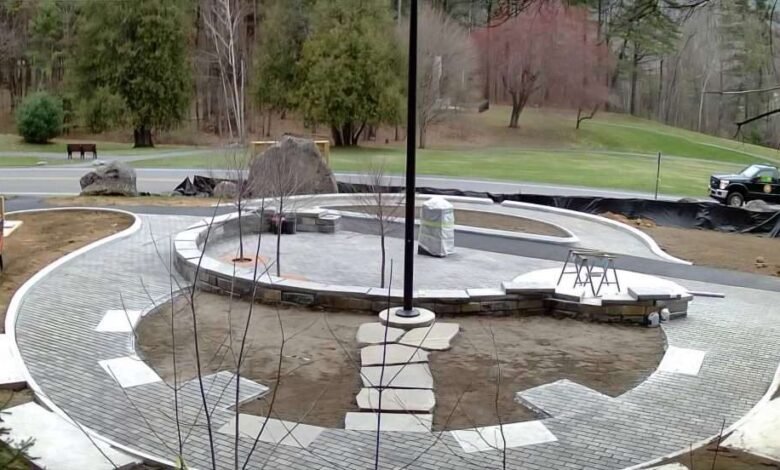
Construction of the reinterment memorial began last October on a knoll along the east side of Fort George Road in Lake George Battlefield State Park.
The design includes several secured columbaria for the final resting place of these early patriots, seating, interpretive signage and a new memorial plaza.
The nearly $700,000 project, funded through the New York State Downtown Revitalization Initiative and private donations, will be formally dedicated on May 22, beginning at 11 am.
The ceremony at the project site will involve municipal and state officials as well as members of Revolutionary War re-enactment groups and local historical organizations such as the Lake George Battlefield Park Alliance, the friends group to the historic property.
Other contributors to the project working under the Town of Lake George’s leadership, include: the New York State Museum; the Department of Environmental Conservation, which manages Lake George Battlefield Park; Empire State Development; the state Department of State; the Lake George and Warren County Historians;, the Lake George Historical Association; Lake George Central Schools; and the Warren County Historical Society.
Read more about the Invasion of Quebec.
Photo: The nearly completed Lake George reinterment memorial at Lake George Battlefield Park, April 2026 (provided by Town of Lake George).
Source link