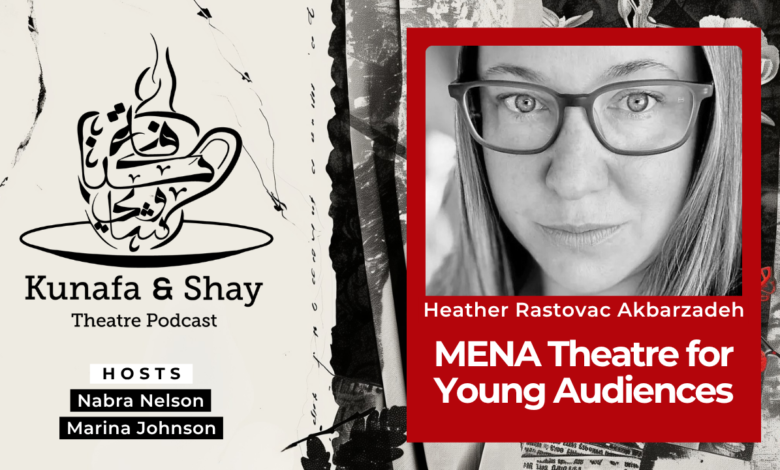
Nabra Nelson: Salam Alaikum! Welcome to Kunafa and Shay, a podcast produced for HowlRound Theatre Commons, a free and open platform for theatremakers worldwide. Kunafa and Shay discusses and analyzes contemporary and historical Middle Eastern and North African, or MENA, and Southwest Asian and North African, or SWANA, theatre from across the region.
Marina Johnson: I’m Marina.
Nabra: And I’m Nabra. And we’re your hosts. Our name, Kunafa and Shay, invites you into the discussion in the best way we know how, with complex and delicious sweets like kunafa and perfectly warm tea, or in Arabic, shay.
Marina: In each country in the Arab world, you’ll find kunafa made differently. In that way, we also lean into the diversity, complexity, and robust flavors of MENA and SWANA theatre.
Nabra: Season six of this podcast marks a double milestone, the thirtieth anniversary of Golden Thread Productions, the oldest MENA theatre company in the US, and my first year as the theatre’s new artistic director. Across ten episodes, we use Golden Thread as a case study to revisit landmark productions from 1996 to 2026, and trace shifting tropes, political urgencies, and aesthetic strategies that shaped the company’s early decades.
Marina: This season also expands to reflect on the past three decades for MENA theatres across the US, not as a closed chapter, but as a living archive, one that illuminates where we’ve been and where we’re headed.
In this episode, we turn to Fairytale Players with guest Heather Rastovac Akbarzadeh, exploring how fantasy, folklore, and play become tools for political imagination for young audiences. As part of Golden Thread’s early years, Fairytale Players carved out space for joy and belonging. Together, we ask what it means to stage fairytales with an MENA theatre framework and tell culturally specific stories to young audiences.
Nabra: Heather Rastovac Akbarzadeh is an interdisciplinary scholar-artist and an assistant professor in critical dance studies at the University of California, Riverside, with faculty affiliation in UCR’s Program of Middle East Studies and Islamic Studies. Extending upon more than two decades as a dance maker, artistic director, and dramaturg among diasporic SWANA and particularly Iranian-American communities, her scholarly research and publications examine diasporic SWANA performances of refusal that are choreographically oriented toward undermining neocolonial structures of seeing, feeling, and knowing the Middle East. Heather earned her PhD in performance studies from UC Berkeley, with a designated emphasis in women, gender, and sexuality, followed by a Mellon Postdoctoral Fellowship in Dance Studies at Stanford University, and a UC Chancellor’s Postdoctoral Fellowship in the Department of Asian-American Studies at UC Davis. She served as Golden Thread Productions’ Fairytale Players Program Manager from 2021 to 2023. Throughout her career, she has performed in DIY street performances, activist circuses, MENA and SWANA cultural events, and full evening dance works on concert stages. Her diverse experience as an educator has ranged from performing in the Folklife in the Schools program in her hometown of Seattle, to teaching performance and dance theory and practice at UC Berkeley, Stanford, and UC Riverside.
Marina: So Nabra and I wanted to add a little bit of context to this episode, which is a great interview with Heather, but we wanted to talk a little bit about the start of Fairytale Players before we dig into the time that Heather was program manager from 2021 to 2023.
Nabra: In the early 2000s, as Torange’s friends began raising young children, they approached her with a simple but generative question. Could Golden Thread offer programming for kids, even a theatre camp perhaps? That question sparked what would eventually become Fairytale Players. The first experiment took shape as a summer camp at the Persian Center in Berkeley, where the children worked on The Girl Who Lost Her Smile by Karim Al-Rawi. Torange explained that she chose the story because it was inspiring and centered art making as a source of joy and well-being. Its structure, focused on a little girl, a little boy, a hoopoe bird, supported by an ensemble, also fit the size and composition of the camp. The experience was really successful and revealed a clear appetite for culturally rooted theatre for young audience.
Marina: And it just shows that Torange Yeghiazarian again, like really was listening to the community. Whenever she was creating work with Golden Thread, she was seeing what the community needed. I was so interested in when I heard this because a theatre that I work with in Palestine, Al-Harah Theatre in Beit Jala, in the occupied West Bank, has a play that is called Jihan’s Smile, and it’s based on the same book. Children’s theatre in Palestine is a really big deal and a thriving practice where so many good children’s plays tour around. It’s very accessible. It’s free. It’s often in the streets. This episode is not dealing with children’s theatre in Palestine, but it’s interesting to note that as we’re looking around for other MENA-specific children’s theatre in the United States, we don’t find a ton, but what we do find, I think, is really responding to the needs of the community, just like in Palestine.
So soon after Torange’s initial experiment, the Asian Art Museum invited Golden Thread to present a family performance for its Nowruz celebration. The camp piece was expanded into a longer production, incorporating elements of naghali (or naqqali), live music, and three of the children from the original camp. Although the museum titled it An Iranian Fairy Tale, the original book was credited in the playbill. The production was also presented at the AAPI Festival at Soma Arts that same weekend. For those performances, an actor from LA with experience in naghali was invited to join the team. And so a note on naghali (or naqqali) is that it’s an Iranian dramatic storytelling where the performer, the Naqqāl, recounts stories in verse or prose accompanied by gestures and movements, and sometimes instrumental music and painted scrolls. So just a little bit of context there. In this timeline, a subsequent outdoor performance on the Embarcadero featured Torange’s mother (Vida Ghahremani) in the role of the Naqqāl. By that time, the production had reclaimed its original title, The Girl Who Lost Her Smile.
Nabra: When the school year began and the children were no longer able to perform, Torange and her collaborators decided to establish a dedicated touring ensemble focused on children’s theatre. This ensemble became Fairytale Players. In shaping the program, Torange consulted with JoAnne Winter of Word for Word, whose longstanding school and library tour model provided this structural template. Then they had a seven-member ensemble led by Carol Ellis, trained for several months, and then toured The Girl Who Lost Her Smile for one or two years.
However, the financial realities of sustaining a seven-person ensemble proved very difficult. Performance fees were way too high for most schools and libraries, and compensation could not adequately support the level of ongoing rehearsal and training required. As a result, programming lacked the consistency that Torange had originally envisioned.
Marina: Despite those challenges, demand for youth programming remained strong. Families who experienced the work wanted more. After securing a grant, Golden Thread hired an education program manager. A study conducted during this period revealed that most schools and libraries had budgets of approximately three hundred dollars per show, and that typical assemblies were structured as fifty-minute sessions: a thirty-minute performance followed by a twenty-minute workshop. In response, Fairytale Players shifted to a two-performer model, creating thirty-minute productions accompanied by workshops in dance, visual arts, clowning, and movement. This streamlined format became the enduring model for the program.
Nabra: In discussing the broader landscape, Torange noted that she’s not aware of any other US based companies consistently producing MENA-focused theatre for young audiences. Word for Word staged a production based on a Persian epic, but sustained youth programming in this area appears to be very rare. She cited Hafiz Karmali as an important aesthetic influence. In 2006, he brought Island of Animals to Golden Thread in partnership with the Afghan Coalition, premiering in San Francisco and Fremont. In 2010, he returned withRumi x 7, part of a broader initiative called Islam 101, which sought to celebrate Islamic art and literature through circus arts and clowning. The production toured widely in the Bay Area, including performances at the Asian art museum, schools, and community centers, in a matter that paralleled the Fairytale Players’ touring model. In 2014, Torange wrote and directed The Fifth String as part of Islam 101 in partnership with the Islamic Cultural Center of Northern California, with additional performances at ODC and Brava in San Francisco. Ultimately, the Islam 101 initiative did not continue due to funding challenges and the conclusion of her collaboration with Karmali.
Marina: From its inception, Fairytale Players primarily adapted children’s books and folktales. The only fully original work that Torange identified was 21 Days That Change the Year. Over time, the company developed a flexible performance framework, a consistent opening and closing, one or two songs or dances, and an element of clowning or acrobatics, which facilitated creation and casting. Yet, as Torange emphasized, the central challenges have remained funding, and the difficulty of securing consistent bookings, even as community interest has persisted.
Nabra: So now we’ll jump into our interview with Heather.
Marina: Heather, we are so happy to be talking with you today about Fairytale Players.
Heather Rastovac Akbarzadeh: Thanks for having me.
Marina: Can you talk to us a little bit about your background itself? Because we read your bio, so audiences are familiar with that. But we would love to know a little bit about you as an artist and scholar. And then we can talk about sort of how that has lended itself to your work with Fairytale Players.
Heather: Sure. Thank you. So I am, for about twenty five years, I have been a performing artist, an artistic director of dance ensembles primarily. I am an arts educator and scholar, and I have been working within and with diasporic Middle Eastern communities in primarily the Seattle area, as well as the San Francisco Bay area, and more specifically with diasporic Iranian communities. So my training is in a variety of dance genres, which then eventually led me to perform Iranian dance among primarily Iranian communities and audiences, but also for the purpose of cultural education in the early days, because I started dancing particularly with an Iranian music ensemble named Shourangeez in Seattle. I was invited to kind of be a founding member of the dance component of the music ensemble, and that was shortly after September 11th in 2001.
And a big reason why I was invited to, and this is, I think this is a funny story, a big reason why I was invited into the ensemble is because they were currently, currently there was a lot of demand for them at the time to come into the local, particularly elementary schools through the Folklife in the Schools program in the Seattle area, which in response to the kind of outcome of a variety of unfortunate discourses following September 11th. And so schools were invested in bringing cultural education through music and dance and other arts into their schools for cultural education at the time. And Shourangeez was touring in these schools, and what I was told in the beginning was, yeah, you know, we’re a bunch of middle-aged Iranian and Kurdish musicians singing classical and folkloric songs in a foreign language, and these kindergartners especially are, like, bored. They’re super bored. So we need dancers. We need dancers to bring this to life.
And so I was invited to be in Shourangeez to primarily help support their cultural education mission in the schools in Seattle. And that experience was formative to me, for me, although children haven’t been my primary demographic of either teaching or performing, it stuck with me because really the children approach the performances with such curiosity and thoughtful questions and so much non-bias, right? And it really, really landed on me how important, if I was invested in social justice—which I have been from the beginning of my, kind of as part of my mission as a performer—that children are really a core, a key audience for where we began with our social justice work. If we can provide exposure and really, kind of, leverage that non-bias and open-mindedness and curiosity, that is where we can see the fruits of social justice labor, you know, start to bloom.
So, yeah, from there, simultaneous to my time dancing with Shourangeez, as I was in community college, I transferred to the University of Washington, where I completed a bachelor’s degree in Middle Eastern languages and cultures with a focus on Persian language and literature, and then later completed a PhD in performance studies at UC Berkeley after writing a dissertation on diasporic Iranian dancers and performance artists. I’m currently an assistant professor in the Department of Dance at UC Riverside, and so I get to continue both my creative and scholarly work there. But also alongside academic work and performance work, I’ve worked in various service, creative, and educational positions with multiple community arts organizations in Seattle area and in the San Francisco Bay Area, including Iranian-American Community Alliance in Seattle; Danceversity, World Dance for Youth in the Berkeley area; creating curriculum with Iranian dance and some choreographies for the program to teach. Also, I was a dancer in Ballet Afsaneh, and they have a culture society called Afsaneh Art and Culture Society, and then I’ve also worked with Golden Thread Productions previous to my time as a program manager, doing different work, like I was the ReOrient Forum coordinator back in 2012 for the ReOrient short plays.
So, yeah, really, my life’s work over the past two plus decades have been bringing together, you know, performance, the arts, activism, scholarship, and kind of community partnerships and social justice work. And so for me, Fairytale Players was a great opportunity for me to put some of these missions into practice.
Nabra: So how did Fairytale Players start, and what was its mission? Can you tell us about, you know, everything you know about that genesis and how you came into it?
Heather: Yes. So Golden Thread Fairytale Players, to kind of give a synopsis of what it is, is the Theatre for Young Audiences Program of Golden Thread Productions in the San Francisco Bay Area. And as we, most of us know, Torange Yeghiazarian is the founding director, artistic director of Golden Thread, and I think we’re in our thirtieth year. Along the lines, I think in its early days, there was so much grassroots and DIY kind of stuff occurring that children were often part of that equation, in part because communities have children. And as we know, with lots of MENA SWANA communities, they’re integrated into our activities, and they’re exposed to all sorts of different storytelling practices, right? But I, so I am sure—this is speculation—that children were a part of, in some form or another, the early days of Golden Thread Productions.
I think formally, if I’m correct, and since around 2003, Golden Thread created the Fairytale Players Program. And it has toured original plays. Up until this point, all the plays of Fairytale Players have been written by Torange. And these plays have been inspired by Middle Eastern folklore and also draw from multiple storytelling traditions, such as hakawati storytelling, ru-hozi and out of Iran, naghali (or naqqali), Karagöz shadow puppetry. And so the style is very lively, very physical. The shows combine storytelling with puppetry, music, dance, circus techniques, and most importantly, the use of various Middle Eastern languages. And so I think the original idea, which has continued, is that it’s a little bit like a street performance. It’s a contained performance, and that works both in its kind of aesthetic, but also in its practicality of touring elementary schools where you just have a box of props and you’re able to pop them up where you are and then close them down and then off you go to the next site. So it has this style and aesthetic and quality of kind of street performance or the types of performance you might see in squares, you know, of the naghali (or naqqali) saying, doing storytelling or ru-hozi in the kind of space of the open air yard in the backyard. So it has that quality and it continues through today. And it, you know, has historically, and while I worked there, has a total of two players who play many characters and we call them players. So player one, player two. You may hear me when I talk about the particular play that we produced as I worked there. I’ll call, I’ll refer to them as players.
So these plays have toured to schools, libraries, community centers, festivals, and museums in the greater San Francisco area. But really a very, because Golden Thread is situated in San Francisco itself, a lot of strong relationships with the San Francisco Unified School District. And so some of the plays, just to kind of name some of the plays that have been produced, Nasrudin’s Magnificent Journey to Samarkand was the play that was produced while I was there. And then Leila’s Quest For Flight,Princess Tamar Rescues Nazar the Brave, and then 21 Days That Change the Year, which is about the Persian holiday of Nowruz. And so the mission really centers on bringing Middle Eastern stories directly to children and creating, I would say, joyful encounters with Middle Eastern culture. And as we know, 2003 during the kind of the era of the axis of evil and American occupation of Afghanistan and Iraq and a lot of the negative stereotypes that were circulating in popular culture and in political discourse and in media, there was a need. And I would argue still is a need to show other aspects of the Middle East that are not as dominant in the US. And so this, the mission would, I would say, include cultural education, representation beyond stereotypes and building, and then also building…. So that would be for maybe audience who were not of MENA or SWANA heritage. But for those also that are of MENA heritage, they serve a purpose of building a sense of belonging and identification for these kids who don’t get to see representations of themselves in a positive way.
So yeah, I would say that is those, that’s the synopsis of what Fairytale Players is. That’s the mission. And I myself started, I was transitioning for a period following the start of the COVID pandemic out of academia. I thought it was going to be a permanent thing, but it turned out a temporary thing. But I was very, I feel very fortunate on multiple levels to have had the opportunity to work with Golden Thread Productions and Fairytale Players. But I was at the time looking for arts, arts administration work so that I could kind of do, like I said, in practice what it was that I theorize about in terms of social justice, but also consider alternative, alternative pathways for careers outside of the academy.
And I was in this place of liminal, liminal—not knowing what was going to happen with my life. And around that time in November of 2021, I saw the job call for Fairytale Players program manager. And I had, as I mentioned, a very long relationship with Golden Thread Productions. And it just came at a time where I was like, this is so serendipitous and so amazing because this is exactly what I need in my life right now. I applied, I got the job, I started, so then I formally started in December 2021. I was with, I was with Golden Thread and Fairytale Players until December 2023, shortly before I started my position at UC Riverside. And I will say that the program of Fairytale Players, there wasn’t anyone who had held the position of program manager for at least a year or two previous to my starting. So there was a gap and I would say that that in part had to do with the COVID pandemic. Although I will share that during the pandemic, Fairytale Players continued its best to partner with schools in the San Francisco Bay Area through offering a radio play of Leila’s Quest For Flight. And so there, that was offered through I think the year of 2020, maybe in this later spring of 2020 into the fall, perhaps into early 2021. So I came at a time where we were finally able to get back into schools, which was both challenging because there were lots of limits that were difficult for us to negotiate. For instance, the, you know, wearing masks and our costumer, Sarah Al-Kassab, who was also the director of the play, for instance, she found a way to get masks that have that, that kind of clear, transparent place where kids can see smiles. So there was ways in which we had to really negotiate and navigate the re-entry into schools, but it was also so incredibly powerful and heartwarming. And I’ll talk more about this perhaps a little bit later of what it meant to bring everybody, kids and educators and us and the actors back into social spaces of joy and play and performance again was really, really powerful. I mean, I get chills just remembering that particular historical moment for us.
So, so yeah, I, I started in 2021 through 2023 and I managed touring logistics and built partnerships. I developed a kind of a dramaturgical educational guide for the play that we produced at that time and conducted program assessments.
Nabra: Well, let’s talk about what you kind of ended on there, which is those moments of recognition for both MENA youth to see their stories reflected on stage, but also non-MENA youth who seem to have responded really well to the work. So can you talk about some of those memories and moments that stood out to you?
Heather: Sure. So I want to give a little credit to a couple people for, for, for that I’m going to be citing. So how, for MENA children, so let me go back for a second and share that for the first year of my working with Fairytale Players and of the tour, I was still working remotely. I had a toddler who, without child care, so I felt very much still kind of in the pandemic. And schools were also limiting the amount of outside providers that could come into, into the schools.
So I actually had what, did not see a live performance of, of Nasrudin’s Magnificent Journey to Samarkand for, for more than a year of managing the program. So I relied a lot on just our teacher evaluations, but also I want to give a shout out and some credit to one of our community partners and the program manager at the time of the American Association of Yemeni Students and Professionals. Her name is Sabria Hassan and she was an incredible partner who helped bring and really advocated for bringing, she had partnerships with Oakland Unified School District. So she helped bring our program into the Oakland schools. And so a lot of my, a lot of my knowledge around the meaning making for MENA children, I owe to her in our conversations. And so she also, of course, through Sarah Al-Kassab, who was the director, she also was the touring stage manager, and then eventually on the second year, she was one of the players. She played Nasrudin. So through Sarah and Sabria, our teacher evaluations, I learned the ways in which it impacted MENA children particularly.
So I heard from them, kids would say like, “oh my God, I know that music, that music sounds like ours,” you know, if they were Egyptian and then there was there was something that was even Turkish or Persian and then for the costumes, some of the quotes were, “oh my God, we wear clothes like that for holidays” or somebody else also shared, “I know what baklava is” because there’s this reference to baklava in the play. And then one educator in a survey says that particularly a student from Egypt in their class lit up the entire performance. And I will share that Nasrudin’s Magnificent Journey to Samarkand is one of the plays in Fairytale Players repertoire that actually is a, I would say, a pan-Middle Eastern play.
Nasrudin, just to give some background for those who may not know this character, this is a comedic person, comedic character, believed to be a real live, real lived person. And he is the wise fool of the greater SWANA region. He’s known as Mullah Nasruddin in Persian, Juha in Arabic, or Nasruddin Hodja in Turkey. And so the greater kind of SWANA region all have folklore as far as South Asia and parts of North India, folks are very aware of this Nasrudin figure. And he’s humorous, he’s kind of considered a fool, right? He rides his donkey backwards, a donkey is a very close companion of Nasrudin. And so there’s something also about this particular story and the way that Torange wrote this play that really resonated beyond an individual very targeted group.
So Leila’s Quest For Flight was about a Palestinian girl. And of course we can still see universal themes, but it was very specific use of Arabic exclusively, for instance, when there were references to Arabic words. But this play had words that were Persian, Turkish, Arabic, and Armenian. So it really had this way to reach broader SWANA children rather than an individual kind of group within them. And so many were, maybe they had heard of Nasrudin even through their parents most likely, right? So there was something about this particular play that really supported this sense of identification and belonging. And so really that I would say is what Sabria really shared with me, especially Sabria, she shared that as someone growing up shortly after September eleventh, you know, that seeing only negative representations of the Middle East in media, that for her and for the children that she serves, really this sense of building confidence, this sense of building belonging in a place, in a time in which this sense of belonging is quite fragile.
So I would say for MENA children audiences, it really served those purposes. And then for broader audiences, non-SWANA kids, I want to give credit to one of the teachers on special assignment in the Oakland Unified School District whose name is Angela Norton Tyler, and we were in lots of conversation and she shared that primarily the first thing that she really emphasized was, you know, we are in a time where the arts are not included in our schools. And so she really advocated for bringing Golden Thread Productions Fairytale Players into the schools because she saw the ways in which the arts supported the kids in two ways. And one was academically and one was socially and emotionally, especially following the pandemic.
So she was sharing how teachers were nearly crying from happiness in the post-show Q and A because they saw students—so we hold a post-show Q and A where the touring stage manager will engage kids in asking questions about the play, answering questions about the play. And Angela shared the ways in which students were using complete sentences and drawing on memory from the play and how this is what they’re really attempting to teach in the classrooms but that weren’t quite landing through these kind of more sit-down workbook standardized test modes.
And so she was sharing how, even just more broadly, about how theatre is such an entry point for these kind of multimodal essential ways of learning and that further also Angela shared how in their curriculum they’re using folklore but that it’s a very Eurocentric folklore so for students to get exposed to other languages, other stories beyond Eurocentric curricula was really helpful for them. And also I would say after the pandemic teachers really kept saying how kids, and I’m remembering a panel when there was a virtual conference panel for the theatre communications group TCG that was on theatre for young audiences and particularly post-COVID and educators there and the educators that I talked to while I was program manager really emphasized the need and the priority for joy and laughter and that really felt and collectivity and that felt more urgent at the time and I would continue I would argue that it still holds true that these opportunities for joy and laughter and collectivity were at that time very significant and so seeing students clapping, dancing, and engaged was really, she felt, Angela shared, very transformative at that time. And she kept saying how kids constantly talked about the play for weeks and weeks and weeks following and that’s something we can’t underestimate. I mean she says learning should be fun and that’s what we’re losing with this hyper-emphasis on standardized testing in lots of school districts. So, in addition to what theatre can in general bring for a multimodal way of learning, there’s also the learning beyond the Eurocentric curricula and then also the joy and laughter and collectivity that our play was able to bring them.
Nabra: That’s so lovely and all of the quotes that you shared just made us all smile so huge. I just love working with youth as well. I’m a teaching artist and teacher often and so it’s so lovely to just hear about that history at Golden Thread, and with MENA theatre specifically. Do you know of any other US MENA theatre for young audience programs? Or, was this really the first one that you know of, or the only one at the time?
Heather: Yes, so I of course, performance happens in MENA communities that incorporates kids you know from homes to parties to community events but structurally or more formally kind of US, in the US, children’s theatre initiatives that are MENA-focused as programs, I had never heard of any previous to Fairytale Players (FTP). When I was a program manager I also sought similar programs just to learn about and to learn from and to potentially create partnerships with and found none.
And so to me this is why FTP is such an important program, and yeah I think again there are individual, kind of individual plays that might be produced or but not so much program like FTP, so yeah I think this points to really kind of the significance of such a program like FTP.
I will share we, and then also the other part of that is as I knew I was departing my position with FTP, we were considering at the time what would the next season look like? So we had toured Nasrudin’s Magnificent Journey to Samarkand for two years and in my search for other plays, other playwrights writing MENA stories for children, there were really next to none.
But I’ll share that we were in conversation with Denmo Ibrahim whose immersive children’s audio work Zaynab’s Night of Destiny, it was a project that toured multiple public schools in Kentucky with the support of the Doris Duke Foundation for Islamic Arts and we were talking about adapting it, or maybe even touring that audio play or the audiobook. But then of course FTP went into hiatus shortly after I left so we never pursued that. But otherwise, like similarly there are few MENA focused theatre for young audiences program or none, and also few playwrights unfortunately focusing on that.
Marina: I think people who are listening who are, um, “I have a story that I want children to hear about” will feel inspired to write or to put the pen to paper because as you’ve highlighted there is a real need for culturally specific youth theatre and you’ve touched on the political and cultural reasons—the post 9/11 landscape, the idea and need for representation. How thrilled some of these youth were, in addition to the learning goals that can be accomplished by incorporating the arts.
You talked about Nasrudin and that was really exciting because he is not part of the folklore that I know very well, so I was excited that FTP was using Nasrudin to touch on people who might be more familiar there. Are there other stories or other pieces of folklore that you, as someone who has a child, long to see told for youth audiences? Or what do you hope the next sort of chapter for this kind of work—besides FTP hopefully coming out of hiatus at some point—but for people listening who might be interested in starting their own program: Are there stories that you recommend or hold close to your heart that you would love to see out there?
Heather: So for me I think yes, my child is currently seven and I think any of the stories coming out of Middle Eastern SWANA folklore would be lovely way in which she can grow up. She’s half Persian. She can grow up with a certain strong sense of identity. But to be honest I feel like what was a gap even as I was a program manager for FTP is the targeted audiences of middle school, high school, and college kids.
I feel that was the missing group. So our plays in theory are produced for FTP for ages five to fifteen. Nasrudin as a play, and I’ll return to your question in a second, but I’ll say Nasrudin as a play was I think a unique one in which it was simple enough. And this is kind of the quality of Nasrudin’s jokes: they’re simple but they’re only seemingly simple really, there’s layers upon layers of depth and knowledge and wisdom in them. And so as a play it also had a lot of humor that I feel like almost would be, was appropriate for five year olds. But like I as an adult, for instance, when they used the surfer dude—there was a moment in which there was surfer dude accent right—like I don’t know I found that funny as a grown-up. So I mean it was a unique play in which I felt both the script and the jokes were layered and nuanced enough to be able to span five to fifteen years old or even beyond. But, I would say generally the plays really serve elementary school kids most and perhaps in some ways like early middle, middle school—this, this is a little bit of a personal opinion about them.
But I, I was interested in, at the time how, what could we produce or how we could target middle school through college age kids. Because they are still kids honestly. So when we say kids or youth, I think a lot of these plays are suitable or oriented toward very young ones, my daughter’s age. And then we produce incredible plays at Golden Thread Productions that I think college kids could go to and in fact when I was a graduate student at UC Berkeley and I was teaching courses there I assigned my students to see plays at Golden Thread Productions.
But I don’t think those plays were written with you know that group between fourteen and twenty in mind and to me that’s a big gap. And I think that’s an important gap to pay attention to for lots of reasons. One: I think this is a real group who’s struggling. They were in middle school during the pandemic, at a very important time in their life. They are really feeling the weight of the world in ways that five year olds might be shielded from. Right? They are dealing more directly with bullying for instance than maybe a five or six or seven year old would be.
So for me, I feel like the stories that we write for MENA youth, I think there’s a real need for that particular demographic in mind and writing them or adapting them. And I also love play—right now my work and my research in general is kind of interested and invested in the intersections of SWANA communities with Black, Indigenous, and other immigrant communities—not to collapse differences but to kind of show shared histories and solidarities. And young people are already living at those intersections, right, through schools, neighborhoods art scenes, you know kind of consumption of art and activism.
And so I feel personally what I would be excited to see are plays written for that particular demographic with these kind of, like the intersections of these communities in mind and addressing through real life stories, and perhaps references to mythology and folklore into the real day you know kind of contemporary world but in some way that these, this particular demographic can can also find a sense of identification in what’s being represented and also show and kind of facilitate and support notions of solidarities across different types of struggle among the communities they are living with.
Marina: Yes. I just want to touch on one of the points you just made because Nabra and I will record a little bit about other youth theatre and you had mentioned when we talked before Heather about youth theatre in Palestine.
Heather: Yes.
Marina: And whenever I talked to Iman Aoun who is the executive director of ASHTARTheatre, whenever she talks about youth she always talks about people until eighteen or twenty. And for me it was the first time thinking of youth in this way because of course you technically become an adult in the United States, but you’re right I do think there’s this demographic that is sort of missed in the work so thank you for pointing that out.
Heather: Yeah, yeah that’s one of the things that, if I had stayed with FTP, that would have been where I would have wished to bring the programming. While not letting go of what’s working for younger children, thinking through what kind of programming we can do for older youth and young adults.
Nabra: Thank you so much for all of your insight and for your inspiration around this—it just makes me want to go out and do youth theatre for young audiences, which I think is what I really want to do on a Thursday afternoon. I really hope to see this program find its footing again. And really also just see more MENA theatre across the US. It is really needed, and you know, there are more and more MENA theatres popping up, and I hope that we can find those niches to bring that theatre to all age groups. So thank you for that insight, and all of the inspiration.
Heather: Yeah. And may I address one more thing?
Nabra: Of course.
Heather: You all had kind of brought up which is encouraging MENA youth participation, or attendance. So, I want to share four things.
And so the first is that participation grows when programs meet youth where they already are. Right? So that’s also what was incredible. It wasn’t asking audiences to come to our theatre and bring their kids. This was a play that made a lot of effort which involved a lot of outreach. A lot of attempts to garner sponsorship, and it was to meet the kids where they are which is in schools or other types of literacy programs or community centers. So that’s the first step.
Kids participate when they see themselves in something in some way, right? So we need to continue with the types of representation that young people can see themselves in.
The second, so that involves outreach, the second is sponsorship. It’s incredibly important for helping subsidize these performances, kind of help remove the financial barriers for these public schools, literacy programs, and community centers who are working on very low budgets. So, I would say, at the time, the most minimal amount that we could charge a school to be able to pay both of our actors equitably and our stage manager equitably was five hundred dollars. Five hundred dollars was a lot to ask of a public school to bring one hour of performance. So the ways in which we were able to do that was through securing sponsorship through various organizations and I just want to thank the Harbor Point Charitable Foundation which, during my time, supported subsidizing these programs and schools but also the history of sponsorship with FTP has been the Middle East Children’s Alliance and Arab Resource and Organizing Center or AROC in the Bay Area. But really that was, that continued to be a huge barrier for us and for schools, was the financial component.
And then obviously the third one is one that we’ve been talking is representation, so kids participate when they see themselves in something in some way, right? So we need to continue with the types of representation that young people can see themselves in.
And then fourth, it’s more broadly and this is basically to show different career pathways. So when I was a graduate student at Berkeley and teaching, they were general education courses for teaching, writing, and research but we could make them around our own thematics. And often, I was teaching non-arts majors primarily in engineering, the natural sciences, medicine. And always, I would have a young person come to me in office hours and say I actually really want to be a theatre major or a theatre minor or you know, an arts in some way. And it was like a forbidden secret they were sharing with me, and so what I would always encourage them is that a) you can be a minor, like consider being a minor. But b) there are so many ways we can find our skillset in the theatre. And that of course includes technical roles, design, sound, management—more than just the idea of acting, right? So I feel like for young people who are very, you know, rightfully concerned about their financial futures, to really emphasize to them that the theatre offers so many entry points, so many skill sets that is not just the what we see in the front which is the acting, right, and so even in my department of dance right now and I emphasize to students like who are considering the major or maybe they are on the fence. You know the theatre or performance offers so many skills, and so many ways in which whatever it is, you’re doing, can bring to it. So that’s another key way of garnering youth participation in the theatre and in MENA theatre.
Marina: That’s so important Heather and I appreciate that you put it into a four-step list because I do think like if, right, if we were wanting more programs like this then we need the people to have actionable items and I think that’s a really great way for us to be able to end this. To say “here are four things, please take these and the other information that you gave us. And go forth, let’s see more of these programs pop up.” Thank you so much Heather, this has been incredible. We’re really grateful for your expertise—
Heather: My pleasure.
Marina: And to get to hear about your experiences with FTP and also just talking about the important need for this theatre and performance more broadly. Thank you.
Heather: My pleasure. It’s been a pleasure, thanks so much to you for inviting me.
Nabra: This podcast is produced as a contribution to HowlRound Theatre Commons. You can find more episodes of this show—and other HowlRound shows—wherever you find podcasts, including on noncommercial open source apps like Anytime Podcast Player for iPhone and AntennaPod for Android. If you loved this podcast, please share it with your friends. You can find a transcript for this episode, along with lots of other progressive and disruptive content, on howlround.com.
Marina: Have an idea for a meaningful podcast, essay, or TV event that the theatre community needs to hear? Visit howlround.com and submit your ideas to this knowledge commons.
Marina and Nabra:
Yalla! Bye!