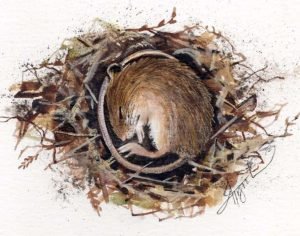
 Spring is often portrayed as the season of rebirth, and for many organisms it is. But spring is also the season of reawakening for those species that spend the winter in some form of hibernation or reduced metabolic activity.
We have reached the point in our annual commute around the sun when the increased daylight and temperature act as a physiological alarm, rousing organisms from slumber. Some species are harder to roust, stirring from their sleep only when the calendar approaches mid-spring.
The meadow jumping mouse (Zapus hudsonius) is, for a mammal, an especially late riser. In the Northeast, they remain in hibernation until late April or May.
In 1951, researcher Don Quimby documented that they were the last mammalian hibernators to emerge in his study area in Minnesota, out-sleeping other species by an average of three or more weeks.
These 10-to-30-gram mammals spend an astonishing six to eight months hibernating in insulated underground chambers that can be anywhere from a few inches to three feet below the surface.
Most of the fall and winter is thus passed in a state of deep sleep, characterized by dramatically reduced body temperature, slowed respiration and heart rate, and consequently little metabolic activity.
Studies show that hibernating jumping mice occasionally rouse from deep sleep, though they do not feed during these bouts. Meadow jumping mice rarely emerge from their hibernacula prior to springtime emergence, and they do not create winter larders.
Instead, they subsist entirely off fat stores they build up in the few weeks before entering hibernation in September or October. Mice that do not accumulate enough reserves die during the winter, and some studies indicate that rates of mortality during hibernation can be as high as 75 percent.
Meadow jumping mice begin preparing for hibernation based on changes in photoperiod (day length), and, to a lesser extent, changes in air temperature.
The decrease in photoperiod approaching the fall equinox kickstarts the physiological changes associated with hibernation, and temperature regulates feeding rate; the colder it is, the more they eat.
Their emergence from hibernation is likely most strongly tied to increasing air temperature; hibernating mice are presumably shielded from lighting cues in their underground chambers.
This notion is supported by Quimby’s trapping data showing that variation between years in emergence date was associated with other temperature-linked phenological phenomena like leaf break and flower bud development.
Once the temperature of their hibernating chamber reaches some threshold, the mice initiate springtime arousal and bring their bodies back to normal operating speed. They then venture to the surface and turn their attention to making the next generation of meadow jumping mice.
Males emerge first, usually 10 to 14 days before females, and head out to replenish their energy reserves and prepare for the appearance of females.
Researchers have found that female meadow jumping mice become pregnant within a few days of their emergence, so males have a strong incentive not to sleep in too long.
Meadow jumping mice are aptly named; they are excellent jumpers and are most often found in moist meadows. They have greatly enlarged hind limbs, a kangaroo-like stance, and they typically leap or jump instead of scurry.
They can jump more than 3 feet in a single bound. For an animal with a 3-inch body, this represents a distance 12 times its body length – the equivalent of a 6-foot-tall person jumping 72 feet. Most of the time, however, these rodents hop only a few inches.
They also move on all four limbs, especially when in thick vegetation, and are adept at climbing tall stalks of grass and other short vegetation.
The range of the meadow jumping mouse in the Northeast overlaps with that of its relative, the woodland jumping mouse, but the two species tend to stick to their namesake ecological niches.
Meadow jumping mice eat seeds, nuts, berries, leaves, invertebrates, and fungi, and while they are present in appropriate habitat throughout the Northeast, they are rarely seen due to their nocturnal and secretive habits.
As we enter their season of wakefulness, be on alert for these small hoppers in open habitats; you may catch a glimpse of them in your car headlights, or the beam of your flashlight as they bound away towards cover.
Read more about mice in New York State.
Loren Merrill is a science writer and photographer with a PhD in ecology. Illustration by Adelaide Murphy Tyrol. The Outside Story is assigned and edited by Northern Woodlands magazine and sponsored by the Wellborn Ecology Fund of New Hampshire Charitable Foundation: nhcf.org.
Source link