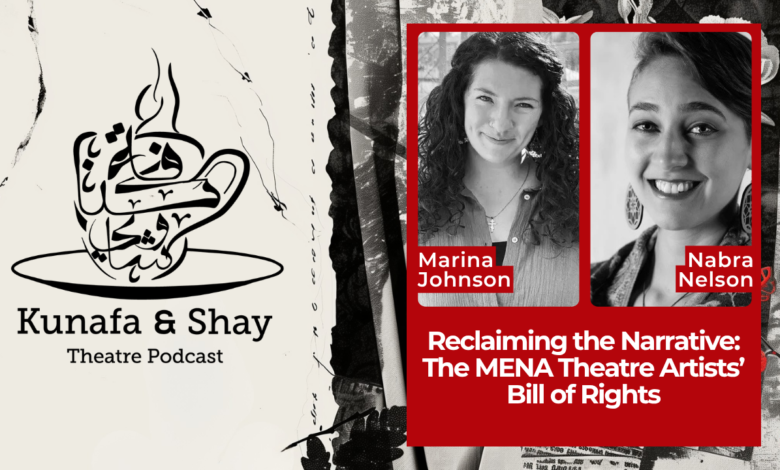
Nabra Nelson: Salam Alaikum! Welcome to Kunafa and Shay, a podcast produced for HowlRound Theatre Commons, a free and open platform for theatremakers worldwide. Kunafa and Shay discusses and analyzes contemporary and historical Middle Eastern and North African, or MENA, and Southwest Asian and North African, or SWANA, theatre from across the region.
Marina Johnson: I’m Marina.
Nabra: And I’m Nabra. And we’re your hosts. Our name, Kunafa and Shay, invites you into the discussion in the best way we know how, with complex and delicious sweets like kunafa and perfectly warm tea, or in Arabic, shay.
Marina: In each country in the Arab world, you’ll find kunafa made differently. In that way, we also lean into the diversity, complexity, and robust flavors of MENA and SWANA theatre.
Nabra: Season six of this podcast marks a double milestone, the thirtieth anniversary of Golden Thread Productions, the oldest MENA theatre company in the US, and my first year as the theatre’s new artistic director. Across ten episodes, we use Golden Thread as a case study to revisit landmark productions from 1996 to 2026, and trace shifting tropes, political urgencies, and aesthetic strategies that shaped the company’s early decades.
Marina: This season also expands to reflect on the past three decades for MENA theatres across the US, not as a closed chapter, but as a living archive, one that illuminates where we’ve been and where we’re headed.
Nabra: In this episode, we revisit a pivotal moment in 2016 and 17, when Middle Eastern American theatre artists gathered across three national convenings to articulate a shared vision for the field. Out of those meetings came two landmark documents, an open letter to American producers and artistic directors, and the “Middle Eastern American Theatre Artists’ Bill of Rights,” drafted by Torange Yeghiazarian of Golden Thread Productions, and Jamil Khoury of Silk Road Cultural Center. We unpack what these documents demanded, the right to tell our own stories without tokenization, the right to cultural competency without stereotype, and the right to artistic agency within institutional spaces.
From casting and cultural competency to coalition building and post-9/11 politics, this episode explores how these texts reframed representation as a matter of structural change, not just visibility. Nearly a decade later, we ask what it means to return to these calls for justice, and how they continue to shape the evolving ecosystem of MENA and SWANA theatre in the United States.
Marina: I’m so excited for us to have this conversation today, Nabra, partially because we talk about these things in a lot of our particular MENA-SWANA circles, but I’m curious if the general listenership has seen these documents. And this is a great way to spotlight them, and bring them to light if someone hasn’t heard of them.
The first document that we’re going to talk about is an open letter titled “Dear Producers and Artistic Directors of the American Theatre,” and the second is “A Middle Eastern American Theatre Artist’s Bill of Rights.” Given that many artists, activists, and scholars involved in these historical gatherings are part of the MENA-SWANA community that we’re both part of, and that continues to make theatre today, our hope is that these two documents will be engaged and discussed in these groups where we already are, but also beyond, because these are formats and letters that can be used in all situations. And also we know that some of the people listening are on college campuses, and these are things that you can take to your college campus, to your production manager, to whoever is part of your department, the department chair, and see how these things can be applied in a more serious way to where you are.
Nabra: The way that they came about is important because it creates a framework also for future creation of similar documents or initiatives, and really thinking about the way that any change comes about, which is gathering of people and discussion of shared ideas. The initial convening occurred in May 2016 in New York City, hosted by the Lark Play Development Center, under the title of Middle East America, A National New Plays Initiative. And the Lark was so important, we talk about this in our new works episode as well, in developing MENA new plays for many years, but unfortunately does not exist anymore.
The second and third convenings, each organized as Middle Eastern and Muslim American Affinity Group sessions, took place in Washington, DC in June 2016, and Portland, Oregon in June 2017, as part of Theatre Communication Group’s annual conference.
Marina: So bolstered by the tremendous input and guidance of the attendees across these gatherings, these documents were created and compiled by Torange Yeghiazarian, founding artistic director of Golden Thread, and Jamil Khoury, one of the co-founders of Silk Road Cultural Center.
So we’ll start with a “Middle Eastern American Theatre Artist’s Bill of Rights.” Nabra, will you read this out for us?
Nabra: Yeah, this is the text and then we’ll chat about it afterwards.
We, the artists of Middle Eastern American heritage and culture, in order to form a more just and inclusive American theatre, adopt the following as self-evident truths. We have the right to tell our own stories in our own words without bearing the burden of representing an entire community’s experiences.
Marina: We have the right to tell our own stories. Great. We have the right to define our own cultural identities free of coercion, policing, and stereotypes, and to embrace our myriad identities, simultaneously.
Nabra: We have the right not to conform to preconceived notions of our cultural identity and to resist political and social judgments in favor of stories that reflect our own truths and understandings.
Marina: We have the right to bring complicated, nuanced, and layered interpretations to the characters we play.
Nabra: We should not be expected to perform preconceived notions of our identities nor acquiesce to hypersexualized or systemically violent representations of our bodies.
Marina: We have the right to examine negative, and/or silly, aspects of our communities, religious traditions, and identity politics without being censured or held up as a model.
Nabra: We have the right to tell stories that criticize certain policies of the US government or specific Middle Eastern governments without being accused of being anti-American, racist, or self-loathing.
Marina: We have the right to tell all stories, including those that are not necessarily about Middle Eastern identity.
Nabra: We have the right to remind artistic decision-makers of the following: Do not single us out to validate or authenticate all content as it relates to our cultural heritage. Hear our concerns as they relate to our identities with the understanding that we are all here to serve the play. Do not assume that one Middle Eastern artist’s participation in a project automatically lends approval to all culturally specific choices that are made.
Marina: We recognize and acknowledge the colonial history of the terms Middle East and Middle Eastern. We adopt the terms because they are widely understood and because more geographically specific terms such as West Asia and North Africa are inadequate and tend to elicit confusion. While we regret having to use terms that place England at the center of the world, we draw strength from defining Middle Eastern broadly and inclusively in order to embrace the multiplicity of ethnic and religious identities that span Southwest Asia, North Africa, Central Asia, the Caucasus, part of Mediterranean Europe, and our diaspora communities. We understand our respective backgrounds in terms of rich pluralism and interconnectedness. We also define America and American in the broadest ways possible to include the continents of North and South America.
Nabra: Furthermore, at this time in history, it’s important that we include American Muslims of all cultural, ethnic, and racial backgrounds as members of our Middle Eastern American community.
Marina: And then it ends by talking about that the document was created by Jamil and Torange and that it’s signed September 29th, 2017.
Nabra: It’s amazing how much this document holds up and is still so many of the conversations we’re still having. And it just lays it all out here. I feel like we should like annually get together and like publicly say this document out loud. I think that would serve everyone really well.
Marina: Yeah, it was actually very cathartic to read it. So I highly recommend if anyone is at home and wants to do that. But I want to draw attention to, so it’s the “Bill of Rights,” right? And it’s using a framework and a repetitive textual style that people in the United States are likely familiar with because we have the United States Bill of Rights, which is the first ten amendments to the US Constitution that guarantees, quote unquote, guarantees fundamental rights and freedoms. It was proposed in 1789 and then ratified, meaning officially adopted in 1791. And yes, I did have to Google all these years because I do not remember this from my US history classes, because I think we can all acknowledge that the ways that US history are taught leave something to be desired.
Nabra: Yeah, there are better things to fill one’s brain with, I think, at times.
Marina: It’s true. But the reason I mention this is because the Bill of Rights from the United States is supposed to protect individual liberties and limit governmental power. And so this is where we have, like, freedom of religion, speech, press, assembly, petition, the right to bear arms, rights in criminal cases like: due process, right to trial by jury of your peers, no cruel or unusual punishment, et cetera, right?
So these are the statements that I think people often hold up to say that the United States is the, quote, land of the free, which, of course, I’m bringing this up only to contest these things. I don’t know that anyone listening is like, yes, the United States is as free as it’s ever been in an age where we have ICE detaining US citizens and other folks who they should not be detaining at all. But to say that I’m really interested in this group taking the framework of something that people in the United States hold up as the pinnacle of American freedom and then altering it and saying, actually, great, like, let’s take this thing that you say the United States is free and let’s use that and let’s use that template as a way to talk about what MENA and SWANA freedom in theatre looks like, right? And so looking at the powers of theatre and trying to put these in that way, I just find that to be a really fascinating idea.
Nabra: And those kind of core goals that you outlined really resonate here. It’s protecting individual liberties and also limiting the power of, you know, government. You said it in a better way, the way that it’s articulated for the United States, I guess. They probably thought about it for a little while. But, you know, the producers being those with power and, you know, of course, the artists and especially MENA artists being those who need to be able to have rights in places where they don’t often have as much agency. And, you know, it really outlines the power of producers.
You know, I’m a producer myself, of course, and we do have a lot of power. We are gatekeepers by definition. And there’s a lot of responsibility that goes with that. And because we’re also all artists, I think we can fall into that kind of misinformed, I guess, notion that, you know, we’re just the scrappy artists doing this with everyone. We’re just gathering everyone together and, like, facilitating the artist’s voice without kind of really understanding and holding the positionality of our power as producers and the fact that artists need to listen to the producers, that the producers are making a lot of decisions behind the scenes that artists aren’t involved in. That the producers are steering the vision of this work, as well as the director, which hopefully directors are also of our background, but they sometimes aren’t.
And again, that idea that, like, I’m just an ensemble director who gets people together. And all the actors with MENA Heritage are going to have so much agency. Well, there’s an inherent power dynamic that we need to recognize. And, you know, that’s your vision. That’s, you know, partially I believe it’s kind of everyone’s vision, but we come with that expectation as artists that we look to the director for the level setting of the culture and the direction for the vision. And so the fact that there are so many, you know, conversations that happen behind the scenes, that alone really urges producers and directors and those who are having those conversations behind the scenes, making those decisions to keep in mind all of these statutes. It’s a huge responsibility.
Marina: Yeah. And I really appreciate that you’re talking about the power dynamics because we have all of these things that have started in theatre because of historical power imbalances that have been problematic. So like intimacy coordinators, fight directors, right? These all have stemmed from movements in theatre to get away from, you know, practices that were abusive in different ways or that had potential to be. And we want to have these safeguards in place before those situations arise. But I think that there’s often still this sense, especially when we’re creating with people who we’re in community with and in community with in beautiful ways that there won’t be power dynamics or, well, we’re all friends in different ways. And so these things won’t happen. And actually we just want to have guardrails in place always before any production because there are external needs that are always being put on productions, right? Just the fact that there’s an opening night is an external force that is acting on a production. And so I love these guardrails and that we’re getting to have this conversation with the artistic director of Golden Thread Productions, which is also lovely.
Nabra: Yeah, it’s something that it’s very much on my mind, you know, shift, not really shifting. I mean, I’m still an independent artist, but stepping into this position of power and really a gatekeeping position and seeing it from really the other side, I’m trying to hold on to both sides of that sensibility of being an independent artist, wanting to break into the doors of Golden Thread, and now being artistic director. And of course, because I have been deeply embedded in this community, thankfully, you know, a lot of these principles are already inherent into who I am and my art making and therefore my producing.
So, you know, but it’s something I have to keep in mind as well all the time. That’s why I think we should have a public declaration of our “Bill of Rights” so that I can remember and especially so that non-MENA producers and directors and gatekeepers and artists can remember and playwrights also. Let’s actually put that out there. Playwrights have a lot of power and they prescribe a lot of how our cultures are approached. So, yeah, a lot of accountability needs to be remembered on the playwrights’ end.
Marina: So something I also want to highlight, which I think that this document does really well, Nabra and I always talk about the burden of representation. And I think that that is highlighted really beautifully in this document. We have the right to tell our own stories and our own words without bearing the burden of representation for an entire community. And essentially that you can be negative or silly in certain aspects of the identity without, again, speaking for people, all people of that identity.
But there’s this other line that is, you know, do not assume that one Middle Eastern artist participation automatically lends approval for all of the choices. And then do not single out a particular person as it relates to their cultural heritage. And I think, like, so my experience is largely in Palestine. And if you ask someone from, I don’t know, from Ramallah, a city in the West Bank, to Jenin, another city in the West Bank, they have very different life experiences, right? They’re still Palestinian. And then we take these experiences and multiply them in the diaspora and multiply them in other countries that are quite large. I mean, looking at the Nubian Egyptian on the screen across from me.
So there are so many ways that people have just different lived experiences, which we all know as humans, but sometimes in the rehearsal room, I feel like it’s like a director puts the burden on to say, well, and in Egypt, what would this be like? Which part of this huge country and when? And is that person Muslim or Christian? And can we have any more specificity around their identity? So I feel like when we talk, we often have these quite layered and nuanced conversations. But I really appreciate that the document is pushing for these things to be highlighted in other ways.
And if you have a good dramaturg on a project, I think that also really helps to spread out some of the burden just because one person is in that show. And we can get to this a little bit more later because I have notes on this, Nabra. But often people will be like, well, is the show Homeland racist? Because it did give Middle Eastern actors parts. Yeah, y’all, the show Homeland is racist. And I don’t fault any Middle Eastern actors for taking a paycheck to be part of like, right, to like make their art.
Nabra: And we get into a lot of this in the next document that we’re going to talk about and read, which is specifically to producers and artistic directors of the American theatre and gives these like action items, I guess. So I think we should jump into that document.
Marina: Yeah. Let’s talk about them in conversation together.
Dear producers and artistic directors of the American theatre, we know how difficult it is to produce a play in this day and age. Between the budget, the timeline, fundraising, and your artistic priorities, the last thing you need is to find yourself caught in an unwitting debate about representation. We feel your apprehension. After all, you cannot be expected to single-handedly correct centuries of racism and misogyny.
Nabra: Our priority is for more plays written by Middle Eastern American playwrights to be produced across the US. We want this not only because it’s good for us as a nation to hear from the people who’ve been vilified for decades, but because these are American plays representing the perspectives and experiences of vastly diverse communities. We want you to enjoy even more success as producers and artistic directors by choosing timely and potent plays that will excite your audiences. We’re here to help you.
Marina: Play selection. There are so many Middle Eastern and Muslim American playwrights on the New Play Exchange. Many excellent plays are listed there in a range of styles and cast size. Plays with humor, warmth, and three-dimensional characters that reflect your audience’s lives more than you may imagine. You like comedies? We have them. You like heartwarming family dramas? We have them. You like sharp political commentaries? We have them. You need a two-hander due to budget constraints? We have them. You need an epic adventure with a big cast for your students? We have them. You need an experimental play? We have them. You need a historical play? We have them.
Nabra: Casting. Some of you are lucky enough to live in a city populated with Middle Eastern American theatre talent. New York, Los Angeles, Chicago, San Francisco, Minneapolis. That said, there are Middle Eastern American theatre artists working in communities throughout the US. Look for them, including reaching out to performers who create outside our established theatre systems. They’ve probably already reached out to you. Bottom line, you all should be working with more Middle Eastern American actors, directors, dramaturgs, and designers.
Marina: If you have a budget to hire out-of-town actors, we are more than happy to offer referrals. If you do not have the budget to hire out-of-town actors and after a rigorous search still haven’t found any Middle Eastern American actors in your local community, then it’s okay to cast more widely in the interest of telling the story. Keep in mind that peoples of the Middle East are quite diverse and have deep historical and cultural ties to peoples of the South Asian, African, Mediterranean Europe, and Latin American. Reach out to these actors in these communities next. We share many experiences, values, and cultural practices.
Nabra: Basically, don’t let casting challenges deter you from producing Middle Eastern American plays altogether. Telling more Middle Eastern American stories has to be first priority. Discuss your casting options with the playwright, and together arrive at decisions that honor his or her intentions. Additionally, make sure you have one or more individuals on your production team that can provide cultural competency. Which leads us to…
Marina: Cultural competency! Cultural competency is the ability to fully dive into the cultural context of a particular story. In the case of Germany and Russia, most American producers feel familiar enough with the history and culture that gave birth to Chekhov and Brecht. This is more difficult when producing a play dealing with Afghanistan, Syria, or Egypt. In these cases, we recommend you work with a cultural consultant, someone who has embodied knowledge of and lived experience with the community in which your play lives, and more importantly, someone who is also familiar with the creative process. The job of the cultural consultant is not to police the creative process or product. The job of the cultural consultant is to provide creative options plucked from within the actual cultural practices, history, aesthetics, and sensibilities of the community in which the play is set. We are happy to serve as or recommend culturally competent dramaturgs and artistic consultants.
Nabra: Agency is both important and necessary. Cultural competency without agency, the power to impact decision-making, is meaningless. On the one hand, artists from marginalized communities should not be put in a position to constantly represent their community’s experience or validate its representation. On the other hand, you must ensure the artistic and creative agency of the members of the marginalized community involved in your project. It is easiest when you are able to include lead artists, director, designer, dramaturg from the community in your creative team. When this is not possible, the playwright and cultural consultant must feel empowered and supported to impact decision-making.
Marina: Facilitating the conversation. Plays dealing with Islam or the Middle East are often perceived as politically charged. Bringing together people of different backgrounds and facilitating a respectful, honest, and meaningful conversation is not easy. Stay focused on the play. Your job is not to solve global conflicts or theological disputes. Your job is to tell a good story to the best of your ability. Keep the conversation focused on the play you are producing and the story you are trying to tell. The conversations will often begin from our differences but invariably end with our commonality.
Nabra: It’s hard enough to produce a play in today’s political climate. The last thing anyone needs is controversy overshadowing the work and the process, not to mention the fundamental motives or abilities of the producers.
Marina: We’re here for you. We’ve been doing this for a long time. Use us as a resource. Use us as community builders. We are happy to share best practices. We are happy to recommend plays and artists that suit your season needs.
Nabra: Sincerely yours, Torange Yeghiazarian, founding artistic director, Golden Thread Productions. Jamil Khoury, chief programming officer and mission trustee, Silk Road Rising. P.S. This writing owes much to the humor and intelligence of Justin Simien’s Dear White People and Ralph B. Pena’s Diversity for Dummies.
So that’s the full text. And, you know, just noting that Jamil’s title and organization name has shifted since then. But, you know, again, this is such a great piece. It’s amazing. It’s wonderful that it, you know, references where it came from, Dear White People, Diversity for Dummies. And then it really is followed by We See You, White American Theatre, which came up in 2020, which is a much more broad statement in the same vein of talking to artistic producers of the American theatre, artistic directors and producers of the American theatre, but kind of with the full BIPOC community involved.
And, you know, I wasn’t part of the development of We See You, White American Theatre, but very part of the conversations at regional theatres post, you know, once that was posted and how that affected us for many years. Does it affect us now? It’s a question. It’s still mentioned at least in producer circles. So we wish we saw more coming that sustained out of that movement, as we wish we saw more that sustained out of the entire Black Lives Matter movement, and its kind of resurgence in 2020. But anyways, that’s a bit of a sidetrack.
That being said, I do wonder how much this letter was, you know, influenced the We See You, White American Theatre statement. If you read that, you’re going to see a lot of, you know, similarities in what it approached, it’s approaching. And of course, this is very specific to our communities and goes into very specific depth, some of which I think applies and some doesn’t apply. But it also is different depending on the producers and who, you know, who’s writing this, who’s saying this might have different opinions on how to, how to approach each of these elements, play selection, casting, cultural competency, facilitating the conversation. But in conjunction with the “Bill of Rights”, it’s a really powerful set of documents that I think would answer the majority of questions that non-MENA and honestly non-BIPOC theatremakers ask me.
Marina: Yeah. Well, I mean, so our podcast, if you’re listening, has a transcript on HowlRound Theatre Commons. And so we’ll link the documents there, including We See You, White American Theatre, which we’re not reading out because for the sake of time, but also it’s not written by MENA folks solely. But obviously, it has been extremely influential, as Nabra was saying, and should be read if you have not read it. A super useful document.
But just quickly touching on like, Nabra, as you were just saying, people ask you all these questions, but they could be answered elsewhere. But this document that we, but this document that we just read is encouraging people to reach out to. And I think there’s always this aspect of like, do some of your own research first, and then reach out because like, yes, people are happy to help you. People ask me all the time, what plays they should be teaching in their classroom or they should be looking at from Palestine or from the Middle East in general, especially if they’re not a MENA SWANA person.
And I really want them to teach plays in their theatre classes that are from the Middle East. So I’m happy. Like I’ve curated lists. I can send you like, you’re actually not creating much additional work for me at that point because I’ve, I’ve done the work I’m ready to send it to you. So I’m so glad that Torange and Jamil here were encouraging people to reach out.
But also something I think universities see this a lot around casting. And as someone who has worked in many different universities, the question is often, well, can we do this play? Will people audition? They might audition. Have you ever done any outreach to any other group on campus? Are you just expecting people who have been historically left out of theatre to walk up to your auditions? With no knowledge or experience of this theatre department. And they’ve seen you do Shakespeare every year for the past ten years. Seems unlikely that someone is going to want to come. Do you seem approachable? No.
Nabra: And that applies to not universities, exact same words for all theatres. Yeah. It’s such a good point. And again, there’s really different perspectives on this. You know, of course, whether you should reach out or not really depends on the person. And that is part of why the MENA Theater Makers Alliance is so powerful. Because now we have this coalition that has an established organization. Which is putting into place structures to make it easier to do many of these items.
And so, you know, with a membership that we’re launching this year. And really a go-to place to reach out and ask those questions. You don’t have to be as worried about that one person being like, how, like, why are you making me do extra labor? Because you don’t know if they already had, if it is extra labor or if they kind of already have ideas to pull quickly and can send you that.
So, you know, that depends on the person. That’s why the MENA Theater Makers Alliance is so important. That’s why coalitions are so important and groups. And the same with casting. We have very different perspectives on casting within our MENA theatre community. And so I love that it, it really says work with your playwright. The playwright being, you know, the first person to have generally clear and strong opinions about how they want this play to be represented.
And one playwright will have very different ideas than the next MENA playwright you work with. And so, you know, don’t be like, great we did this one play and we cast all white people. And so let’s go. All MENA plays, all white casts forever. I don’t know. Maybe you can do that. Maybe. But the next writer, if you work with me, I’m going to be like, no, although I kind of can be in the middle and, and, you know, if, you know, recognizing constraints, especially in places without arts access, that’s something in my, you know, knowledge base and, you know, working with rural communities is something that I’ve done in community engagement work.
And so, you know, maybe I have that kind of flexibility, but another artist might be like, if I’m, if you’re doing my Egyptian play, you need a cast, Egyptian specifically. And, you know, those conversations are just what, what really we urge you, I think the heart of so much of this is urging folks to have the conversation and be open to the conversation and not be afraid of it.
And also not have expectations for how that conversation is going to go. Being open to the complexity and the messiness of the process with the intention, as long as that there’s that true intention to represent and to put on our plays. I like that they also really like, say it simply that like, we want you to put on our plays.
So we’re all coming with that mutual desire and re-centering in that, that plan, you know, plan and goal and mutual goal. When conversations get messy, I think can, can bring us back and say, oh yeah, we’re just trying to do this thing that we think is important and tell this story that we think can make positive change.
Marina: Yeah. The nuance is so important. It’s the conversation. It’s actually being able to engage in the conversation. I directed Food and Fadwa, one of my favorite Palestinian American plays by Lameece Issaq and Jacob Kader at the University of Iowa in 2016 as my MFA thesis play. I had no Middle Eastern actors. I was deeply involved with People for Justice in Palestine in the Iowa City area. So I knew a lot of the Middle Eastern folks in the area. I was like, hey, does anyone want to act? And they were like, no, really happy to come support Marina, but we’re not interested in beginning our acting career as your thesis production.
But I wrote to Lameece and Jacob and I explained like, hey, I’ve been to Palestine. I really, like I was in Palestine specifically to do research for this play. I ended up getting invited to a wedding in Bethlehem, the plays about this wedding that’s supposed to take place in Bethlehem. It was really lovely the way that the coincidences worked out. But I was like, are you comfortable with me doing this with a cast that includes BIPOC folks, but is not entirely BIPOC because of the limitations of where we were in Iowa City.
And here are the ways that I’m trying to make this piece like a really sort of special experience and to highlight the culture we’re having. At the time, my Arabic teacher was Syrian and she came and she brought food and we did like Arabic lessons. I zoomed in a lot of my folks from Palestine. Not to say that these things make this work, but it is okay, right? Like certain things are lost in that process and certain things are gained, but it was great.
And I was so happy they were willing to engage in the conversation. Perhaps it would be a different world and experience if we were doing it now, right? This was a particular moment in time that this was happening. And a lot has changed as far as Palestine and other aspects of our world are concerned. So again, not using any of these things as like a case study of, well, it happened this way once, so it can happen that way again. Sure. And it’s a different time, moment, place, experience. Like use your words, have the conversation. And there are people, and I love, I didn’t know MENATMA is making this membership. That’s really huge because these coalitions are places we can go. So it’s not burning out one person repeatedly and asking for labor from one person, but really looking at the coalition.
Nabra: And like, you know, before MENATMA even launches membership and even with membership, you know, not everyone is on there, obviously. Actually, there have been like spreadsheets and forms that went around, especially after We See You, White American Theatre. I feel like both like the general BIPOC community as a whole in solidarity came together and did like BIPOC designers, directors, actors, et cetera, like lists. And then the MENA specific community did that. I, maybe we can compile some, find and compile some of these again, because I’m like, I remember adding my name to like five different lists in like 2020 and 2021. Where are they? So if we succeed in that quest, they will be linked in the transcript. Otherwise maybe they’re there somewhere in the ether.
But so like, there’s like, there’s a lot of that happening, trying to like have something that basically says producers and artistic directors, you have no excuse not to hire us and to be culturally competent, which is true regardless, because you know, you can, there are people you can reach out to, I’m sure. And in that vein, you know, I wanted to touch on play selection. I love that it’s like this kind of list goes on for a while because it’s so true. We have like every type of work and you know, being artistic director of Golden Thread, I’m reading a ton more plays even and feel like there’s a wealth of wonderful plays already. And I’m like, we do not have enough segments of our season to produce all of the really incredible plays that fit so well into the slots we have.
And I’m already talking to other artistic directors being like, can I just send you this play? We probably can’t do it or they’re, you know, it’s between these two, please produce one of them. And so we are actually really good resources, Marina and I, to reach out and be like, I need a two-hander comedy with a historical lens that integrates like sci-fi elements. Like you can just like be really specific. And honestly, we probably have a play we’ve already read and think is great that we can just send you.
That is so easy. And it honestly is like when people reach out to me and are like, is there like, I want to do a MENA play. Can you send me something? That’s when I’m like, oh my god. Like that’s, that is when like, I just feel the anxiety of labor thrust upon me.
If you, because there are so many, and I don’t want to go off on a long conversation with you about what the specifics are. Send me your specific producing needs and I will find you a play because I’ve probably already read it. That is, we are really like the amount of times it’s like, can you send a good MENA play? It’s like, that’s so reductive of our work. It’s like saying, can you please send a good American play, a good white play. Can you send a good play by a white man? Nobody would say that. It would be so weird and wild. And so I just want to emphasize that because I’m just blown away by how many amazing plays I’ve been reading and how much variety obviously in our huge community.
Marina: Yes. Oh, very much agreed. Nabra. I didn’t realize people were reaching out to you and just saying like Middle Eastern plays generally, like yikes. That’s a pretty big ask.
Nabra: Thankfully, that does not happen very often, but it’s just like recently. It’s like, what good MENA play have you read? I’m like, ah, I like reaching out to classic theatres. It’s so weird because I feel like Shakespeare theatres and like places that generally do classic work. I’m like, Ooh, I know what you need because you know, there’s very specific kind of guidelines, I guess, producing guidelines there.
And so it’s like, I’m looking for those pieces that fit really well into that. And there are so many, again, you know, plays that can fit within like a classical theatre producing model. Yeah. But I hope not to get that question very often, but, and thankfully I haven’t, but like the couple of times it’s happened, I’m like, oh my God, I’m so overwhelmed.
Marina: Yes. That’s very fair. Well, so we’re going to end this episode here because we’ve talked about the documents we wanted to talk about. We’re linking them. If you’re listening or reading the transcript and like the United States Bill of Rights, you’re like, oh, this could use some amendments. Like what amendments would you add?
I’m so interested in a world where we keep thinking of how we can expand these documents and continue to ask for what the MENA SWANA community needs. At some point, we’ll talk more about why we use the terms MENA and SWANA the way we do. The document talks a little bit about that one perspective. Nabra and I have things of course, to add to that, that we always talk about in our lives.
But yes, looking forward to having more conversations around these documents and to see what other documents continue to emerge, now that we are one decade past the first of the documents being created. And Nabra, a reminder of almost one decade into our friendship here in just a few months.
Nabra: Oh, that’s lovely. Equal, absolutely equal moments, I think. Sorry. I’m such a sarcastic person in real life. I try to keep it in.
Marina: But they are, in my life, they’re equal.
Nabra: Yeah. So keep listening to Kunafa and Shay. Is it ten? No, it’s not ten years of Kunafa and Shay. That’s too dramatic. We’ll make a big deal about that when that happens. But definitely revisit. I think after, you know, if you can go back and take a read of these documents. And we’re so appreciative to Torange and Jamil and everyone who is involved in creating these documents. They are so important, so relevant. And you know what? I’m going to start sending this more to people. I’m just going to kind of link it. I should just link it, honestly, and probably my, my signature in my email or something. But really does answer so many questions that I get. And that I think a lot of, especially MENA producers get. So just read them, remember them, post them on your wall, put them in your signature. And thank you to everyone who made them happen and put this on paper. It’s so important.
Nabra: This podcast is produced as a contribution to HowlRound Theatre Commons. You can find more episodes of this show—and other HowlRound shows—wherever you find podcasts, including on noncommercial open source apps like Anytime Podcast Player for iPhone and AntennaPod for Android. If you loved this podcast, please share it with your friends. You can find a transcript for this episode, along with lots of other progressive and disruptive content, on howlround.com.
Marina: Have an idea for a meaningful podcast, essay, or TV event that the theatre community needs to hear? Visit howlround.com and submit your ideas to this knowledge commons.
Marina and Nabra: Yalla! Bye!