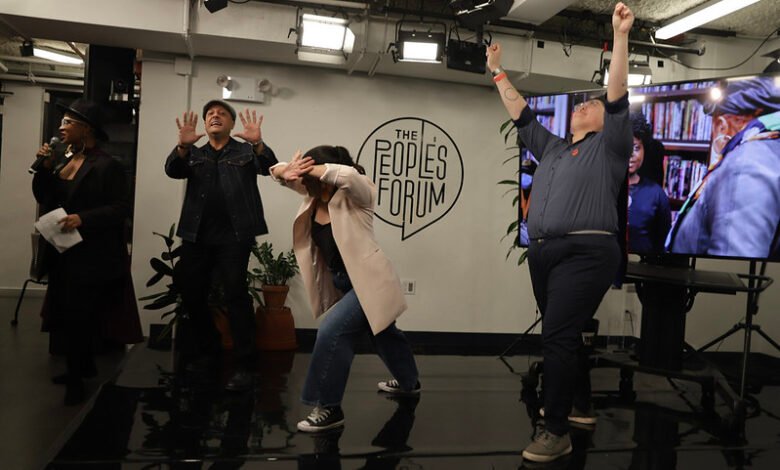
TW4C: For many performing artists and arts organizations, this is an especially frightening time to take a stand on any political issue, let alone one as contentious as Palestine and Israel. Tell us about how you made the decision to take a public stand and become an AFZ. What kinds of discussions did you have within and beyond your organization? What obstacles did you face?
Maria: We’re a small organization. On one hand, we can be nimble. We can pivot quickly. But it also means our capacity is not as large.
Conversations circled around: What’s our risk tolerance as an organization? As individuals? What kind of protections do we naturally have by privilege, by how we look, our legal status? Were we willing to risk our nonprofit status or funding? We took into account what that could mean for staff livelihoods, programming, and the artists that we serve.
The conversation was less pro/con and more if/then, like: If this happens to our organization and we lose our status, then let’s game out options for how we can navigate that. If our funding goes away, what are some other alternatives to keep our programming going? It was the right thing for us, and we absolutely stand by it 100 percent.
Sulu: Yeah, I really appreciate the if/then framing. Where other people were feeling fear of retribution or losing funding, that was not really our position for a couple reasons. One was that we were already losing a ton of funding. We are currently a salaried staff of two. Three years ago, we were around six or seven. We were already navigating our work being systemically devalued.
There’s a general sense that nonprofits can’t be political, which isn’t true. Because we wanted to understand the bounds of how our work could be political, we had already, for years, done a lot of investigation: What are the bounds of supporting legislation? What is our board allowed to weigh in on? If there is any pushback from a donor or from somebody who’s coming at us legally, we have tactics for navigating that. We’re already on the problem list. We’re adjacent to people who are already being investigated.
Maria: Why not add something else?
Sulu: Yeah. And it’s been lovely, I will say, to see the other people doing that and taking a stand.
Liz: As a small group of organizers, we were writing the newsletters during our tenth annual festival when 7 October happened. As early as November 2023, FLACC encouraged people to sign on to the Palestinian Campaign for the Academic and Cultural Boycott of Israel (PACBI) and honored the lives of people who were martyred, like Aaron Bushnell and Refaat Alareer. A lot of our work is connected to Dia de los Muertos and honoring those that we’ve lost.
The following year, our curatorial theme was titled “El Grito Por Thawra” (“A Call for Revolution”), which highlighted Latine and Palestinian artists in collaboration to raise awareness and embody solidarity. We didn’t get as much funding as we were expecting, but we formed bridges in our community that were invaluable. One setback during our October 2023 festival was that our social media got hacked, and we lost our Instagram account. We were deplatformed during this time that it was important to be vocal in solidarity with Palestine. My response was to write an article interviewing several other dance artists in the Bay Area who were taking a stand, which was published in the San Francisco-based INDance magazine. FLACC simply recreated its Instagram account, and we continued to be active. But it kind of radicalized us and our audiences even more when we were censored.
The larger the institution and the more they’re run by people who are closer to right-wing, who are conservative, who are from wealth… those institutions are going to stay aligned with US empire work.
TW4C: At various moments in history—certainly during the struggle against apartheid in South Africa, in some ways even during the Black Lives Matter uprisings of 2020—fairly mainstream arts organizations have embraced a sense of political responsibility and used their platforms to support the oppressed. The United Nations, Human Rights Watch, Amnesty International, and basically every respected human rights organization in the world—along with many world governments—have declared the assault on Gaza a genocide, yet what we’ve heard from mainstream theatre and dance organizations is overwhelmingly silence. Why do you think this is? What makes this moment or conflict different from, for example, the South African struggle?
Sulu: We are often taught that everybody was on board for things like ending apartheid in South Africa or for the Civil Rights Movement. The reality is that’s not true. I was a young person seeing the AIDS crisis—not in the industry yet, but entering the theatre world—and seeing that was not a space where mainstream support was aligned. I feel like it’s a bit clearer to speak now in solidarity with Palestinians.
It lines up with how the industry moves with any liberation work, any work around disrupting power. The larger the institution and the more they’re run by people who are closer to right-wing, who are conservative, who are from wealth… those institutions are going to stay aligned with US empire work.