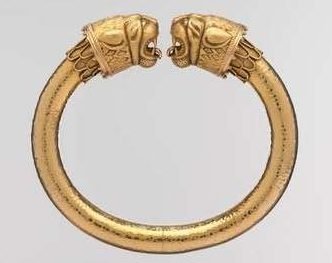
 In September 1887, in broad daylight, a robbery took place at New York’s Metropolitan Museum of Art (the Met). The thieves got away with a pair of ancient bracelets described in a New-York Tribune crime report as “solid gold, about four inches in diameter, richly carved and studded with all manner of precious gems.”
The police did not recover the items, but Tiffany & Co. created fine replicas (the firm acted as “sole agents” for the reproduction of the Museum’s works of art). Originating in Cyprus, the bracelets were part of the Museum’s “Cesnola Collection,” the formation of which itself was a story of mass thievery.
Diplomats & Other Vandals
The disclosure of early civilizations was a nineteenth century adventure tale. Royals and politicians visited excavation sites in Italy, Greece, or Egypt; newspaper headlines announced the latest digs; and thousands flocked to visit exhibitions of artifacts from distant millennia.
These were the pioneer days of digging, the rush for ancient treasures, when excavators employed hundreds of workers in a frenzied search for hidden riches. Out of this mania, archaeology was born.
Over the decades, passion for the past deteriorated into concerted theft and vandalism, erasing rather than illuminating the past.
The spade was in the hands of greedy diggers. The legal issues surrounding the retention of looted property are fought out in courtrooms to this day.
 In the early 1800s agents working on behalf of the diplomat Thomas Bruce, Lord Elgin, shipped the “Elgin Marbles” from the Parthenon in Athens to the British Museum in London.
Ironically, the French added a newly coined word “elginisme” to the vocabulary, referring to an act by which antiquities are torn out of their cultural and spatial context.
In comparison to the extent of Napoleon’s art sackings, British public opinion regarded Elgin’s “purchase” of the Marbles as an entirely honorable transaction.
As looting (euphemistically called “acts of seizure”) in occupied territories was acceptable under international norms at the time, museums stacked their exhibition rooms with displaced objects.
The appointment of “collectors” such as Henry Salt (1780-1827) or the notorious Turin-born tomb raider Bernadino Drovetti (1776-1852) to Consular posts in British and French services respectively, as well as state-sponsored expeditions to secure antiquities for national collections, led to the mass export of stolen art works to Europe’s major museums. Cultural imperialism was in full swing.
Museums were the creation of plunderers; chauvinists pushed the concept of a National Museum. Europe’s great powers asserted their claim to pre-eminence by amassing vast collections of colonial objects.
In 1818, the British Museum acquired the colossal bust of Ramses II from the Abu Simbel Temple, Upper Egypt. Not to be outdone, three years later the Louvre obtained the “Dendera Zodiac,” a bas-relief taken from a chapel dedicated to Osiris in a temple complex on the Nile.
An international mob of early archaeologists stripped Egypt of its treasures in an insane rivalry for possession between the British Museum and the Louvre.
When France signed the Treaty of Amiens in March 1802, one of the British conditions of surrender was the handing over of antiquities Napoleon
had removed during his campaign in Egypt, including the “Rosetta Stone.”
Egyptology was a competitive encounter between France and Britain in which passionate feelings of national pride and imperial prestige were at stake. The United States would join the circus later.
The Met
During the summer of 1866, several prominent Americans living in Paris put on a Fourth of July festival to celebrate the nation’s ninetieth birthday.
In his speech, lawyer and attorney John Jay II (1817–1894) pointed out that New York was ready to compete with Europe’s great cities by creating its own museum. He called for the foundation of a National Gallery of Art. As President of New York’s exclusive Union League Club, he actively rallied civic leaders, artists, and philanthropists to the cause.
 The Met was incorporated on April 13, 1870, opening to the public in the Dodworth Building at 681 Fifth Avenue. The first object the Museum received was a Roman marble sarcophagus dug up in Tarsus, modern day Turkey, in 1863. The treasure was donated by J. Abdo Debbas, the American vice-consul in the region.
Collection formation at the Met started with the abuse of diplomatic privilege to smuggle a work of art out of its country of origin. Legal immunities eased such illicit movement. The Museum gained its reputation as a repository of antiquities after the acquisition of the Cesnola Collection of Cypriot Art.
Luigi Palma di Cesnola was born in July 1832 in Rivarolo Canavese, near Turin, then part of the Kingdom of Sardinia. His family was of minor Piedmontese nobility and Luigi embarked upon a military career.
In 1848, he served (and suffered defeat) in the Sardinian army fighting against Austrian forces in the First Italian War of Independence (1848-1849); he then volunteered in the Crimean War (1853-1856) on the side of the British.
In 1858 he settled in New York, founded a training school for army officers, and married the daughter of the 1812 naval war hero Samuel Chester Reid.
At the outbreak of the Civil War, he joined the Fourth Cavalry Regiment of New York with the rank of Colonel. In 1863, leading a charge of his troops at the Battle of Aldie in Virginia he was wounded and captured. Following his distinguished service, Luigi received the Medal of Honor for gallantry.
For his military credentials and multilingual abilities (fluent in Italian, French, and English), President Abraham Lincoln appointed the United States Army veteran in 1865 as Consul at Larnaca, Cyprus, then under Ottoman occupation.
His duties were light and, with plenty of spare time, he joined in the hunt for ancient treasures which had become a diplomatic pastime on the island. He was one of several amateur “gentlemen” diggers who plundered and pillaged the island’s antiquities.
 Although academic interest in the history of Cyprus as one of the oldest civilizations in the eastern Mediterranean was deepening, adventurers, tomb robbers, and dodgy dealers exploited Ottoman indolence towards its heritage.
Cesnola was not bothered about scholarly considerations, nor did he show much respect for the socio-historical context of the objects he accumulated. His operations were a commercial venture. The past was for sale. As there were no institutional rules of provenance ethics nor any norms on dealings with cultural heritage, he used his consular office to collect some 35,000 antiquarian items.
By 1870, the scale of his activities had alarmed the authorities. He was denied permission to remove his treasures from the island. Using diplomatic levers, he was able to bypass custom officers and ship 360 large cases to Alexandria. For a while, the collection’s destination remained uncertain.
Negotiations took place with Napoleon III, who wanted the collection for the Louvre; Russian officials discussed a transfer to the Hermitage Museum at St Petersburg. Soon afterward, Cesnola transported the collection to London where its exhibition aroused interest.
At that point (1872), the Met intervened and bought the collection. Cesnola himself supervised its installation. In 1877, after his duty as Consul in Cyprus had ended, he took a seat on the Museum’s board of trustees and served as its first Director from 1879 until his death in 1904.
When in March 1880, the Museum moved to its permanent site at Fifth Avenue and 82nd Street the collection of over 6,000 works occupied a prime location on the first floor. He pushed for the publication of (unreliable) catalogues, including the six-volume, richly illustrated Atlas of Cypriot Antiquities and oversaw the arrangement of his artifacts in dedicated galleries.
Its display was trumpeted as an asset to the city, outdoing similar collections in London or Paris.
Treasure of Curium
Discovered in 1875, Cesnola unearthed the Curium antiquities at the site of Kourion, an ancient Greek city-state on the southwestern Cypriot coast.
They were added to the Museum’s earlier collection and enhanced its reputation – for a while at least. In 1877, Luigi “documented” his excavations and procurements in Cyprus: Its Ancient Cities, Tombs, and Temples.
Controversy started soon after publication when experts began fact checking the story lines. The “Cesnola Scandal” exposed his corrupt morals, crude methods, and unauthorized removals. His geographical descriptions were unmasked as either wildly inaccurate or completely fictional.
Archaeologists accused him of forging provenances and fabricating dates and/or locations; newspapers called him a liar and a looter.
Theft was a family affair. Luigi’s younger brother Alessandro also served in the military, before emigrating to America in the 1860s where he claimed citizenship. In 1873, he was appointed honorary American vice-consul in Paphos, a position that allowed for his involvement in archaeological activities on the island.
 Between 1876 and 1878, in partnership with his father-in-law, the London financier Edwin Lawrence, Alessandro excavated many artifacts (by whatever means), principally from around Salamis.
His attempts to flout the ban on private excavations instituted by the first British High Commissioner following Britain’s occupation of Cyprus in July 1878, resulted in his expulsion from the island and the confiscation of part of the collection. He disposed of the bulk of the material at various auctions in London between 1883 and 1892.
Luigi’s projects were overseen by a character named Beshbesh, a Turkish fixer who contracted local vandals to plunder sites without record or documentation. He also bought objects from local dealers, inventing excavation narratives to justify his expenditure.
The Consul himself rarely visited the digs; he simply retold the stories and published them as factual accounts. This explained the extraordinary mixture of periods in the Curium treasure. The collection was not properly classified until 1914 by Oxford professor John Myres (1869-1954).
A pompous character, Cesnola remained unmoved by the tsunami of criticism directed against him. He died in 1904 at his apartment in the elegant Seymour Hotel on West 45th Street.
With the controversy raging over the acquisition of antiquities, their fraudulent restorations and illegal export, the collection became an embarrassment to the museum.
The Cesnola Collection was quietly dissolved over the decades, except for the most authentic pieces. When the Met opened new galleries in 2000, a reduced number of six hundred pieces was on display at its Department of Greek and Roman Art.
Agents of Displacement
Western museums were displacement agents of classical art and sculpture, either through the physical removal of artifacts, or through the misrepresentation of their original appearance.
Objects were adapted to fit European aesthetic taste, presenting Greek and Roman sculptures as pure white. All traces of coloring were scrubbed off to enhance the “marmoreal gleam,” fostering a false association between whiteness and beauty.
It was the wealth of our heritage that allowed for “cultural terrorism” to occur. Abundance provokes carelessness. If ancient treasures had been scarce, the alertness to protect them would have been more acute.
Cesnola is a comprehensive collection of Cypriot art, highlighting a blend of Greek, Egyptian, and Near Eastern influences that were at play throughout antiquity, but key issues surrounding the acquisition history of items stay unresolved.
While Cypriot officials acknowledge the collection’s importance for international study, there have been (sporadic) calls for the repatriation of “plundered” works.
There seems to be a resigned acceptance that the Cesnola treasures, like the Elgin Marbles, were removed with consent of the Ottoman regime, making a legal challenge of ownership complicated. The charge of “colonial theft” would be difficult to prove.
 The black market of antiquities is still rampant as the looting of archaeological sites in conflict-ridden regions like the Middle East and North Africa continues.
As of early 2026, ongoing conflicts and political instability in countries such as Syria, Iraq, Libya, Yemen, and recently Iran have resulted in the widespread pillaging of archaeological sites.
That situation has prompted attempts to exert international control over the illicit trade. The joint fight against the trafficking of cultural objects may encourage a trickier conversation on the status and presentation of museum collections.
To reduce ancient histories to a dreary display of exhibits removed from their original context and deprived of their spiritual essence, is meaningless. Rather than telling a coherent tale, museums impose a sense of lost history and forgotten cultural identities upon its visitors – mental fatigue rather than inspiration.
Restitution is the return of a cultural object to its rightful owner from which it was wrongfully taken. That is an obligation under the law and, therefore, a legally binding duty.
Repatriation is more complex. It implies the return of a significant object to its community of origin for historical, cultural, or spiritual reasons.
At present, this is a voluntary “ethical” choice, not an enforceable requirement. However sensitive and complicated proceedings might (and will) be, the discussion on repatriation must continue.
Apart from fostering restorative justice, the process will restore historical context by allowing communities of origin to reconnect with their heritage and rewrite Western-centric narratives. History itself will be the winner.
Read more about Museums in New York State.
Illustrations, from above: Tiffany reproduction of Cypriot bracelet from the Curium collection of the Met; Archibald Archer’s “The Temporary Elgin Room in 1819” with portraits of British Museum staff, a trustee and visitors. (British Museum); The Amathus sarcophagus from the Met Cesnola Collection; Luigi Palma di Cesnola, American consul in Cyprus and first director of the Met (Cultural Centre of the Popular Bank Group); Sculpture from the ‘Cesnola Collection’ on display at the Met (Harper’s New Monthly Magazine, May 1880); and the ransacked Iraq National Museum in 2003, during the Iraq War (photo by Patrick Robert).
Source link