 One of the great joys of early May in the Northeast is the dawn-break aubade of songbirds returning to summer habitats or passing through to their nesting grounds in higher latitudes.
Mornings that only a month ago were silent – save the croaking crows and shrieking blue jays – are now filled with a polyphonic chorus of trills, chirrs, and fluted arias that quicken both body and soul.
This delight, however, can obscure the fact that birds are not only producers of sound but well-honed and astute listeners as well. While we only hear morning melodies, for the birds, these vocalizations and songs constitute serious life-or-death communications: the competitive labor of defending territories, wooing mates, raising their young, and sounding alarms.
And as ecologists are discovering, these crucial conversations are struggling to be heard above the din of our modern, mechanized world.
“It’s easy to underappreciate how important it is for these organisms to communicate by sound,” said Jason Hill, a quantitative ecologist with the Vermont Center for Ecostudies. “That’s advertising their availability as potential mates, defending their territories from neighboring males, warning members of their own species and other species about nearby predators, such as outdoor house cats, and finding their young after they leave the nest.”
Given the almost unimaginable loss of roughly 3 billion birds in North America over the last 50 years – a decline that continues to accelerate across nearly half of the species scientists have studied – quantifying the impacts of noise pollution may help preserve our avian populations.
Natalie Madden and four colleagues recently completed a meta-analysis of 160 studies measuring the impacts of noise pollution on birds globally between 1990 and 2025.
While the scientific literature had previously documented the harms of climate change, the introduction of invasive species, habitat loss, chemical pollutants, and over-exploitation, Madden’s high-level assessment, published in the Proceedings of the Royal Society B, is among the first to demonstrate the many impacts of human-produced noise on birds across a range of traits, habitats, and species.
“We think of noise as an annoyance or a nuisance, but what we’re seeing here is that it’s actually a real hazard to them,” says Madden, a conservation science and policy analyst with Defenders of Wildlife. “It’s not just masking their communication or altering their risk aversion. It’s affecting all of these different types of behaviors.”
In addition to standardizing data from those 160 studies, which were often focused on particular species, habitats, or geographies, Madden’s research sought to discover differences in the ways that anthropogenic, or human-related, noise was mediated by specific traits and characteristics. It also tracked and measured how birds responded to noise pollution – for example, which species might change their song length, frequency, or timing.
Among Madden’s key findings: noise significantly reduces reproductive success across many species, impacting everything from the initial pairing to the survival of fledglings, and it also acts as a stressor that changes hormone levels (like corticosterone). It forces birds to alter critical survival behaviors like foraging and risk assessment.
Crucially, traits such as preferred habitat and nesting style can determine a species’ vulnerability; high noise levels impacted reproductive success, growth rates, and other physiological markers more negatively for birds that nest closer to the ground or in the open compared to tree dwellers.
Madden said the meta-analysis overturned one of her main assumptions about noise pollution.
“Regardless of how loud the noise was, it was still having an impact on them, whereas I think we expected obviously louder noises to have more of an impact,” Madden said. “And then similarly, the source of the noise didn’t have much of an impact either.”
Hill believes a range of actions is needed to reduce the negative impacts of noise pollution: establishing wilderness preserves, using vegetation thoughtfully to dampen the impacts of development and infrastructure, and reducing one’s own contributions to the soundscape by using gasoline-powered equipment like lawnmowers and leaf-blowers less frequently, or switching to electric-powered tools.
“They’re not probably huge effects in and of themselves, but if we all stopped and listened around our houses, I’m sure we could find ways to reduce the amount of noise pollution that we’re generating at a household level,” Hill said.
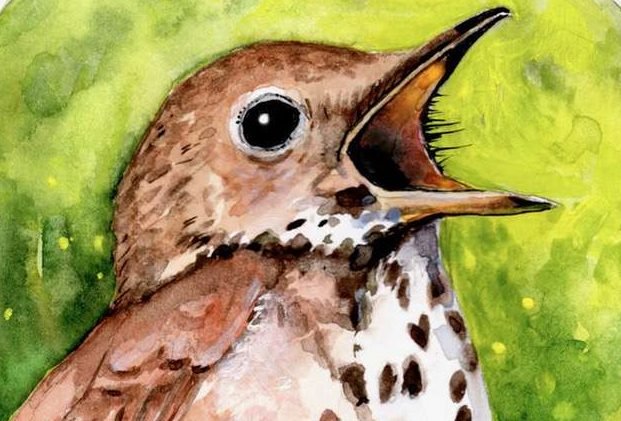
And on fresh spring mornings like these, who wouldn’t prefer the song of a hermit thrush over the buzz of a lawnmower?
Read more about Noise Pollution or Nature Sounds.
Jack Beaudoin is a frequent contributor to Northern Woodlands and a Maine Master Naturalist. Illustration of a singing hermit thrush by Adelaide Murphy Tyrol. The Outside Story is assigned and edited by Northern Woodlands magazine and sponsored by the Wellborn Ecology Fund of New Hampshire Charitable Foundation.
Source link