 This Memorial Day weekend, Old Fort Niagara will highlight 300 years of military history with special exhibits and programs tracing military life from the 1600s through modern times.
Multiple artillery pieces from the 18th through the 20th centuries will fire a cannonade, complete with an explanation of how each leap in technology affected battlefield tactics.
The event, scheduled for Saturday and Sunday, May 23-24, will begin with a salute to the colors of three nations that garrisoned the Fort over the years: the United States, Great Britain and France.
This will be followed at 11 am by a program entitled “Cocked Hats to Kevlar: Military Dress through the Ages.”
The artillery cannonade will be followed at 12:30 pm by a guided tour of the Fort’s Civil War era underground casemates, areas not usually open to the public.
 At 1:00 p.m. visitors will go back in time to the 18th century when military music played a significant role in military camps and on the battlefield. The Fort’s regimental field music will perform both duty calls and popular tunes from the French and Indian War, American Revolution and War of 1812.
The great French commander, Napoleon Bonaparte reputedly said, “an army travels on its stomach” and the Fort’s 1:30 program traces the development of military rations over three centuries. From pea soup and hard tack to MREs, Fort volunteers will demonstrate the evolution of soldiers’ food in war and peace.
At 2:00 p.m. reenactors will demonstrate three centuries of military small arms technology as the Fort presents Matchlocks to M16s, a firing demonstration that chronicles arms development and how it influenced battlefield tactics. At 3:30 visitors will get a closer look at firing a flintlock musket, the technology that was in use 250 years ago during the American Revolution.
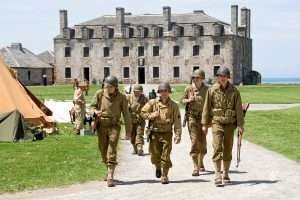
 Each day concludes with a leap forward to World War II, as reenactors representing soldiers from the First Infantry Division assault an enemy bunker, demonstrating American infantry tactics of the 1940s. This will be followed by a retreat ceremony as the Fort’s garrison retires the colors.
The event also includes extensive special exhibits of World War II and Korean War military vehicles, period camps from the 17th through 20th centuries, camp cooking demonstrations, women in the military and the home front during World War II.
The French established the first Fort at Niagara in 1679 and the United States Army decommissioned the post in 1963, making Fort Niagara one of the longest held military posts in America.
Soldiers Through the Ages- Event Schedule
11:00 AM: Cocked Hats to Kevlar: A visual evolution of military dress, showcasing how the soldier’s uniform has transformed from 18th-century regalia to modern tactical gear.
12:00 PM: Artillery through the Ages: A cannonade featuring artillery pieces from the 1700s through the 1900s. Experts will explain how each technological leap reshaped the battlefield.
12:30 PM: Behind the Bricks: A rare, guided tour of the Fort’s Civil War-era underground casemates—historic areas typically closed to the general public.
1:00 PM: The Echoes of Battle: The Fort’s regimental field music takes center stage, performing the duty calls and popular tunes that boosted morale during the French and Indian War, the American Revolution, and the War of 1812.
1:30 PM: An Army Travels on its Stomach: Napoleon’s famous adage comes to life in a sensory exploration of military rations. From 18th-century pea soup and tooth-cracking “hardtack” to modern MREs, volunteers will demonstrate how soldier sustenance has evolved over 300 years.
2:00 PM: Matchlocks to M16s: Three Centuries of Military Small Arms Reenactors explain how firearms evolved over the centuries and how technology affected battlefield tactics.
3:00 PM: Firing a Flintlock Musket
3:30 PM: World War II Bunker Assault American soldiers attack an enemy bunker during World War II.
4:30 PM: Retreat Ceremony
Old Fort Niagara, one of North America’s most historic places, is host a year-long celebration in 2026 marking the 300th anniversary of its iconic “French Castle.”
Built in 1726 during King George’s War, the French Castle is believed to be the oldest building in the Great Lakes Basin. For three centuries, it has stood guard over the mouth of the Niagara River on Lake Ontario as a silent witness to the birth of nations, serving as a military stronghold, a bustling trading post, and a meeting ground for European and Indigenous cultures.
More information is available on Old Fort Niagara’s website, www.oldfortniagara.org
Source link