 Barnum & Bailey’s Greatest Show on Earth opened their 1882 season March 11th with a torchlight parade to Madison Square Garden. Every foot of their route through the city was shoulder to shoulder with spectators. Those who braved the cool evening were rewarded with a two-and-a-half-hour circus parade.
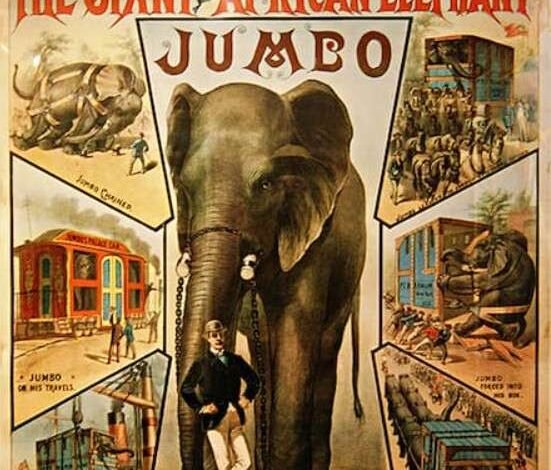
Their next stop, Philadelphia on April 24th, was just the beginning of a busy season that would take the circus across 129 cities in New England, New York, and down the eastern seaboard. Also that spring, Barnum and Bailey purchased Jumbo, a 21-year-old African Savanna Elephant from the London Zoo. He soon joined the other elephants on the tour and was quickly given top billing.
The circus made its 66th stop of the year in Troy, New York, at the beginning of August. Over the previous four days, their 60-car train had been in Albany, then 70 miles south to Poughkeepsie, and then back north again for one-day stops in Hudson and Schenectady.
The logistics of keeping this massive operation on schedule required that, after final performance at each stop, the circus be packed up and moved to the next venue as quickly as possible. Leaving Schenectady, the performers arrived during the night at the Adams Street Freight Depot in Troy.
Crowds were already forming when the circus began disembarking their train and forming up for the circus parade. From the depot, the circus proceeded two miles north through the city, following Fifth Street to River Street, with their destination the Bulls Head, a former cattle market, turned baseball lot, bordering the Hudson River on Glen Street, at the north edge of the city.
The Troy Daily Times of August 2nd proclaimed the procession to be “entertainment in itself,” and then continued to describe the scene that unfolded before the crowds of spectators that lined the streets:
“Calliopes, gorgeous chariots and band wagons, gilded cages filled with wild animals and their keepers, gay cavalcades of spangled ladies and gentlemen, droves of camels, elephants, and ponies, and grotesque attractions of various kinds.”
Both the afternoon matinee and evening performances went off without a hitch, and as each act ended, crews packed it up and headed towards the train. To make the trip back to the circus train shorter, it was moved to a spot directly across the Hudson River in Green Island, with access from Troy via the bridge that connected the two communities.
One of the last acts each night was the elephants, who were led through their routine by elephant trainer George Arstingstall and assistant William Newman. It was around 10 pm when their performance ended, and the elephants were taken out of the big top and onto River Street towards the waiting train.
With Jumbo accompanied by his handler Matthew Scott in the lead, the elephants walked with the other circus animals to the bridge without incident. While Jumbo turned onto the bridge towards Green Island, the four Asiatic elephants, led by a large male named Emperor, refused to follow and continued down River Street into South Troy.
With the handlers caught off guard by this change in direction and trying to catch up with the herd, the elephants soon arrived back at the railroad’s Freight Depot at Adams and River Streets, where they had gotten off the train the day before.
While the herd stood quietly waiting, spectators began to gather, with some in the crowd pelting the animals with stones and broken pieces of pavement bricks.
Frightened by this assault, Emperor stumbled and fell, with the others falling over him, adding to their panic. In an instant, all of the elephants were back on their feet and at a full run, heading along the railroad tracks towards the Rensselaer Iron Works, a rail mill on the Hudson River.
The factory was in full operation, glowing with bright lights and molten steel, when Emperor led the other elephants into the main room, with workers fleeing in every direction. Not realizing the danger, Emperor stepped on a pile of red-hot metal, was severely burned, and, in a rage, turned and bolted towards the nearest exit.
In all of the panic of scared and injured animals, one of the elephants fled to the mill’s dock and into the river. Swimming 100 yards upstream, he climbed out, destroying a floating dock in the process. While this animal was quickly captured and chained to a street lamp, the other two elephants fled the mill site and headed east on Madison Street to First Street.
The pursuit of the two elephants ended quickly when they were trapped and captured in a blind alley. However, their time in captivity was short-lived, as after being reunited with their companion at the lamppost, all three took off again and disappeared into the darkness.
During their time of freedom, the herd made a detour onto Third Street, where they trampled the fence of the German Catholic Church. Continuing down Third, to where it merged with Fourth Street, the three turned west onto Lincoln Street and entered St. Joseph’s Cemetery.
Restless in unfamiliar surroundings, these large beasts moved through the cemetery grounds, trampling gravesites and overturning stones. By
2 am, the three escapees were finally located and were soon being led across the bridge to Green Island.
The elephant Emperor, enraged by the painful burns, also followed Madison Street, then took a detour onto First Street. Following the sidewalk, he soon encountered Patrick Conlon.
Picking the man up and tossing him twenty feet across the street marked the first attack in his South Troy rampage. Also within sight were Mr. and Mrs. Michael Casey, who were so surprised at this strange creature that they froze in place. In an instant, Mr. Casey was on the ground, injured, while his wife was left standing untouched.
He next attacked home-bound mill worker Thomas Maher, hitting him in the stomach with his trunk. The force of the blow hurled him to the street, where his bare arms were scraped raw and clothes torn as he slid across the pavement. Taking off through vacant lots, Emperor made his way to Van Buren Street.
At the corner of First Street, he next attacked Patrick Burns and his wife, throwing the man down an embankment with his wife tumbling down as well while trying to escape. As she fell, Mrs. Burns was struck by falling rocks, suffering internal injuries that would cause her death within a month.
While these two were being attacked, Lizzie Prentice turned to stay out of reach of the enraged beast and, in the process, fell and was seriously injured. The elephant then headed to Second Street, where he picked up and threw a barrel, breaking down the wall of a nearby barn.
From here, he raced five blocks south to Tyler Street, where fifty-five-year-old Michael Minehan, unaware of the pending danger, sat quietly smoking his pipe. In an instant, Minehan found himself covered by the splintered remains of a smashed fence with three broken ribs and an injured back.

Patrick Moulton and his wife were relaxing on the front stoop when Emperor came down their street. Sensing the need for action, Patrick grabbed a pail and swung it against the elephant’s head, then paid the price when a trunk shot out, seizing his wife and throwing her violently against the wall of their home. Turning back to his puny assailant, the elephant released a blow that knocked Moulton senseless and broke his collarbone.
Hearing the commotion on the street, John Roarke, well drunk and fearless, stepped out of the shadows to confront the beast, who simply pushed him aside, crushing the man’s foot as he passed.
Emperor next encountered Patrick Ryan and his wife, who also stood unaware of an impending attack. The elephant again struck with his trunk, knocking Patrick unconscious and leaving his wife injured. Further down Second Street, in front of Farley’s Saloon, was Patrick Morton, who was struck before he could escape, suffering a dislocated shoulder.
Next, the enraged animal picked up a peddler’s wagon and tossed it twenty feet in the air while Patrolman Kennedy stood helplessly watching the scene unfold.
Following Tyler Street away from the river, Emperor then turned south back on First Street, passing Union Square, and onto Polk Street. Continuing his carnage, he grabbed Edward Burke, tossing him aside with a rough landing that caused a sprained arm and a badly bruised body.
Near the intersection of Polk and River Streets, Emperor used his trunk to grab and squeeze the wife of Joseph Langley while she was standing at the door of her husband’s saloon.
Here, David Murphy shot at the beast with a handgun, but missed the mark, though this act of bravery may have kept the woman from being killed that day. Unfortunately, her injuries caused recurring convulsions that led to her death five months after the attack.
Continuing on his erratic path through South Troy, the next victims were Patrick Molten and his family. Picking Patrick up and throwing him through the door of their home, Emperor then struck his wife, who was holding their eight-month-old child.
The blow lifted Mrs. Molten into the air, through the doorway past her husband, where she landed far up the stairs. While the mother came away with a dislocated shoulder, the baby was unharmed in the attack.
After two more assaults, Emperor next caused havoc in the Bessemer Steel Works, and from there entered the river and swam downstream to Burden’s Iron Works. Here he emerged from the water and fled back onto city streets, breaking fences and anything else that stood in his way.
Heading again south on River Street, he crossed the Wynantskill Creek bridge, turned onto Batavia Street, and into the alley behind Dwyer’s saloon. He again headed back into South Troy, crossing the stream again at Water Street, and around 1 am entered the grounds of one of the large mansions along the Wynantskill Creek.
It was not long before a commotion in their garden awoke the mansion’s occupants. Thinking it was cows that had gotten loose and were eating their flowers, they sent Tom, their groundskeeper, to investigate. Armed with a bean pole, he stepped into the garden to confront the interlopers.
Suddenly, out of the shadows emerged a gigantic, shadowy apparition that raced towards him, filling the air with a trumpeting call. Fleeing to a nearby apple tree, Tom climbed as fast and far as his limbs allowed. The noise of Emperor’s trumpeting, mixed with the screams of Tom and the other servants, brought the homeowner himself to investigate.
Scolding Tom for his inaction, the groundsman is said to have cried out, “May the Lord have mercy on us, master; it’s the devil himself that’s in the garden.” At that very moment, Emperor thundered past, sending another man up the tree. In time, their tormentor moved to another part of the estate, and the men returned to earth.
At first light, Emperor was led by his handlers back through South Troy and across the bridge to Green Island, where he was secured in his railcar. With the elephants captured, the circus left Green Island for Gloversville, New York, the next stop on their summer tour.
Aftermath
Back in South Troy, while the circus was heading west, Barnum and Bailey representatives were busy surveying the previous night’s path of destruction. By the time they had completed negotiations with the victims of the rampage, the circus had distributed over $4,000, equivalent to $125,000 today.
Several of the injured parties sought further redress and filed personal injury lawsuits against Barnum and Bailey. The Troy law firm of Smith, Furman & Cowen, representing the circus, denied any wrongdoing in the death of Mrs. Burns, even pointing out that while her husband was paid for his injuries, no similar claim had been made for his wife.
For Mrs. Langley, at that point still alive, but in failing health, they claimed that a preexisting condition caused her convulsions and that, in fact, she had never claimed to have been hit by the elephant, only frightened by its actions. In all, eight personal injury claims were paid, as well as a number for damage to personal property.
Jumbo and Emperor continued in circus life, though tragically died in separate incidents only three years after the Troy rampage. For Emperor, his end came from a misstep while being unloaded from his train car in Liberty, in Sullivan County, New York. The injury caused a rapidly spreading tetanus infection that took his life in three days.
The death of Jumbo was also a tragic accident, but one that, over time, became shrouded in myth and legend. On September 15, 1885, in St. Thomas, Ontario, Canada, Jumbo was being led across a series of railroad tracks to his car when an unexpected locomotive came in sight.
Frightened by the sound of the train and the frantic commands from his handler, Jumbo took off down the tracks. Unable to stop, the engine struck the fleeing elephant, causing fatal internal injuries. His lifelong handler Matthew Scott by his side, Jumbo soon passed away, with some witnesses recalling that Jumbo held Matthew tenderly with his trunk as he expired.
P.T. Barnum, looking to gain attention for his circus from this tragedy, claimed that Jumbo’s death was a heroic sacrifice, his life given to protect the smaller elephant, Tom Thumb, who was also in the path of the train that day.
Barnum continued to profit from Jumbo over the years by selling his skeleton and hide. In 1975, his stuffed remains were destroyed in a fire at Barnum Hall on the Tufts University campus in Medford, Massachusetts.
Some of the ashes from his remains were collected and today sit in a Skippy Peanut Butter jar in the university’s athletic director’s office.
Read more about circus history in New York State or about the History of Troy.
Illustrations, from above: A circus poster highlighting P.T. Barnum’s Jumbo; and a map showing the elephant’s route into South Troy.
Source link