 The skeletal remains of 44 people believed to have been associated with the Continental Army effort to invade Quebec in 1775 will be transported in historic U.S. military vehicles on Wednesday, May 20 from the New York State Museum in Albany to Lake George.
Scientists there have spent seven years identifying and reconstructing the remains. They will be reinterred in a new memorial at Lake George Battlefield Park being dedicated Friday, May 22.
On the morning of May 20 at the State Museum, there will be a dignified transfer of wooden caskets to the three vehicles that will transport the remains 60 miles north via Route 9 to Lake George Battlefield Park, site of the nearly $700,000 memorial.
The motorcade for the “Repose of the Fallen” project will include New York State Police leading nine Korean War and Vietnam-era military trucks operated by members of the NY-Penn Military Vehicle Collectors Club. The convoy will include an escort provided by New York members of the Patriot Guard Riders.
The motorcade will depart from the back of the State Museum at approximately 10 am. The route north will take it through downtown Albany into the Albany County town of Colonie, and then on to the Saratoga County towns of Halfmoon and Clifton Park, the Village of Round Lake, the Town of Malta, to the city of Saratoga Springs, where the motorcade will halt for a brief patriotic observance in front of City Hall at 474 Broadway.
The procession then will continue north through the Saratoga County towns of Wilton and Moreau and village of South Glens Falls, into Warren County and the city of Glens Falls, where there will be a brief halt at the intersection of Route 9 and Bacon Street for an observance.
From Glens Falls, the motorcade will travel through the town of Queensbury to the town of Lake George. Upon entering the village of Lake George, the motorcade will turn north onto Elizabeth O’Connor Little Boulevard, then head east on Beach Road for a short distance before turning onto Fort George Road and stopping at the memorial site. The estimated time of arrival is noon to 1 pm.
Upon arrival, most of the caskets will be immediately interred in the memorial. The remaining four caskets will be taken to a nearby church to be safeguarded until the ceremony on May 22.
Volunteers will serve as round-the-clock honor sentinels at the church until the morning of the 22nd, when the four caskets will be placed upon a horse-drawn wagon and transported to the memorial site for the formal reinterment ceremony with Federal, State and local officials.
Lisa Anderson, New York State Museum Curator of Bioarcheology, said “We have spent the past seven years painstakingly working to piece together the story of the individuals whose unmarked graves were destroyed. As we close this chapter, it’s hard to put into words the gratitude my team and I have for being part of this project. It has been a privilege to help uncover the story of these veterans and we look forward to them finally having the dignified burial they deserve.”
 The remains were discovered during a construction project on private property on Courtland Street in Lake George beginning in February 2019. Subsequent recovery and scientific analyses led by the New York State Museum and the Department of Environmental Conservation determined that they are American soldiers or associated personnel.
They likely died in 1776, when a large Continental Army hospital housing many smallpox victims was located at Fort George near the lake’s southern end.
Hundreds of Continental Army soldiers who fought in the failed invasion of Canada launched in late 1775 are known to have died from smallpox in 1776 at Lake George.
Ultimately, 44 distinct people were determined to be among the remains, though current methodology to ascertain their individual identities has not been available for this effort.
They were buried in unmarked cemeteries in and near what is now the village of Lake George. Although the identities of those uncovered at the Courtland Street site are unknown, several uniform buttons found with the remains indicate that at least one of them served in the 1st Pennsylvania Battalion, known to have fought in the Quebec campaign.
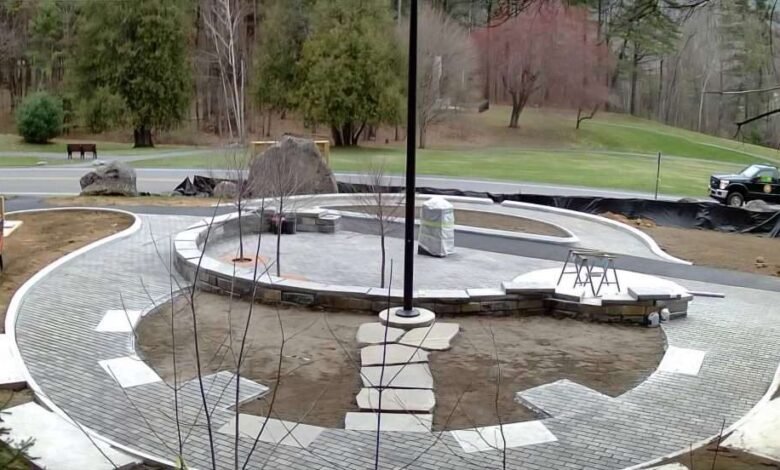
Construction of the reinterment memorial began last October on a knoll along the east side of Fort George Road in Lake George Battlefield State Park. The design includes several secured columbaria for the final resting place of these early patriots, seating, interpretive signage and a new memorial plaza.
The “Repose of the Fallen” project, funded through the New York State Downtown Revitalization Initiative and private donations, will be formally dedicated on May 22, beginning at 11 am.
Read more about the Invasion of Quebec.
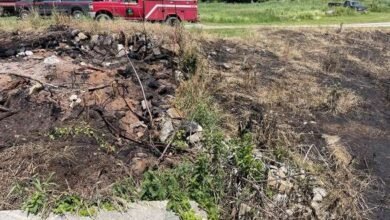
Illustrations, from above: The nearly completed Lake George reinterment memorial at Lake George Battlefield Park, April 2026 (provided by Town of Lake George); and people look into hole where additional remains were found in Lake George 2023 (provided by Lake George Battlefield Park Alliance).
Source link