 The spongy moth (Lymantria dispar) is a non-native insect from Europe. In New York, spongy moth caterpillars feed on a variety of trees, with oak as their preferred species.
Spongy moths have naturalized in our forested communities, which means they are always present in New York in some capacity. In recent years, spongy moth populations have experienced a boom throughout the Northeastern U.S.
The New York State Department of Environmental Conservation (DEC) first observed growing populations in New York State in 2020 when spongy moth caterpillars defoliated 27,157 acres in the Finger Lakes Region.
Oak forests are also combating oak wilt in New York State, with quarantine districts in Yates and Ontario counties in the Finger Lakes after finding new trees infected with oak wilt.
In 2021, New York experienced a nearly statewide outbreak of spongy moth, resulting in 682,652 acres of defoliation scattered throughout the state’s oak-heavy forests.
2022 saw a decrease in defoliation in many of the areas that spongy moth had defoliated in 2021; however, 62,458 acres of new defoliation were mapped throughout the middle to lower Hudson Valley.
The number of defoliated acres in the Hudson Valley continued to grow in 2023 (188,313 acres) and then peaked in 2024 (618,765 acres).
In 2025, spongy moth defoliation in the Hudson Valley saw a sharp decrease, with 66,928 acres of new defoliation.
Typically, trees can recover from a couple years of defoliation during a spongy moth outbreak.
After three consecutive years of defoliation, the outbreak can lead to mortality, especially in trees that are stressed from other factors such as poor soils, drought, or those growing on rocky ridges.
While the number of defoliated acres were substantially less in 2025, more than 10,000 acres of oak mortality were recorded in the Hudson Valley Region.
Egg Mass Surveys in Spring 2026
In response to the oak mortality in 2025, DEC performed spongy moth egg mass surveys to help predict spongy moth populations and the likelihood of defoliation in 2026.
Surveys in March of 2026 focused on the Finger Lakes and Hudson Valley Regions because forests in these areas had been stressed by defoliation in recent years.
Survey results found minimal new egg masses, indicating a significant decline in spongy moth populations.
This reduction is likely the result of early summer rains in 2025, which allowed naturally occurring soil bacterium (Bacillus thuringiensis kurstaki) to thrive.
This bacterium plays a major part in reducing spongy moth populations below outbreak thresholds (where defoliation levels are not a concern).
From these results, DEC does not expect noticeable defoliation in these surveyed areas in 2026.
While DEC predicts a lower population of spongy moth throughout the state, in part due to the boom-bust cyclical nature of the species, it is still important to look for and report population growth.
DEC will be conducting statewide aerial surveys throughout New York to search for any new areas of defoliation and ask that the public keep an eye out for any new areas with significant numbers of spongy moth caterpillars.
Spongy moth caterpillars are easier to identify during late May/early June once the caterpillars have their characteristic red and blue dots.
If you notice dense numbers of spongy moth caterpillars accompanied by defoliation, please report sightings to foresthealth@dec.ny.gov.
Learn more at DEC’s spongy moth website.
Learn more about insects in New York State.
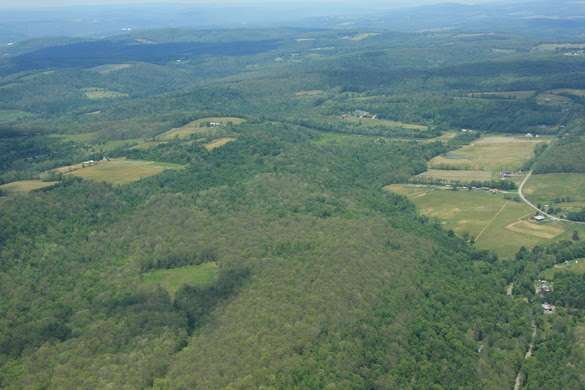
Illustration: Aerial view of the Hudson Valley in 2022 showing areas of defoliation from spongy moth caterpillars (large brownish patches where trees are missing leaves).
Source link