 Born in Berlin-Schöneberg in December 1901, Marie Magdalena (Marlene) Dietrich made an early career in her home city before achieving international stardom. Mentored by the legendary Max Reinhardt at his Deutsche Theaterschule (German drama school), she then joined his stage company.
Throughout the 1920s, she performed in Berlin and Vienna, including roles in Shakespeare’s The Taming of the Shrew and Bernard Shaw’s Back to Methuselah.
She cultivated the persona of a “Berlin woman,” becoming a style icon whilst performing in musicals, revues, and silent films.
Her role as the cabaret singer Lola Lola in Josef von Sternberg’s 1930 film The Blue Angel (simultaneously filmed in German and in English) brought her international acclaim.
Catapulted to stardom, she signed a six-picture deal with Paramount Pictures and moved to Hollywood. Arriving in New York aboard SS Bremen in early April 1930 with an extraordinary amount of luggage, American admirers greeted her with a welcome luncheon at the Ritz-Carlton.
Career prospects (and the presence of Von Sternberg in Hollywood) played a part in her leaving Berlin, but she was also eager to escape an emerging Nazi regime that she despised.
In 1939, she became an American citizen. Despite pleas from Adolf Hitler for her to return home and star in propaganda films, Dietrich refused.
Instead, she toured with the United Service Organizations (USO), performing over five hundred times for Allied soldiers to boost troop morale for which she was awarded the U.S. Medal of Freedom and the French Légion d’Honneur, both in 1947.
Following the war, she reinvented herself from a Hollywood film star into a global cabaret sensation. Marlene exported the “Voice of Mitteleuropa” (Central Europe) and the Weimar cabaret culture to the United States.
With a voice at low register, her style was not about fancy vocal skill or technique. Hers was erotic “talk-singing,” carrying the decadence and androgynous aesthetic from 1920s Berlin to Hollywood, Manhattan, and beyond.
Apartment 12E
The “biography of a house” is the narrative of a property’s history, a tale of fleeting lives, accumulated memories, shifting cultural streetscapes, and changing fashions or inhibitions. A singular building serves as the container for individual lives and intertwined fates, acting as a witness that holds memories of the inhabitants it once housed.
Brothers Alexander and Leo Bing were born in New York City to an immigrant family of German Jews from Hesse-Darmstadt. They grew up in an environment that encouraged education and professional achievement.
Having both graduated in law, they set up a joint practice in New York City around 1900, before shifting focus to real estate development.
In 1906, the brothers co-founded Bing & Bing, a firm that would become renowned for constructing spacious and elegant apartment blocks in the metropolis. Between 1906 and 1921, they built more than three dozen homes and hotels.
One of their developments was 993 Park Avenue in Manhattan’s Upper East Side. Designed in 1915 by Robert Timothy Lyons, this thirteen-story building displayed the Italian Renaissance style that was in vogue during the early twentieth century.
The district was becoming an attractive location to settle.
Its earliest high-rise apartment structure was 925 Park Avenue, designed in 1908 by Deano & Aldrich, at the northeast corner of 80th Street. It set a model for later developments, all adopting variants of the classical style.
Driven by post-war shortages during the 1950s, New York City experienced a boom in the development of housing cooperatives, becoming the nation’s “co-op capital.” It transformed the city’s residential landscape.
 When 993 Park Avenue “went co-op,” Marlene Dietrich bought apartment 12E (two bedrooms, two bathrooms, an eat-in kitchen and living area) in 1959.
Staging her comeback as a cabaret star at the time, she wanted to be closer to her daughter and only child, the New York-based television actress Maria Riva, and her four grandchildren.
The move may also have settled her mind about re-visiting her place of birth. In 1960 she returned to the stage in West Berlin for an emotional performance.
Having lived mostly in hotels, her Manhattan apartment was the only piece of real estate Marlene Dietrich would ever own. Although dividing her time between New York and Paris, she regarded 12E as her primary residence, a retreat from exhausting tours all over the globe.
It was here that she entertained friends and admirers, a sanctuary where she changed roles from “femme fatale” to “Hausfrau,” throwing cocktail parties, or serving up pot-au-feu, crawfish, or filet mignon to a circle of intimate friends that included Noël Coward and Orson Welles, whilst her musical associate Burt Bacharach played her songs in the living room on a black-lacquered “Blüthner” grand piano (acquired as payment for performances behind the Iron Curtain).
It was at 12E that “granny” arranged or ended passionate encounters with a string of lovers including Kirk Douglas, Edward R. Murrow, and young Yul Brynner, the great love of her late mid-life.
“Men cluster to me / Like moths around a flame / And if their wings burn / I know I’m not to blame,” she sang in her 1930 signature tune “Falling in Love Again.”
Her estranged spouse Rudolf Sieber (Maria Riva’s father) lived on a chicken ranch in the San Fernando Valley, California, until his death in 1976.
Fatal Fall
On September 29, 1975, Dietrich was due to perform at Her Majesty’s Theatre, Haymarket, in Sydney, Australia. The house was packed when the lights dimmed for her to make an entrance and salute an enthusiastic audience.
She never did. Backstage, Marlene fell into the open orchestra pit and broke her leg. Her career was over. She retired to her rented four-room apartment at 12 Avenue Montaigne in the prestigious 8th arrondissement of Paris (close to Christian Dior’s headquarters).
A recluse, the singer and screen goddess refused to leave her living quarters, allowing just a few people to come near her. Marlene died there in 1992, a ninety-years old bedridden and abusive alcoholic.
By the time of her death, she had not set foot in her Manhattan flat for some fifteen years. The property remained empty and barely touched, a repository for mementoes of past triumphs.
In the September 1997 issue of Vanity Fair Matt Tyrnauer published an article entitled “Dietrich Lived Here,” after he had been invited for an exclusive tour of the apartment by Maria Riva, preceding the auction of the property’s contents.
For the author, entering 12E was a melancholic experience, describing its interior as “filled with a macabre stillness and the musty smell of mothballs mixed with old perfume.”
Sotheby’s auction took place on November 1st in Beverly Hills to a standing-room-only crowd. The auctioneers had shipped the flat’s contents there, expecting that the event would generate more interest near Hollywood.
The sale of 270 lots featured personal effects and memorabilia, furniture, jewelry, and some works of art (including an oil painting by Jean-Baptiste-Camille Corot gifted to her by novelist Erich Maria Remarque, a former lover).
Bids were received from around the world and buyers spent nearly $660,000, double the anticipated amount. The apartment itself was sold separately that same year.
One of the more desirable objects under the hammer was Marlene’s gold-tipped cane made by Swaine Adeney Brigg, a prominent London manufacturer of luxury goods since 1838.
Its original owner was Noel Coward, Dietrich’s close friend, advisor, and confidant. The playwright and performer had given her the walking stick when he learned she was doing a top hat and tails act in Paris.
Coward insisted that the routine would be incomplete without a stick. American actress Jennifer Tilly was the highest bidder, paying $4,600 for the privilege of ownership.
An eye-catching item in the sale was a prestigious Van Cleef & Arpels cigarette case that had been gifted to Marlene by French-born actor and Hollywood legend Charles Boyer (the couple starred together in the 1936 romantic film The Garden of Allah).
Founded in Paris in 1906, the company at 22 Place Vendôme was famed for its stunning Art Deco designs.
Ashtrays & Luckies
At her Manhattan retreat Marlene Dietrich had matched fine possessions with a collection of pilfered ashtrays from the most exclusive hotels and restaurants where she had stayed or dined during her travels (Hassler in Rome, Maxim’s in Paris, Los Caracoles in Barcelona, the Grand Hotel in Stockholm, or the Intercontinental in Geneva).
 At Sotheby’s auction, a lot of twenty-three ashtrays fetched a staggering $3,220.
The ashtray has mirrored aesthetic preferences of its era, from Victorian styles during the nineteenth century, to Art Nouveau at the turn of the twentieth century, and Art Deco during the 1920s and 1930s.
When women took up the smoking habit, its design followed the trend adding touches of elegance to the lumpy marble and pewter male ashtrays. It involved major designers such as René Lalique (admired for his iconic crystal ashtrays).
The ashtray’s heyday came after the Second World War when smoking was almost universal, and companies realized its advertising potential. Hotels, clubs, cocktail bars, airlines, tyre companies, and casinos, they all followed the trend.
The passion for ashtrays was snuffed once smoking became a social taboo. They disappeared out of sight. It is only now that historians are starting to acknowledge their historical significance. Today, ashtrays from Manhattan’s Plaza Hotel or Sardi’s Broadway restaurant (birthplace of the Tony awards) are highly collectable.
Marlene Dietrich needed ashtrays. Reportedly puffing up to fifty cigarettes a day, smoking meant much more than a compulsive habit. It was central to her “femme fatale” image during the 1930s and 1940s, a tool to craft her enigmatic persona.
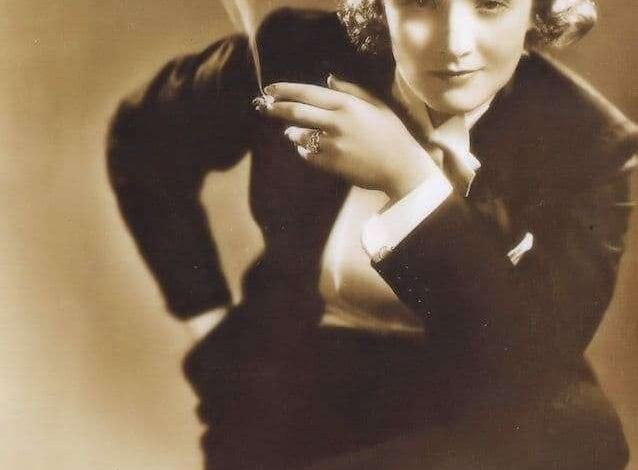
Swirls of smoke added to her aura. She used cigarettes as props to challenge or blur gender lines, as she was often photographed smoking in a tuxedo and top hat. This iconic look became known as “le smoking.”
 The use of a long, slim cigarette holder added another dimension of sophistication to her image. Cigarettes were a hallmark of her career (on and off screen).
Marlene was one of several Hollywood stars who endorsed Lucky Strike (“Luckies”), making the brand fashionable. The company’s advertising campaigns aimed at breaking a taboo and make public smoking for women acceptable.
Dietrich and “Luckies” represented the Hollywood aesthetic of the era, symbolizing a stylish but subversive brand of femininity. Promoted as “torches of freedom,” cigarettes suggested allure and urbanity. To light a cigarette was an expression of independence and empowerment, a statement of socio-cultural rebellion.
Marlene Dietrich moved to Manhattan in 1959, the year that marked her transition from screen to cabaret after a sensational live performance in Rio de Janeiro (later released as the album Live in Rio 1959) and a celebrated November concert series at the Théâtre de l’Étoile in Paris. She also made her television debut that year.
Marlene Dietrich covered the world in a haze of cigarette smoke. Some scientists at the time warned about the dangers of nicotine. Based on Anglo-American research during the mid-1950s, the medical world expressed concerns about the link between smoking and lung cancer.
It marked a turning point. Apartment 12E witnessed the cultural shift from smoking as a symbol of glamorous rebellion to the stigmatized habit which it is today.
Illustrations, from above: Postcard of Marlene Dietrich in the Josef von Sternberg’s film Morocco (1930); Dietrich in her New York apartment; a René Lalique “Deux Colombes” crystal ashtray, ca. 1930; and Marlene Dietrich in a 1950 Luck Strike cigarette advertisement.
Source link