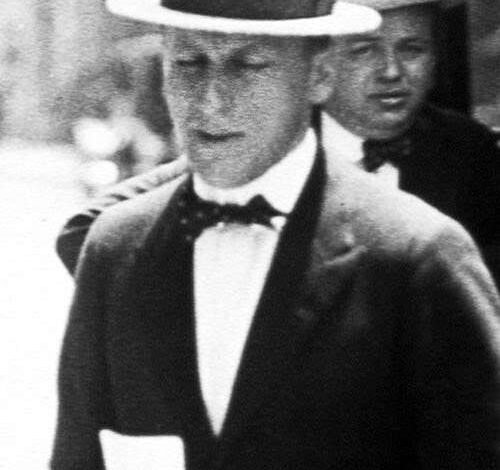
 Arnold Rothstein was of the most famous of America’s 20th century criminal masterminds, and for more than 20 years, the New York City native spent his summers in Saratoga Springs, gambling on the horses by day – and just plain gambling by night.
He first started coming to Saratoga on a regular basis in 1904, when he was 22 years old, and he largely gave up on Saratoga after 1925 – by then, he was able to make so much money bootlegging liquor that he no longer spent much time gambling at the Saratoga Race Course.
In his gambling, he never minded doing things to tweak the odds in his favor – and his most audacious tweak, the fixing of the 1919 Chicago White Sox-Cincinnati Reds World Series, was at least discussed at his famous and exclusive private club in Saratoga, The Brook.
Rothstein was variously known as “The Brain” or “The Big Bankroll” – he was said to have never made a mistake with numbers. He was always thinking a step ahead and was a ready source of cash, though always with repayment at high interest.
 It was that reputation that led to his involvement in the White Sox’s 1919 Chicago World Series scandal, which would have the team forever after known as the “Black Sox,” though none of the involved players was ever convicted of a crime, and neither were any of the gamblers.
Rothstein denied involvement, though there’s no question that his name was being thrown around by nearly everyone.
The one person the scandal couldn’t have happened without, though, was Charlie Comiskey, the owner of the White Sox, and builder of the legendary Comiskey Park, demolished in 1991.
The White Sox, with Shoeless Joe Jackson (1887-1951) as one of their leading hitters, were one of the great teams of all time, but Comiskey was known as a cheapskate who paid his players poorly, taking advantage of the “reserve clause,” a major league baseball policy that bound a player forever to the team that first signed him, unless he was traded.
During the 1919 season, when star pitcher Eddie Cicotte (1884-1969) reached 29 wins, Comiskey ordered the manager to bench him, to avoid having to pay a $10,000 bonus promised if he won 30 games.
Not surprisingly, many of the players hated him. With Cicotte among their leaders, they begin thinking about whether they could make a lot more money from gamblers by agreeing to lose the World Series to the Reds, even though the White Sox were the much better team.
The gamblers would be able to get a big payoff by betting on the long-shot Reds, secretly knowing that the Reds were going to win.
The White Sox were well-secured in first place in August, when the rich, the sports gamblers, and the mob were mixing in Saratoga Springs, even though the World Series was many weeks away.
 At Rothstein’s club, The Brook, there would later be testimony that a Chicago gambler and wire service operator, Mont Tennes, was talking about having inside information that the World Series was going to be fixed.
Tennes told wealthy restaurateur and recreational gambler Charles Weeghman, who until recently had owned the Chicago Cubs, that he had heard the rumors from Rothstein himself, and from other gamblers including Nat Evans and Abe Attell.
Weeks later, it would be Attell – a former lightweight boxer turned professional gambler – who made actual contact with the White Sox players.
The players – eight to ten of them – wanted $10,000 each to throw the series. The fix was going to cost $100,000. Only one person in the underworld, Rothstein, had that kind of money, so it made sense that Attell turned to him.
One of the enduring questions is whether Attell turned to Rothstein for the money, or Rothstein was the fix’s mastermind who sent Attell to Chicago.
In any event, the players saw almost none of the promised payoffs. Cicotte was given $1,000 after the Cubs lost the first game, but few if any of the other promised payoffs came through.
Rumors about the series being fixed started almost immediately, and Rothstein was at the center of the rumors. In the end, the Reds won the World Series in eight games (the World Series was a nine-game series at that time.)
 What happened is recounted by Glenville, NY, author David Pietrusza in his Rothstein: The Life, Times and Murder of the Criminal Genius Who Fixed the 1919 World Series (2011).
After the series was over Monte Tennes saw Weeghman in a Chicago barbershop, and reminded him of the conversation they’d had earlier in Saratoga Springs.
Weeghman remembered; he would later testify that he just didn’t believe it was possible to fix the World Series.
Eventually, in 1920, there would be a Chicago grand jury investigation. Weeghman testified to what he heard in Saratoga; by then, three players, including Cicotte and Jackson, had made police confessions.
On the advice of his New York City lawyer, Rothstein went before the grand jury, and denied any knowledge of the fix. In the end, eight players were indicted, as were Attell and several other gamblers.
Rothstein wasn’t indicted. By the time the case went to trial, the player confessions and much of the other grand jury testimony had somehow disappeared from the district attorney’s files. The remaining evidence was unpersuasive, and everyone was acquitted.
If the series was fixed, no one was ever held legally responsible.
The Brook, out Church Street, near the corner with West, was the finest and best-known clubs in Saratoga Springs during its brief life. Rothstein knew that the gambling odds always favored the house, and believed running a house that appealed to richest visitors would be best for his business.
The food at The Brook was excellent, but there were no prices listed on the menu; his clientele was meant to be the sort who didn’t need to worry about such things.
Rothstein almost certainly was doing his best to manipulate horse races, including the 1921 Travers, which was won by a Rothstein-owned horse, Sporting Blood.
 Arnold Rothstein was murdered in New York City in 1928 at age 46, but his Saratoga legacy lasted decades longer.
The young proteges who worked at The Brook included Dutch Schultz (1901-1935), Lucky Luciano (1897-1962) and Meyer Lansky (1902-1983), the latter of whom went on to run a (by then illegal) gambling house on Woodlawn Avenue, the Chicago Club, for decades, until the 1950s.
Editorial Notes on Upstate New York Crime Syndicates
Arnold Rothstein, Lanksy and his compatriot Bugsy Siegel (1906-1947) took part in pragmatic alliances with the dominate Italian crime syndicates operating in upstate New York.
In 1936, Luciano was convicted for his prostitution racket by the District Attorney Thomas E. Dewey and sentenced to 30-50 years in prison. Thanks to a deal made by Lansky, he was released after providing naval intelligence during the Second World War, and deported to Italy. His body was returned to the United States for burial.
Arnold Rothstein was also a mentor to Frank Costello (1891-1973), boss of Luciano’s crime syndicate . Costello spent several years in prison before retiring in 1957, following an assassination attempt ordered by Vito Genovese (1897-1969).
Rothstein is believed to have been killed over a poker debt in a game he thought was fixed, or possibly by Dutch Schultz (1901-1935) in retaliation for the killing of his friend and associate Joey Noe by another Rothstein protege, Jack “Legs” Diamond (1897-1931).
Diamond was murdered in 1931 (probably by Schutlz’s orders) in Albany, NY on the evening of his acquittal in Troy, NY on kidnapping charges. Dutch Schultz was killed at the Palace Chop House in Newark, New Jersey four years later, in 1935, after disobeying an order not to put a hit on Thomas Dewey.
Stephen Williams is a former reporter for The Daily Gazette, author of a column collection, Off the Northway, and editor of the Saratoga County History Center’s History Lives Here newsletter. Editorial Notes were provided by John Warren.
This essay is presented by the Saratoga County History Center.
Read more about the history of Saratoga Springs.
Illustrations, from above: Arnold Rothstein in Saratoga; Eight members of the Chicago “Black Sox” accused of conspiring with gamblers; The Brook Club (The Brook, Brook Resort); David Pietrusza’s 2011 biography of Rothstein; and the 1928 shooting of Arnold Rothstein crime scene.
Source link