 Red Hook in Brooklyn is home to Fort Defiance, one of the most overlooked Revolutionary War sites in New York City, and it may also hold a key to the community’s climate resilient future, according to Friends of Fort Defiance and Resilient Red Hook organizers.
They say Fort Defiance is both a sacred site of early American history and a strategic opportunity for a modern-day resilience and community space and are hosting a discussion about integrating this site into Red Hook’s Climate Justice Action Plan to ensure that history, green infrastructure, and community identity are woven into climate planning decisions ahead.
Fort Defiance was one of the forts constructed by General Nathanael Greene in 1776 to provide for the defense of New York. On August 27, 1776, during the Battle of Long Island, five cannon, a series of earthworks and a defensive wall were manned by colonials on an island in New York Bay.
It was the westernmost of forts along Brooklyn Heights, defending the Upper New York Bay from incursion by the British navy. Prior to the battle a thousand men worked under General Israel Putnam‘s direction to prepare for the invasion of New York, building the fort during one night in April.
 General George Washington inspected the fort in May, 1776 finding it “exceedingly strong.” The complex consisted of three redoubts on the small island, connected by trenches, with an earthwork on the island’s south side to defend against a landing.
The fort was abandoned after the war, the embankments leveled, the dredges filled in the ponds and the Atlantic Basin was hollowed out to be made into a protected wharf.
The Indigenous path to the fort was named the Red Hook Road from the fort to Fulton Street. By the 1850s, it was becoming the largest port in New York Harbor.
Valentino Park has a plaque commemorating Fort Defiance (a stop on the Revolutionary War Heritage Trail) about two blocks from its actual former location at Conover and Van Dyke Streets.
Event Details
This event will take place on Thursday, May 21, 2026, from 6 until 8 pm in the Lehigh Valley Barge No. 79 at the Waterfront Museum, 290 Conover Street in Red Hook, Brooklyn. RSVP here.
The discussions will include:
Revisiting the historical significance of Fort Defiance as a key Revolutionary War fortification and what it meant for the defense of Brooklyn and New York;
Exploring how the site’s elevation and location make it a natural refuge and staging ground for climate adaptation and storm response;
Exploring concepts for nature-based design, public memory, and multi-functional green infrastructure that could transform the site into a community resource for the 21st century; and
Hearing updates on the New York City Historic District’s “Six to Celebrate” program and the broader push for recognition and stewardship of Red Hook’s cultural and ecological assets.
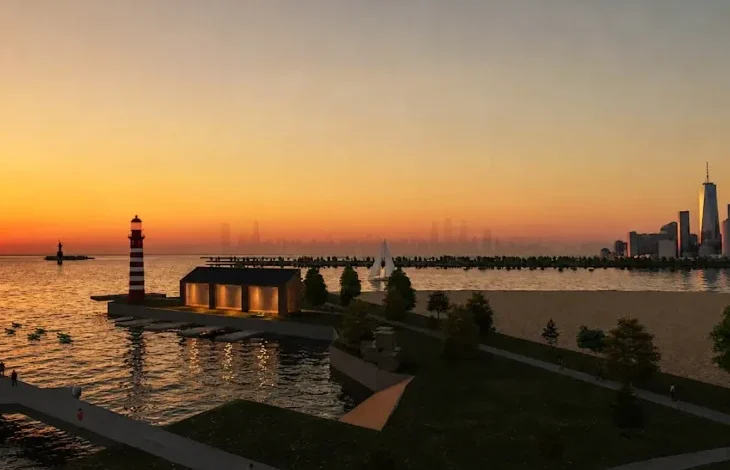
Formed in December 2024, Friends of Fort Defiance‘s activities include the design of a modular system for neighborhood-wide flood mitigation; historical and archeological research on the Revolutionary-era redoubt Fort Defiance; and a design concept called “Fort Defiance Park” that proposes the development of a resiliency hub with a historic park overlay and an urban industrial campus.
Resilient Red Hook was inspired by the spirit of unity that helped the Red Hook community survive Hurricane/Superstorm Sandy. Their vision for a resilient and thriving community is to strengthen Red Hook by minimizing differences and maximizing cooperation among all who live, work, and play there.
Illustrations, from above: The Statue of Liberty, New York Bay and Manhattan from Red Hook (provided); and a map marking British and American positions at the Battle of Long Island, 1776. HMS Roebuck is shown bombarding an American battery at Fort Defiance.
Source link