The original Luddites were textile workers trying to stop machines from taking their jobs.
Today, the term describes people who can’t or won’t adopt new technology.
Raise your hand, Division of Homes and Community Renewal!
How else to explain this state agency’s insistence on absolutely bonkers paperwork requirements for substantial rehabilitation applications?
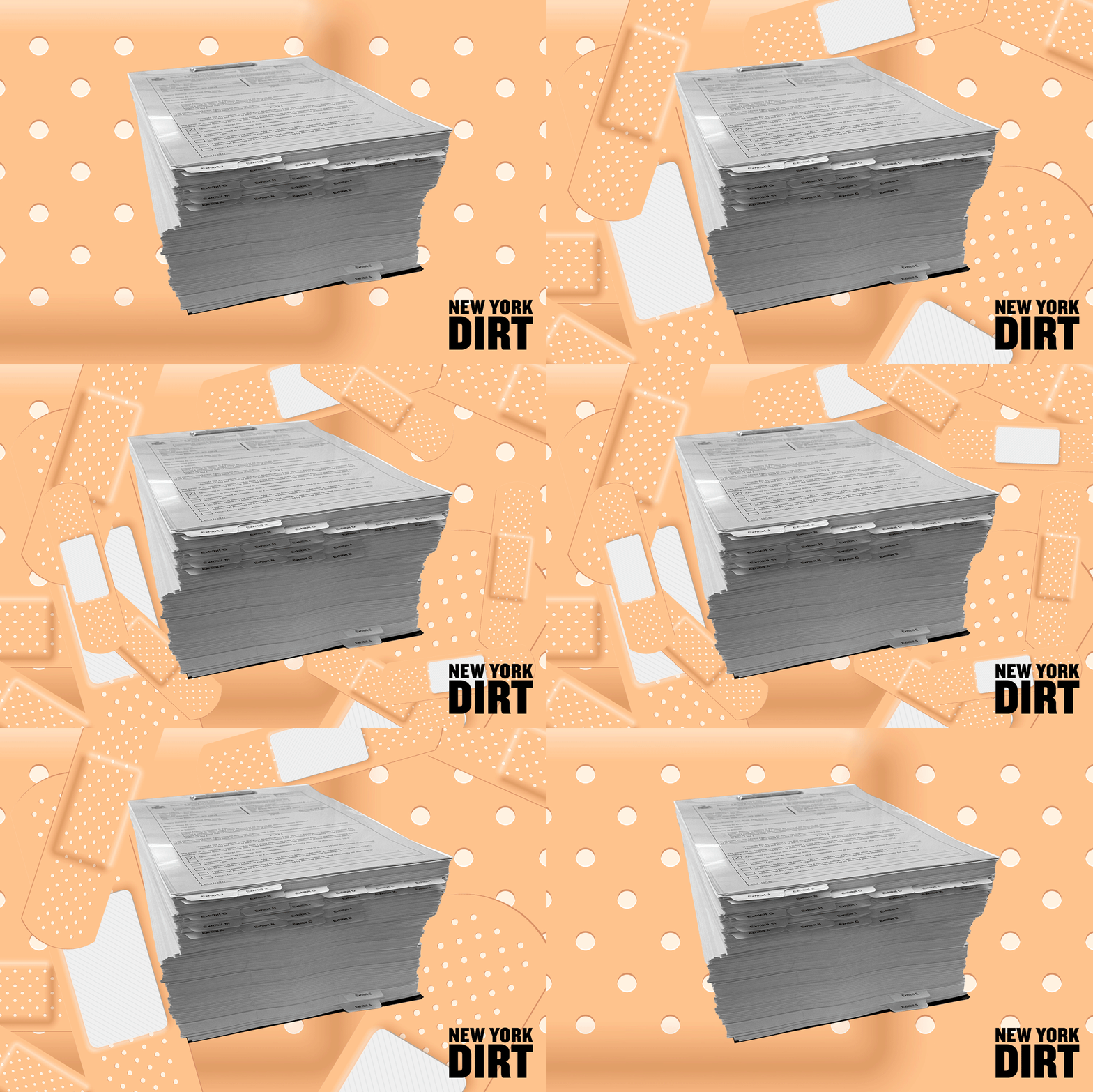
The photo above is an actual sub-rehab application. It’s 1,100 pages. And that’s not even the worst part.
One of these stacks must be printed for each tenant in the building to be rehabbed. In this case, the printing bill came to $4,900.
Shipping is not included; HCR has no Prime membership option, and unfortunately, hand delivery to tenants is not allowed. Applicants must send the printouts — labeled for each tenant — to HCR, which in turn ships them to the tenants. Tenants are entitled to review and respond to all claims made in the application, which itself is two pages, but requires supporting documentation for the claims.
“The DHCR wouldn’t allow us to keep one copy online or provide it to the tenants online,” said a person who helped prepare the documents. “This is our government at work.”
But is this because the agency is staffed by luddites? I suspect not.
Paperwork requirements have been reduced by every level of government — a major improvement, even if the digital alternatives rely on clunky websites.
I’m sure HCR looked at its processes and made decisions about which one to digitize. Sub-rehab notices were excluded. By the looks of things, it seems they were made as paperwork-intensive as possible.
A cynic would say this was done to discourage sub-rehabs — especially of buildings with tenants still in place. The agency has been taking a dim view of these projects because they remove buildings from rent stabilization.
One way to avoid preparing six-inch stacks of paper for each tenant is by applying to rehab only vacant buildings. This often requires buying out tenants.
The catch is that HCR rejects substantial rehabilitations based on buyouts. But that’s another story.
What we’re thinking about: Absurd paperwork requirements are not only a disservice to landlords, but also to tenants. No tenant is going to read a six-inch stack of papers. With a digital version, they could at least search for keywords. And it wouldn’t become a disposal burden or a trip hazard in the home of an elderly renter. Send your paperwork pet peeves to eengquist@therealdeal.com.
A thing we’ve learned: Under the City Charter revisions, rezoning applications to increase affordable housing in districts in the bottom 12 in housing production will get a shortcut to approval starting next year (a three-month process culminating in a City Planning Commission vote), but that option will help applications win City Council approval in those neighborhoods this year — because of the threat that they could be re-filed in 2027.
Elsewhere…
City Council Speaker Julie Menin will soon release a study on which of the 219 city library branches could accommodate affordable housing. But why not also name the libraries where housing might pencil out without income-restricted units?
Presumably, Menin is looking for libraries in markets where demand is high enough that market-rate units could subsidize affordable ones. In Brooklyn Heights, for example, David Kramer’s Hudson Companies built an initially controversial but ultimately well-received project. That’s the economic premise of Mandatory Inclusionary Housing.
In lower-rent communities, cross-subsidizing affordable units without government money is not possible. However, if the Council is evaluating every library, it might as well see what kind of housing, if any, is feasible at all of them.
Closing time
Residential: The most expensive residential sale recorded Tuesday was $16.3 million for 109 East 79th Street, 5W. The Upper East Side condo is 3,100 square feet. It last sold as a new development unit in 2022 for $9.9 million.
Commercial: The most expensive commercial transaction was $42 million for 698 West End Avenue. The Upper West Side rental has 90 units and is 91,500 square feet. Benchmark Real Estate Group is listed as the buyer.
New to the Market: The highest price for a residential property hitting the market was $18.5 million for 165 East 64th Street. The Lenox Hill townhouse is 7,000 square feet. Compass’ Charlie Attias, Brooke Winsness and Connor Ramage have the listing.
— Joseph Jungermann