
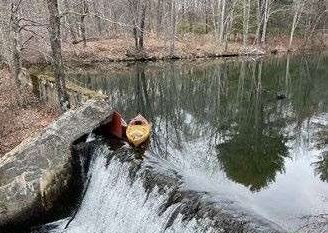
 Water currents can be strong at any time of year, but early season boaters, paddlers, anglers and swimmers are at a greater risk in spring when waters are still cold – cold enough to cause cold water shock, hypothermia and death in minutes.
Three recent stories highlight the dangers of recreating on and around cold and fast waters in Spring:
The Neversink
On an early recent Friday afternoon, 63-year-old from New Jersey got stuck between two rocks while wading and fishing in the Neversink River Unique Area in the Catskills, in Sullivan County, which features a spectacular gorge and several waterfalls.
He was eventually freed and crawled to shore where he met three Forest Rangers and members of the Rock Hill Fire Department. They splinted his ankle and loaded him into a wheeled litter, and carried him to a UTV for transport to a waiting ambulance.
He was lucky. Strong currents take the lives of several New Yorkers each year.
The Schroon River
On May 11th missing kayaker Sohail Nabi, a 21-year-old Colgate University senior, was recovered from the Schroon River in Warrensburg, in the southern Adirondacks. The 21-year-old from Yonkers’ kayak was found Sunday night about 9:30, and he was located about 22 hours later by the NYS Police Underwater Recovery Team.
Lincoln Pond
A few days later and about an hour north, in the Adirondack community of Elizabethtown, Essex County 911 called DEC’s Ray Brook Dispatcher about two paddlers in distress at Lincoln Pond.
Three Forest Rangers arrived on scene and determined it was three paddlers in the water after their canoe and kayak flipped.
Rangers assisted two out of the water and Horicon Fire Department and EMS transported them to Elizabethtown Hospital to treat them for hypothermia.
Around 1 am, the Horicon Fire Department Dive Team recovered the third paddler, a 30-year-old from Syracuse, deceased.
Cold Water Shock May Happen As Warm As 68°
Boats capsizing and falls overboard are the leading causes of cold-water immersion. Any water less than 59°F will trigger the physical response to cold water, but some studies suggest that the water can be as warm as 68°F.
The colder the water, the more severe the response. Total immersion in cold water is very painful and the disoriented victim can quickly panic. With these combined reactions, the victim may drown quickly. The best prevention for this danger is to wear a lifejacket.
The colder the water, the greater the risk to the unprepared person. If the water temperature is under 50°F , the window of opportunity for rescue is only a few minutes if the involved person is not dressed for the water conditions.
Nearly 90 percent of boating fatalities are due to drowning and nearly half of those are attributed to the effects of immersion in cold water.
Should an immersion occur, try to get out of the water as quickly as possible. Do not try to remove clothing or shoes. Air trapped between layers of clothing will help keep a person afloat and also protect from direct exposure to cold water.
Paddle Safe
Drownings occur more frequently at this time.
The safest early season paddlers will stay closer to shore, and wear a drysuit in waters below 50°F (10°C), or otherwise a wetsuit, and a pfd.
In New York State, all people on a vessel 21 feet or less are required to wear a personal flotation device (pfd) from November 1 until May 1.
Since 2025, a safety certificate has been required of all operators of motorized vessels, regardless of age. Both in-person and online options are available for earning a certificate.
They provide high quality boater and water safety education which has applications for paddlers and canoeists as well.
Illustration: Cold Spring Creek, where boaters and an attempted rescuer became submerged in frigid waters in April, 2023.
Source link