How new people are welcomed matters. Last summer (August 2025) I met playwright CJ Willette. When CJ asked to hang out in rehearsals for Hundreds and Hundreds of Stars, they aren’t just set up for success as my guest—they become the room’s guest. Someone immediately stewards them, gives them a space to be, a script, even a task. This isn’t about me abdicating responsibility; it’s about the room taking collective ownership of its culture. CJ becomes so embedded that they are present several times a week, sometimes on book for actors, sometimes helping with scene changes, sometimes just being a great cheerleader. CJ becomes part of our familia all the way through opening night, not just the “director’s friend.”
One of the clearest signals of this kind of leadership is how tasks get distributed. In our production, this looked like: the director (me) helping the stage manager figure out the schedule; actors washing their own dishes; everyone helping. When someone sees something that needs doing, they ask themselves: Is this something I know how to do? Do I have the space and time to do it? Can I be helpful here? Crucially, tasks aren’t ranked. There’s no hierarchy of worthiness between artistic and logistical labor. These tasks might vary depending on the theatre, but their importance does not. It’s really valuable for the entire community to see the director helping tape out the set (a more logistical task) as well as the assistant stage manager offering an insight into character motivation at an appropriate moment (an artistic observation).
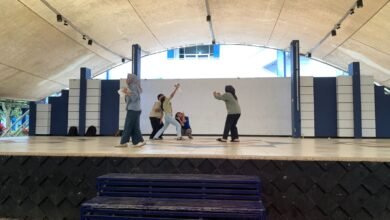
Creating “rituales faciles”—like warm-ups and check-ins—that anyone could lead helps establish that this isn’t a space organized around one person’s presence. In a more hierarchically led space, it is incumbent upon the director to begin the day. The director starts the warm-up; the director leads the rituals. For our first few days, choreographer Raquel Torre leads our warm-ups. Soon, other people take the lead. The youngest member of our ensemble, Charlotte Arias, hasn’t yet found her voice in the rehearsal room full of gregarious adults. She had shared with us that she plays soccer, so one day she leads us in her soccer warmup. This simple distribution of authority to the least empowered person in the room gives everyone the chance to cheer her on.
Regina Garcia has modeled our scenic design after a zoetrope, so it is not a literal use of space. However, some scenes take place in more realistic environments. When it comes time to stage a scene in a kitchen, I make the physical parameters transparent to the group and invite everyone to engage, rather than just telling them what I think it should be. The bolder voices in the room immediately speak up with ideas, while some are more hesitant. Peer mentorship emerges organically, which feels fundamentally different from me pushing someone to speak up. Top-down prompting can feel oppressive, like the performance of participation rather than genuine collaboration. Ideally, the chorus of voices finds harmony, each instrument finding the way to participate, where no one dominates. Everyone feels invested in the choices, better able to navigate the space they’ve created, and able to make adjustments because the play belongs to them.
This approach becomes especially vital when building the prologue. In the play, Sandra has written a beautiful opening moment where the character Clara stands alone. And then Sandra writes: “Beyond her light is the energy of an infinite number of beings. They breathe with her.” These “infinite number of beings” are played by members of the ensemble, and we refer to them as our “stars.” Multiple voices in the room—Raquel, our choreographer; our dramaturg, Yasmin Zacaria Mikhaiel; and I—bounce ideas back and forth in real time. Raquel has a map in mind. I’m thinking about bodies in space. Yasmin raises the audience perspective. We have to let go of ideas and keep the flow going. We are dealing with the abstraction of “stars” versus more concrete characters: Who is the actor playing in any given moment? As we think out loud, change our minds, and build on each other’s ideas, we model something essential: that lots of ideas are possible, that thinking is a team sport, that you don’t have to arrive with all the answers. Facilitative Leadership research in other disciplines emphasizes “framing work as a learning process” where exploration itself is valuable.
There’s a particularly powerful moment when Raquel has to work something out in front of everyone. It needs no apology. Our trust in her is assumed, and her vulnerability makes us trust her even more. Allowing everyone to witness process means there’s no need for the “leader” to come in with everything totally figured out. Preparation is important, but performed certainty can actually inhibit creativity. “I don’t know…yet” is not only acceptable but also an invitation. Understanding the feeling of a moment, its role in the larger story, even its energy or impulse, can sometimes be enough of a seed to spark something for a company. The onus to come into a rehearsal with everything completely solved is unnecessary.
But here’s where it gets complicated: In practice, conventional leaders tend to have all the information. The director has been in on the project from the beginning. My conversations start with the artistic director, and I’m beholden to the values and mission of the institution, including fulfilling the promise of the project within budget. Plus, I’ve been working with designers and know the possibilities and limitations of the physical space. Most of this information isn’t useful to dispense. I’m happy to share if someone is interested, but it would be time consuming in an already constrained process. However, if everyone is encouraged to problem-solve without knowing the practicalities like budget and logistics, a lot of time and energy can be wasted on ideas that aren’t viable.
How do we avoid dismissing an idea out of hand, or shutting someone down mid-idea just because they don’t have all the information? That could deter team members from speaking up later. The answer lies in transparency about constraints upfront and in creating a culture in which “no” is acceptable—where hearing “that won’t work because of X” doesn’t feel like personal rejection because trust exists. Also, not every decision is on the table. Saying “here is something where I’d welcome everyone’s participation” signals one thing. Saying “please give me a moment to figure this out on my own” signals something else. Clarity and transparency are key.
Are we all clear on the objectives of the piece and production? Are we aligned in pursuing the same impact? When we share not just tasks but context, we equip all stakeholders to consider all the variables. Building trust is different from assuming trust in the director.
Assistant director Natalie Friedman spoke of the work:
The generosity of information was truly invaluable, because it meant we could further lift each other up and divide and conquer whenever it was helpful. It started with the director empowering others to contribute and lead by example, which allowed us to build trust within each other and ourselves. It also created a more dynamic production, encouraging rough drafts and evolution along the way.
And there are rough drafts! From everyone! There is a moment when I discover (embarrassingly late in the process) that the phone call that makes up the epilogue is almost entirely in voiceover. It wasn’t entirely explicit in the script, but still. Normally, I would be defensive, embarrassed. Instead, in this space we’ve created, it is totally fine. We are all able to discuss what that moment means. The tangible directive I now give participants in this model is: “Give me permission as the director to make mistakes and have bad first ideas.” It’s a practice. When the leader can be fallible, everyone else’s risk-taking becomes easier.
Here’s something I wasn’t prepared for: Typically, the collective energy of the group shifts when the director’s energy wanes. It’s not solely the director’s responsibility to keep things going. In this space, we can pass the baton of energy. This removes some of the burden (fácil!) of leadership—perhaps putting the director in a better mood, which benefits everyone. It requires building a culture in which that’s expected and normal and trusting that others will pick up that baton and know what to do with it.
I’d be dishonest if I didn’t acknowledge complexities. In this particular case, some of us shared decades of theatremaking together. People have diverse experience levels. Creating an equal playing field doesn’t mean pretending these differences don’t exist. In each space, it becomes imperative to acknowledge these complexities in order to move forward with greater possibilities of shared ownership of the work, opportunities for peer mentorship, and a trusting collective.
Everybody isn’t the director. That’s not the goal. The goal is that everyone feels empowered to contribute their expertise, ask questions, and take creative risks. All ideas count, even when the answer has to be no.
The ultimate test of decentering leadership is this: Are we creating the work for the approval of the director or for the work itself? If I go to Parents’ Weekend at my son’s college and work can still happen, if we’re all aligned with the task and the mission, then we’ve succeeded in building something larger than my singular vision or presence. The director is essential, but the director is not the sun around which everything orbits. We hold storytelling check-ins as the play evolves so we all evolve with it—especially around interstitial moments that affect multiple departments. The playwright, choreographer, assistant director, and I sync up regularly. Not because I’m gathering information to make a decision, but because we’re thinking together.
Facilitative Leadership in directing is not about the director’s disappearance. It’s about the director’s transformation from auteur to lead collaborator, from commander to cultivator. It requires transparency about constraints, generosity with information, willingness to be fallible, and active redistribution of power. The work I’m learning to do is this: holding structure while staying permeable, maintaining vision while remaining open, keeping responsibility while sharing authority. The paradox resolves when you realize that strong Facilitative Leadership makes better art—not despite the distribution of power, but because of it.