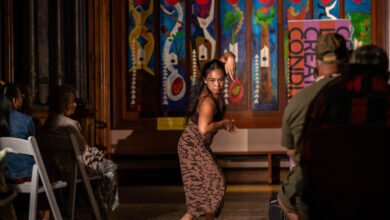
Yet a tension persists. For white or Western viewers, Kim’s excavation of her father’s rage and her mother’s buried ambitions may feel revelatory. For me, and perhaps for those others who arrived already fluent in this particular grief, the play offers little beyond the act of reliving it. In this way, the play occasionally feels like it’s explaining itself to a neighbor who will never truly understand. This raises a pressing question: Who is this ultimately for? If it is for people of color, immigrants, and those with similar experiences, do we need to witness our own violence and trauma vicariously? If it is for a white audience, does it inadvertently profit off the performance of marginalized pain?
The Who Is this Theatre For?
In a capitalist theatre landscape, sharing experience is never politically neutral. Purchasing a ticket is not an act of solidarity. It is worth asking who profits when marginalized experiences become legible enough to sell. The white audience member who leaves sighing, newly enlightened, having paid to feel something—what have they taken, and what has been given up to provide them with it? Kim’s generosity as a performer is genuine, but generosity does not exist outside of political economy. In my view, the play’s desire to claim personal healing sits uneasily against the fact that an institution programmed the rights to her belonging, and an audience bought tickets to witness her survival.
The tension reveals the fundamental hypocrisy of nonprofit regional and Off-Broadway theatre: an industry that markets itself as a sanctuary for progressive empathy while operating on commercial extraction. Under institutional capitalism, marginalized stories are assigned economic value only when their grief is made legible and monetized. The artist relies on institutional funding and subscriber ticket sales to secure a stage, yet those very institutions require the artist’s raw, personal history to serve as a seasonal diversity metric and a cathartic luxury item for affluent patrons.
This extractive dynamic persists even when culturally specific organizations attempt to build counter-infrastructures within the system. This production’s development through Asian American theatre companies (first with CHUANG Stage and Seoulful Productions, and later through Ma-Yi Theatre Company’s residency at the Public) offered vital community programming and affinity spaces. Yet, within the political economy of Off-Broadway theatre, these grassroots efforts are caught in a double bind. While they create genuine pockets of sanctuary for Asian American audiences, they also risk being absorbed by the host institution to insulate itself from critique. The larger institutional apparatus effectively offloads the emotional and logistical labor of community care into specialized affinity organizations, using their presence to brand itself as radically inclusive while continuing to rely on subscriber-class revenue. Ultimately, community-oriented access initiatives do not dismantle the commercial framework; rather, they highlight the tremendous labor culturally specific companies must perform just to protect artists and audiences from the very extraction the institution runs on.
Recognizing these institutional constraints does not mean treating artists as passive victims of the market. While this financial reality creates pressure, it does not dictate artistic submission. The institutional pipeline presents a trap, yet the artists still hold a choice of how to meet it—whether to resist through opacity, disruption, and refusal or to bend toward institutional approval. Did You Eat?(밥먹었니?) chooses compliance.
What might begin as an act of self-reclamation in the rehearsal room is surrendered under the house lights, where the performance offers the audience a neat, commodified catharsis. They buy them absolution without being required to dismantle structures that produced the trauma in the first place.
If we are to move past this trap, theatremakers must reject the false choice between the model minority myth and the commodified trauma narrative. We can turn instead toward non-extractive models of performance: work that abandons the traditional proscenium to center site-specific community care, ancestral accountability, and shares sustenance over spectator consumption.
What does it look like to stage Asian American life not as an explanation or a defense, but as an internal conversation? Opacity is not a refusal to share; it is a refusal to be surveilled. The quietest revolution on our stages happens when we stop designing our healing for the gaze of those who caused the wound and start building spaces where our joy, our sideways love, are allowed to exist entirely for ourselves.