

Few people passing 2031 Eastern Parkway would have given it much thought.
The parking lot for buses was obscured by graffiti-stewn fencing and zoned for one story of manufacturing. I’ve probably driven past it a hundred times after exiting the Jackie Robinson Parkway at Bushwick Avenue.
But it was just what Adam Zeidel was looking for. The Coconut Properties principal saw its potential to provide hundreds of affordable homes and create value out of thin air.
To understand why, we have to go all the way back to 1986, when Cornell University won a precedent-setting case, Cornell v. Bagnardi.
The court ruled that educational or religious institutions’ land use applications should generally be granted unless they have a net negative impact on the health, safety or welfare of the community.
Coconut Properties is not a school or a church. But Zeidel knew that in 2018, New York City’s Board of Standards and Appeals had extended the “Cornell doctrine” to nonprofits building 100 percent permanently affordable housing, even on sites without any unique conditions or hardship.
At the time, the de Blasio administration was trying to reach its goal of creating 200,000 affordable homes. The BSA is technically independent, but its chair takes direction from the mayor, and board members take direction from the chair.
I like to say that in politics, there are no coincidences. This is an example. The BSA in April 2018, stretching the Cornell doctrine beyond its original scope, awarded the Catherine Sheridan Housing Development Fund Company a variance to build 92 affordable units for seniors and a senior center at 23-11 31st Road in Astoria.
Stop by the site today and you’ll find an attractive, seven-story brick building called the Bishop Rene A. Valero Senior Residence. At the BSA, the policy is called the Catholic Charities doctrine.
That October, the BSA did it again, allowing WellLife Network to build six stories and 66 units of low-income, supportive housing at 80-97 Cypress Avenue in Ridgewood. That site also now features a spiffy brick building.
It would be nice if these projects didn’t have to hire lawyers and spend 18 months getting sign-off from an obscure, five-member board. Any reasonable person could see in a matter of minutes that affordable housing would be a big improvement for these locations.
But going through the BSA still saves a year or two — and a lot of money and uncertainty — compared with the Ulurp gauntlet. So that’s what Zeidel did, although he first got informal approval from Council member Sandy Nurse and Community Board 4. The Doe Fund is his nonprofit partner, and Studio Gang and SLCE are the architects.
Dmitry Morozov of the project’s MEP engineer, Altera, called it “a masterclass in overcoming urban complexity.” Two sets of subway tracks run past the site, and directly below is an 80-foot-wide freight rail tunnel through which the planned Interboro Express will run.
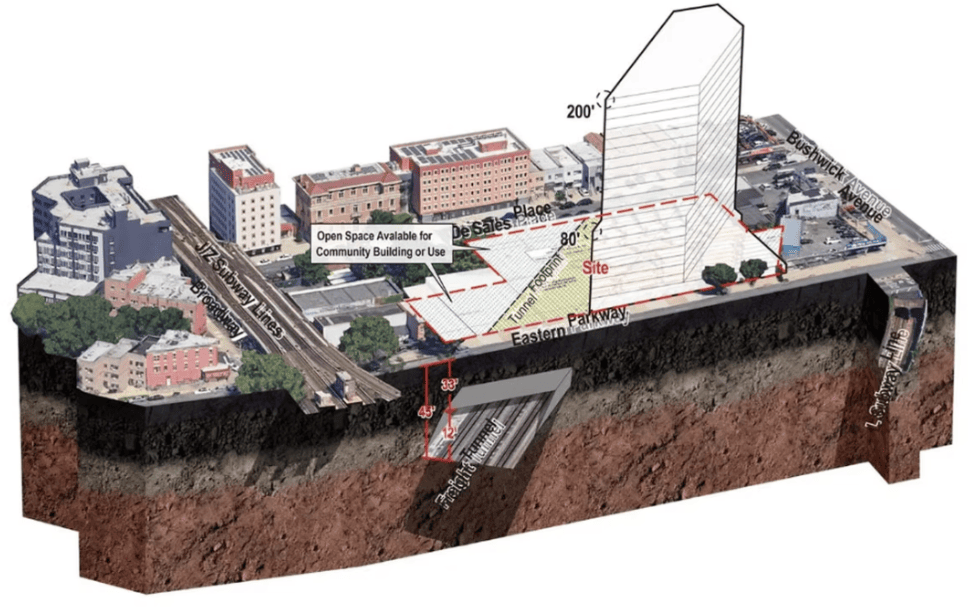
After entitlement, 2031 Eastern Parkway, which the developers acquired for $19 million, was appraised at $27 million — “$8 million in public value created through legal and policy creativity, reinvested directly into affordability and sustainability,” Coconut’s website boasts.
Zeidel expects to break ground next year on the 20-story, 379-unit project. Eco-friendly features will include mass timber, geothermal wells, Passive House efficiency, a self-shading facade, bird-friendly glazing and a rooftop greenhouse.
At 227 feet tall, it will tower over its neighbors, but its developer predicts passersby will think, “Why wasn’t this always here?” It’s a good question, given the city’s housing shortage and the site’s two-minute walk to the Broadway Junction transit hub.
The Cornell doctrine “created a new class of undevelopable sites waiting to be unlocked,” the website adds.
But despite these positive outcomes, developers have used it just nine times in nine years, including Mega Development this month for a 310-unit project at 220-28 Jamaica Avenue in Queens.
Perhaps this column will inspire more.
Read more

PolicyPro: Affordable housing fast-tracked by BSA; state bill eyes $10K per unit payouts

Manhattan Mitchell-Lama gets handout, then kills affordable housing

A seniors housing project is latest proposal to replace this Fort George church