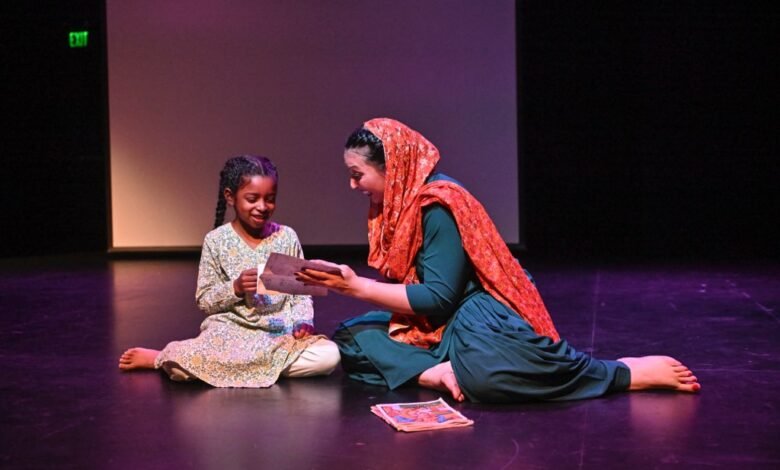
In my correspondence with Singh after the performance, she described this process as one of discovery. “It has always felt like such a joyful celebration to dance bhangra,” she wrote. “Figuring out that we could actually mold it to a different purpose was somewhat surprising even to myself.” Meaning shifted through the face, the direction of a gaze, the weight of a step. “How much a movement embodies a certain emotion…what we’re doing with our faces,” she reflected, became central to the dancers’ work. Giddha moved through a different logic. Its circular structure allowed roles to pass between dancers. Bodies entered the circle, took position, returned to the group. Clapping patterns held the rhythm while movement carried narrative. Singh described the dancers moving through positions of colonizer and colonized within this form. “It’s my first language when it comes to dance,” she said, “so it was important to me to ground the work in my ancestry, my lived experience, and my community.” That grounding opened outward. During the song Jaldi Karo, bhangra rhythms moved in conversation with West African movement vocabularies. Singh shaped a choreographic language attuned to the Ghadar Party’s revolutionary history that crossed religious, caste, and economic boundaries while reaching toward solidarities beyond the nation-state. In the performance, gesture returned altered. Sound travelled across scenes. Poetry, movement, and memory continued to move.
These movements echo the conditions that shaped the Ghadar Party itself. Migrants from Punjab, along with students and intellectuals from across the subcontinent, travelled through networks stretching from the Pacific Coast to East Asia and Africa. They encountered racial violence in North America while remaining tied to international movements of anticolonial resistance. From these crossings emerged a shared political consciousness that refused to separate struggles across geographies. Their newspaper, Ghadar, moved through the same routes. Printed in San Francisco, it travelled through Shanghai, Hong Kong, Singapore, and Nairobi—carried in luggage, passed between hands, read aloud in gatherings. British authorities tried to intercept it, but the material kept moving. Circulation becomes method in this performance too.
For Singh, this history is also familial. Her great-grandfather, Bhagwan Singh Gyanee, was one of the Ghadar Party’s leaders. The performance is constructed around fragments of his poetry and spoken text, composed into new songs. Language moved inside the choreography. In one of the songs called Firangi, Gyanee’s lyrics described the imperial reach of European powers as well as their extraction of labor and wealth from the colonies. Indian soldiers appeared within this structure, placed at the front lines while strategies were formed elsewhere. Ishmeet Narula, the song’s singer and composer, carried the voice as it gathered force in its call for revolt. That voice moved across the stage—through singer, dancer, collective—never settling in one body. Sachi Pukar, also composed by Narula from Gyanee’s poetry, carried a different intensity. The call sharpened. Revolution pressed into the present.
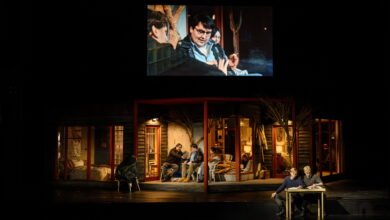
Singh brought the parallel between past and present into sharp focus as she stood beside a projected photograph of Gyanee pointing towards a sword on a table. The image was still, contained within the frame of the archive. She looked at it, then gestured to a sword of her own. The gesture carried weight. She asked someone to take a similar photograph, preserving her image as Gyanee’s had been preserved before her. Time folded without closing the distance between then and now. The question of inheritance sat in the space between the two figures. What does it mean to step into that frame? The choreography left the question open.