From education to health, from justice to environment, sectors that work to create compassionate webs of support are being systematically dismantled in the United States. The arts are part of this ecosystem, and theatre artists are storytellers and collaborators with the skills to organize, communicate, and imagine resistance. In this conversation from the Cultivating Cultural Resilience series, theatremaker Michael Rohd speaks with two artists and cultural leaders who deploy theatre to build coalitions and center what’s possible: Irina Kruzhilina and Coya Paz.
Michael Rohd: Coya and Irina, your work is global in perspective and super local in execution. You are both artists, producers, educators, and, I’m going to say, activists. And, before now, you’ve never met. What do you want to share as we’re getting to know each other?
Irina Kruzhilina: I think that my cultural and artistic background are mixed together, and they’re both important. I was born in Russia. My mom was born in the Ukraine, and my father is a Georgian Jew. I moved to the United States when Putin came to power. Since then, my work focuses on how to find some resistance and how to engage youth in that work.
Coya Paz: My primary theatrical practice is as an ensemble creator, co-creator, deviser. My parents are both anthropologists, so I grew up traveling and living in a different country every one or two years, mostly in Latin America. I’ve never not spoken Spanish and English together.
My first theatre company was very identity specific, stories about Latina women. I don’t really identify as Latina per se now, but at the time, they’re like, “Oh, you’re born in Peru. You grew up. Come on in.” I’m like, “Okay.” The blessing of that is that I met so many South Side Mexicans here in Chicago. The city is incredibly segregated. Chicago invented redlining quite literally, and segregation is still the shaping factor of Chicago.
My work focuses on how we think about geographic equity and environmental justice working with people rather than larger systems. I don’t have a lot of faith in civic and political institutions. I put my faith in making life very hard for decision makers and very joyful for the people who are trying to get a decision made.
Michael: The current dominant political ideology and party is using both of your cities—New York and Chicago—to build an authoritarian movement through the creation of a certain kind of narrative. In this moment, where control of story and narrative seems to have so much to do with swaying large masses of people, how do you both think about story, ideology, and persuasion?
Irina: In the last two years I’ve been really focused on immigration. I think that issue divides us most. How can we use theatre to educate people without being prescriptive?
So, I’ve been creating work with asylum seekers. I talked to a lot of immigration judges, and they said nobody knows what happens there. Nobody knows why decisions are made. To bring those stories to light is very important.
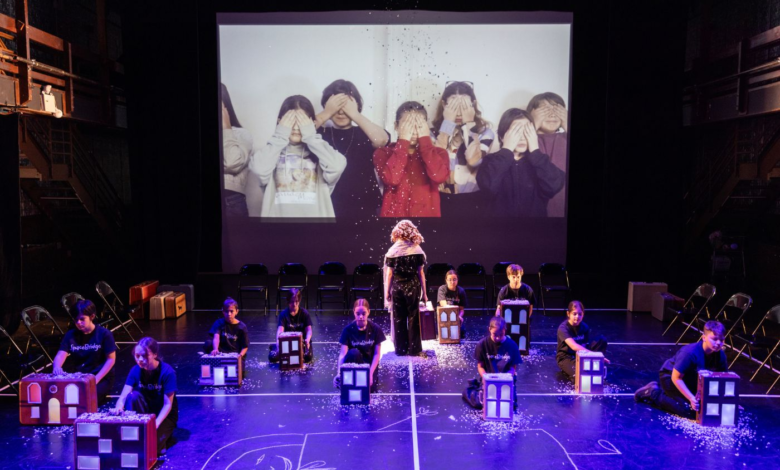
I’ve noticed that a lot of stories about refugees and asylum seekers are about us experiencing empathy towards them, but there is very little call to action. With SpaceBridge, it was very important to not just tell the stories of young asylum seekers, but to ask what they needed. And what they really wanted was to meet American friends, so the project became about the friendship and the world they create.
Coya: My theatre company, Free Street Theater, always has a call to action in our work. We work with community partners; we work with partners who have a political agenda. We always have an easy ask: “Pull out your phones and follow this ordinance on Instagram,” or “Pull out your phone and text the electric company.”
I don’t think any of us believe that the performance itself is going to radically change a system, but it could create conditions that allow people to feel they could be involved. I think about our work as a space to galvanize people and to support people who are doing really radical work and maybe feeling discouraged.
We’re really trying to engage the Mid-South Side of Chicago to deepen that relationship and to create a context in which a theatre company is supporting community organizing and economic development in ways that don’t displace the existing population and that can be responsive to community needs.
I don’t care that much about what people outside of the community think about our work. It’s for a very specific neighborhood and area. We’re really trying to create something that feels aesthetically, culturally, politically, socially relevant to them.
Michael: You’re speaking to something that’s been really important to me more and more over the years, which is the tension between theatre practice as a field of folks judging and rewarding certain kinds of excellence, versus making work with purpose in relation to specific audiences and participants, not worrying about the aesthetics that are going to garner other kinds of attention.
I wonder if we could show Irina’s three-and-a-half minute trailer for SpaceBridge.