How My Process Has Evolved
I used to think that my perspective was a roadblock to my presence in Shakespeare, but now I know that I have a unique lens that brings different questions to the story and characters.
I feel like I am going to ping the gaydar regardless of how I’m presenting onstage, so I like to lean into it.
In my creative processes, I always lead with questions. That’s something that my coming out process taught me: Lead with curiosity.
Any time I find a rule, I ask “Why?” and “What if?” Why is this rule here? Is it as inflexible as it’s presented? Does it have to be? What if the rule was different? How does that change the possibilities? What possibilities have been overlooked?
If Shakespeare characters are assumed to be cisgender or allo, I ask, “What changes if they’re trans? Or aspec? Or both? What in the text provides evidence of that? How do they move through the world? Are they out? To whom? What’s the world’s attitude to queerness? Do they need to be out, or are they accepted as they are? How does their identity inform their relationship to other characters?”
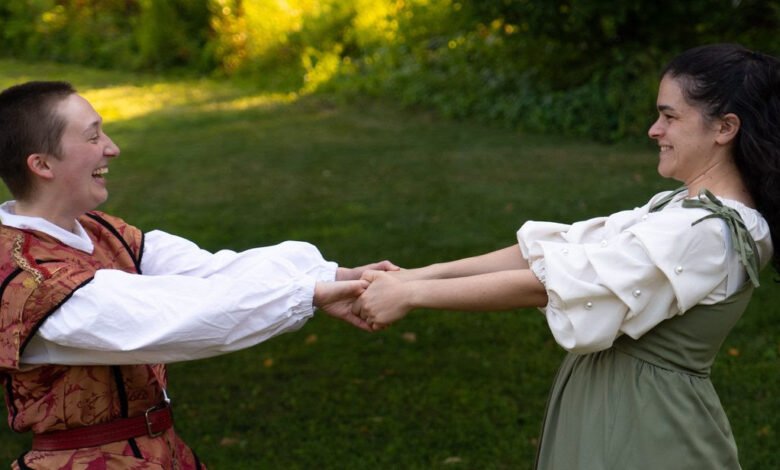
My primary focus with putting my queerness at the forefront of my acting is sheer representation. I don’t get to see a lot of nonbinary, aspec Shakespeare performances, so I’m gonna contribute to what I want to see.
Also, it raises fascinating story questions that have had multiple directors intrigued. Asking questions literally helps me book work! I got hired to play Romeo because I made a case for him being ace, and a director said, “I want you so we can work together to stage this.”
Why Trans and Aspec Identities Make Sense in Shakespeare
There’s so much room for trans and aspec interpretations of Shakespeare.
I got here because other scholars put their work forward. Dr. Aley O’Mara’s trans Hamlet article cracked my world open. For the first time, here was someone sharing news about a Hamlet who orbited in similar queer realms to my own performance.
Scholars like Drs. Liza Blake, Cat Clifford, Aley O’Mara, and others have laid amazing groundwork for revealing aspec resonances in particular, though some scholars in Early Modern Asexualities cross over with Early Modern Trans studies. The Arizona Center for Medieval and Renaissance Studies (ACMRS) Asexuality in Early Modern Literature Roundtable introduced me to Dr. Liza Blake’s work, which would lead me to the Early Modern Asexualities conference and the Asexuality and Aromanticism Bibliography. For anyone curious about ace and aro studies in early modern literature, that bibliography is a gold mine.
Like the scholars paving the way, I’m not ascribing identity. I’m highlighting resonances: character choices, social forces, and lines of text that echo my own experience as a nonbinary aroace person.
Bringing aspec love into Shakespeare isn’t adding something unrelated. It’s simply highlighting the complexities of human relationships and the beauty of aspec connections. Bringing trans life into Shakespeare isn’t pushing an agenda or inclusion for inclusion’s sake. It’s about celebrating the ambiguity and fluidity that’s already present though a lens that brings language formed by lived experience to the story.
When I pitched myself as Aufidius, the freedom fighter general who’s the antagonist against imperialist Rome in Coriolanus, I saw multiple theatremakers pause, think about it, and go, “I’d never pictured you as him before, but now that you say it, I can see how it could work.”
I stand by finding queerness within the text, which for me is easier to do with Shakespeare and other classical works than contemporary plays. Contemporary plays often have more specific casting breakdowns (age, race, gender etc.) than classical works do. Plus, classics are in the public domain. That means I don’t have to spend as much time and money finding the complete texts, and we can cut things.
Now, I’m not cutting Romeo down into a narrow few lines that support my head canon. With Shakespeare, I’m often pointing to famous lines and showing how they don’t just have to be read as cisgender or allo.
For example, Romeo’s language is very flowery and full of visual imagery. Who’s to say they’re not experiencing aesthetic attraction for Juliet and conflating it with romantic attraction? (High school me absolutely thought those two were the same…) This reading clarifies Friar Lawrence’s observation: “Thy love could read by rote but could not spell.”
Other examples: Characters like Boyet in Love’s Labors Lost cross between gendered spaces within the world of the play, and no one bats an eye. Jacques in As You Like It not only tells Orlando that “the worst fault you have is to be in love,” but deliberately chooses a life in the woods away from the social pressures of the court, including marriage. Macbeth’s masculinity is a point of debate (“I dare do all that may become a man. Who dares do more is none.”). Once you ask whether Macbeth is transmasculine, different motivations surface. How might Macbeth’s fear of being discovered be affected by whether he’s out or not or how anti-trans the world of the play is?