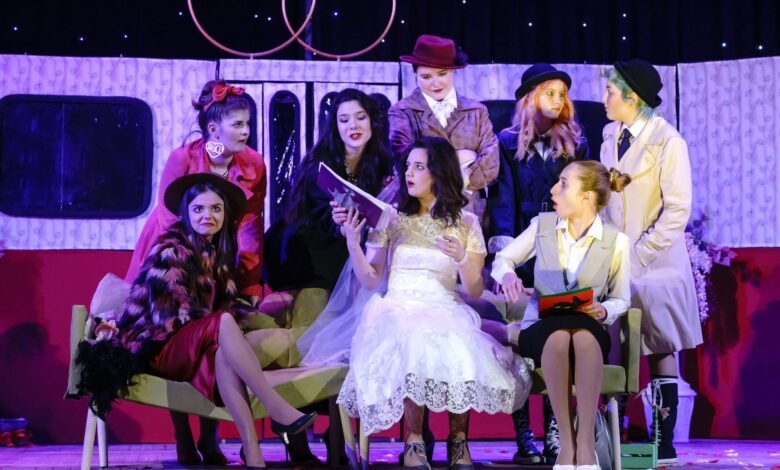
At the same time, the younger students—many of whom had been forced into premature adulthood by war—were given an opportunity to feel young again. To return, at least within the rehearsal room, to an age in which dreaming is allowed, not only surviving.
I witnessed a remarkable transformation: The younger students grew more confident. The older ones became calmer.
Two needs were addressed simultaneously:
- Those who needed protection received it.
- Those who needed to give found a meaningful way to do so.
The group stopped functioning merely as a theatre class. It became a community. That excessive sense of responsibility ceased to be destructive and began to stabilize the collective.
Lesson Two: I Stopped Demanding Emotional Openness
Before the war, I believed that emotional openness was an essential component of an actor’s growth.
I often asked teenagers to search for personal parallels, to recall their own experiences, to work from internal impulses. I was convinced that the depth of a scene emerges when an actor allows themselves to be vulnerable. After the war began, I stopped doing this. Not because they had become less sensitive—but because their sensitivity had become too real, and returning to it too directly had become too dangerous.
Emotional experience was no longer material for creative exploration; it had become material for survival. Asking a teenager to “go deeper” meant risking intrusion into a space where no protective layer had yet formed. Even when they agreed, I sensed an inner resistance. It was not refusal; it was caution. Not an unwillingness to work, but a need to preserve themselves. I realized that depth is not the same as confession. So, I changed the principle. I stopped treating emotional openness as a goal. I began to treat emotional autonomy as a right. And paradoxically, this made the work more honest.
Instead of autobiographical material, I turned toward structure. We began focusing more on physical actions, tempo-rhythm, spatial composition, and ensemble coordination. I paid greater attention to the precision of entrances, the quality of pauses, the architecture of mise-en-scène, and interaction through movement. When no one was required to “open up,” they began to open in a different way—without pressure, without expectation.
I understood that after the war, emotional openness could only be the result of a truly safe space.
Lesson Three: The Body Began to Speak Instead of Words
Another change became visible almost immediately.
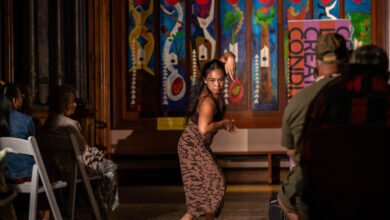
Before the war, the teenagers were ready to speak. They engaged in discussions, analyzed texts, argued, and articulated their thoughts openly. Yet physically, many of them were constrained. Their bodies held tension. Movement required effort. Plastic expression needed development. After the war began, this dynamic shifted dramatically. They became quieter. Words grew heavier. Speech required more energy. At the same time, something in their bodies seemed to unlock. They could move for long stretches of time to music. They were willing to improvise physically. Their range of movement expanded. What they could not articulate verbally, they began to express through gesture, weight, rhythm, and breath.
The central exercises in our work were aimed at associative development through movement. We listened only to carefully structured musical compositions—pieces with a clear introduction, development, climax, and resolution. I asked them not to narrate a story in words, but to live it through movement. They felt the music and constructed narrative lines through physicality. Sometimes they later shared their associations; sometimes they did not. What mattered was that they were given permission to feel without explaining.
This shift changed the rehearsal room. They began sharing with the audience not through speech, but through gesture. Not through monologue, but through silence. Not through text, but through breathing.
Movement became a form of safe articulation. They were not required to survive their emotions; they were allowed to inhabit them. Gradually, their emotional range expanded. Confidence returned—not through verbal declaration, but through embodied presence.
The body, in many ways, became more honest than language.
Lesson Four: Noise as a Form of Stabilization
When emotional and verbal confidence slowly began to return, I noticed another unexpected shift.
The rehearsal space started to fill with noise: Props falling to the floor. Doors slamming loudly. Sudden bursts of music turned on and off. Sharp, exaggerated laughter. At first, it felt like disorder, almost like a loss of discipline. But gradually I understood—it was adaptation.
They had become so afraid of the sounds of explosions, drones, and falling debris that they were trying to transform suddenness into familiarity. What once triggered fear, they were attempting to domesticate. If a loud sound becomes part of the everyday background, it loses some of its power. They were, in a sense, training themselves to tolerate intensity. The rehearsal room became louder than before—not chaotic, but intentionally saturated. It was as if they were recreating unpredictability inside a controlled environment, where they could decide when the sound began and when it stopped.
I abruptly decided not to prohibit this. At that stage, it functioned as stabilization. A space filled with everyday noise offered predictability rather than threat. Within the walls of the rehearsal room, loudness was no longer violence—it was choice.
I understood that after the war this habit would need to be softened, recalibrated. But during an active phase of war, it became a psychological mechanism of self-regulation.