You’ve found the dress and that feels like a win. But here’s what no one really tells you until it’s too late: the dress itself is only half of it. The way it fits on the night is what people see. And most of the issues that ruin a look don’t come from the dress being “wrong.” They come from small decisions made too late, rushed fittings, or assumptions that seem harmless at the time.
The good news is that almost all of these mistakes are avoidable. You just need to know where things usually go off track.
The Timing Problem Nobody Considers
This is, by far, the most common mistake. And the most expensive one. People wait for the dress to arrive. Then they wait to “see how it looks.” Then they realize something needs adjusting… and suddenly there are ten days left and no room for error.
Alterations are not instant. Even simple ones need time to be done properly. When things are rushed, you start seeing issues like uneven hems, tension around seams, or adjustments that technically work but don’t sit right on the body.
Most professional tailors will tell you the same thing: your first fitting should happen at least four to six weeks before your event. If your dress has structure, boning, or heavy embellishment, that timeline should stretch even further.
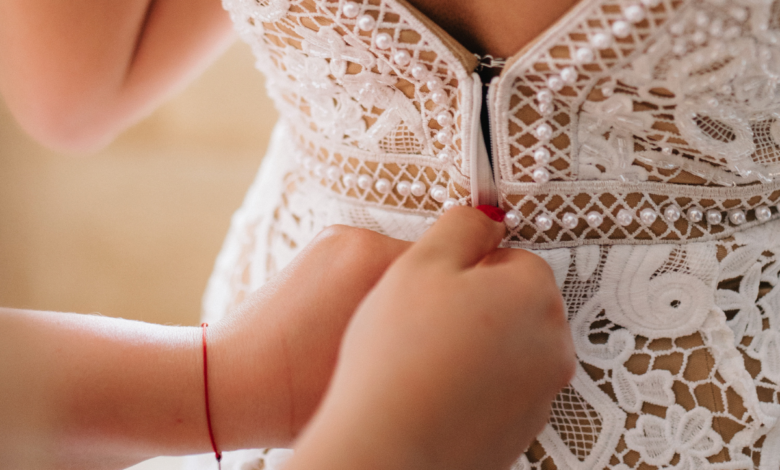
A dress with beadwork or a complex bodice cannot be handled the same way as a simple satin slip. It just can’t. The easiest fix here is also the one people ignore the most. Buy your dress early, and as soon as it arrives, book your fitting. Not “when you have time.” Not “next week.” Immediately.
The Shoe Mistake That Ruins the Hemline
Does this one seem too small? It’s not. The height of your heel changes everything. Not just the length of the dress, but the way it falls, the way it moves, and even how your posture adjusts when you walk. And yes, even a half-inch difference matters.
You might think you’ll wear “something similar” to the fitting. Then the actual shoes arrive, or you change your mind, and suddenly the dress is either dragging on the floor or sitting awkwardly above it. Neither looks intentional.
We’ve seen enough alterations to tell you in full confidence: hem adjustments are among the most commonly redone fixes simply because the original shoe height wasn’t right.
The solution is simple, but it requires discipline. Bring the exact shoes you plan to wear. If you don’t have them yet, bring a pair with the same heel height. Not “close enough.” The same. And bring them to every single fitting, not just the first one.
Undergarments: The Invisible Detail That Changes Everything
You try the dress on with a regular bra during your fitting. On the actual night, you switch to strapless. Or shapewear. Or adhesive cups. And suddenly the fit across the bust, waist, or hips feels… off. Because it is.
Let us tell you a secret: undergarments are not neutral. They shape how the fabric sits on your body. They change tension, lift, and even where seams align.
A structured gown with built-in cups will behave differently depending on what you wear underneath it. A fitted dress will react immediately to shapewear. Even something as simple as a different bra strap position can shift the neckline slightly.
The golden rule here? Undergarments should be decided early in the process, not the day before the event. The fix is straightforward, but it requires planning. Decide what you’re wearing underneath, and bring those exact pieces to every fitting.
The Size Illusion
This one is emotional more than anything else. People want to fit into a certain size, so they order smaller, thinking they’ll “make it work.” Or they go the other way and size up too much, assuming it will be easier to fix later.
Both approaches create problems. Formalwear sizing is not the same as everyday clothing. A size 6 in one brand can easily translate into an 8 or even a 10 in another. Designers use their own charts, and they don’t always align with what you’re used to.
Trying to alter a dress that is too small leaves very little room for correction. Seam allowances are limited. Fabric can only stretch so much. And forcing it usually affects how the dress sits overall. On the other side, a dress that is significantly too large requires more restructuring than simple tailoring. At that point, you’re not adjusting the dress. You’re rebuilding it.
Most professionals agree on this: it is easier to take a dress in than to let it out. Always.
The fix is not guesswork. Get professionally measured, and if you are between sizes, go up. You will have more control over the final fit.
The Standing-Still Illusion
A dress can look perfect when you’re standing still. Completely flawless. And then you sit, or walk…or try to dance. Suddenly, everything changes.
Just think about it: you evaluate the dress in a mirror, in a static position, and forget that you will actually need to move in it for hours.
Fitted gowns can restrict steps. High slits can shift more than expected. Structured bodices can feel different once you sit down. Trains can become difficult to manage without practice.
The fix here is almost embarrassingly simple: move as much as you can. At every fitting, sit down. Walk around. Turn. Raise your arms. Take a few steps as if you’re entering a room. Try to mimic the actual event, even just a little. The dress you can’t move in is the dress you will spend the entire night adjusting.
Fabric Reality (and Why Some Changes Just Don’t Work)
There is a moment in almost every fitting where someone asks for a change that sounds simple… but isn’t.
“Can we just take this in a bit?”
“Can we change the neckline?”
“Can we reshape the skirt?”
Sometimes the answer is yes. But often, it depends entirely on the fabric and construction.
Delicate fabrics like silk, chiffon, lace, or tulle don’t behave like structured materials. They shift, they stretch, they react differently to stitching. Heavily embellished dresses, especially those with beadwork, require adjustments that involve removing and reapplying details by hand.
That takes time. And it costs more. But the real fix happens earlier than you think. Choose a dress that is already close to what you want. Don’t rely on alterations to transform it completely. Adjust, refine, perfect. Don’t redesign.
Skipping the Final Try-On (and Regretting It Later)
This is the last step, and somehow, it’s the one you will be tempted to skip. Everything seemed fine at the previous fitting. You’re busy. The event is close. It feels unnecessary.
Until you put the dress on the day of the event and notice something small. A strap that slips slightly. A hem that feels uneven. A section that bunches just enough to be annoying.
Individually, these things seem minor. Together, they change how the dress feels.
The final fitting is where these details get caught. Schedule it one to two weeks before the event. Bring everything. The shoes, the undergarments, the accessories. Look at the full picture. Because once the event day arrives, there is no time left to fix anything.
What You Should Bring to Every Fitting
-
Your dress, obviously. The shoes you plan to wear. The exact undergarments you’ve chosen, whether that’s shapewear, adhesive cups, or a specific bra.
-
If your outfit includes a belt or anything that sits near the neckline, bring that too. It can affect how the dress falls more than you expect.
-
And if you can, bring someone you trust. Not a crowd. Just one person who will actually tell you the truth.
The Part People Get Wrong About “Perfect Fit”
A perfect fit doesn’t mean the dress is tight everywhere or perfectly symmetrical from every angle. It means you can wear it without thinking about it. It means you can sit, move, walk, and exist in it without adjusting every few minutes. It means nothing feels like it’s fighting your body. That’s what turns a beautiful dress into something memorable.
Most fitting mistakes come down to timing and preparation. And both of those are entirely in your control.
One Last Thing Before You Choose the Dress
If you’re still searching for something that’s worth the effort of getting the fit exactly right, take a look at what’s available at New York Dress.
The right dress won’t need to be forced into place. It will already be close. And from there, the fittings are not about fixing problems, but refining something that already works.