None of this structure relies on formal titles alone. Work establishes legitimacy. Competence speaks louder than hierarchy.
Beneath that efficiency sits a tension. Technical universities tend to value measurable output: prototypes, data, academic reports. Artistic labor receives praise during performances, though less recognition in institutional metrics. Students constructing large productions often do so without long-term financial backing or professional mentorship.
Ramzy acknowledges the pressure, though he names it differently. “Polinema has more than 3,500 students across seven different majors, each of them having different skills or technical backgrounds.” Keeping members actively engaged in an arts organization, against the university’s pull for measurable output, is the real daily challenge. The campus supports Theatrisic formally, he says, as a way of providing students space to express themselves in the arts, and as part of what the institution needs to maintain its national accreditation. But the energy that fills Graha Theater each afternoon does not arrive because of policy. It arrives because members keep choosing to return.
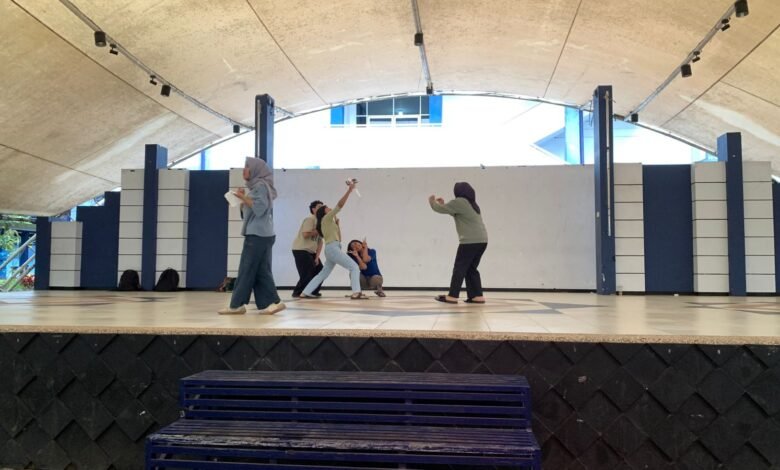
Inside Graha Theater, resource limits show up in small ways: tape rolls run out, costumes get re-stitched, portable speakers fill in where proper systems would cost too much. The pressure builds, but it also hones how everyone works together. Whoever can fix the problem does so. Constraint, handled often enough, becomes craft.
In larger institutions, technical systems usually come before creative exploration. At Theatrisic, ambition moves first, and infrastructure follows.
The campus recently received Excellent accreditation status, labeled Unggul in national evaluation. Administrators celebrate academic metrics. Within the collective, the reaction is quieter. “What we are currently fighting for is, of course, maintaining the growth of every member,” Ramzy says, “by developing our work programs and scaling them up to the national level.” Equipment purchases enter discussion. Proposals for facility upgrades circulate.
Still, the community maintains a cautious attitude toward expansion. Larger budgets sometimes centralize authority. Shared systems risk turning into top-down management structures. Theatrisic grew through distributed labor rather than formal control.
When Ramzy looks at his own term as general chairman, the thing he most wants to change is not a program or a budget line. It’s the two-year membership cycle. Senior members, after finishing their first year, naturally become more experienced and more confident in their judgment. Junior members, still new to the organization, can sometimes hold back instead of pushing back or leading with full authority. Diva experienced this directly as a first-year junior directing an established production. When that sense of seniority disappears, Ramzy believes a sense of ownership will grow in every member instead.
That goal points toward something structural. For twenty-five years, what has held Theatrisic together is what Ramzy calls the “family system.” Five divisions, each with different skills and different languages for what art means, find a way to complement each other and unite under the name of art. The system survives not because resources exist, but because people keep showing up to make the work happen together.